1. The Conscientiousness Paradox
Ask any hiring manager whether they would prefer a conscientious candidate to an unconscientious one, and the answer is always the same. Of course they would. The question seems almost too obvious to ask.
And yet organisations are consistently surprised by the consequences of conscientious people working together. They are surprised when a high-performing individual makes working life difficult for their team. They are surprised when a team of high achievers fails to gel. They are surprised when the diligent employee who never misses a deadline also fails to adapt to change. And they are repeatedly surprised by the predictable damage inflicted by those at the low end of the scale — the social loafers, the shirkers, the free riders who corrode team cohesion from within.
Conscientiousness is, in fact, a paradox. It is the personality trait that most reliably predicts success, and simultaneously the one whose misapplication — in selection, team composition, and leadership practice — generates some of the most preventable failures in organisational life. After IQ, conscientiousness is the second-best predictor of important life and career outcomes identified by psychologists [Peterson, 2017]. But its relationship with performance is curvilinear, not linear: the optimal level is moderately high rather than maximal, and both too much and too little create predictable, avoidable problems. And in teams, as original doctoral research has shown, variance in conscientiousness between members is more damaging to performance than low levels alone [Keca, 2019].
Understanding this trait properly — its structure, its spectrum, its interactions, and its limits — is one of the most practically valuable things an organisation can do.
2. What Is Conscientiousness?
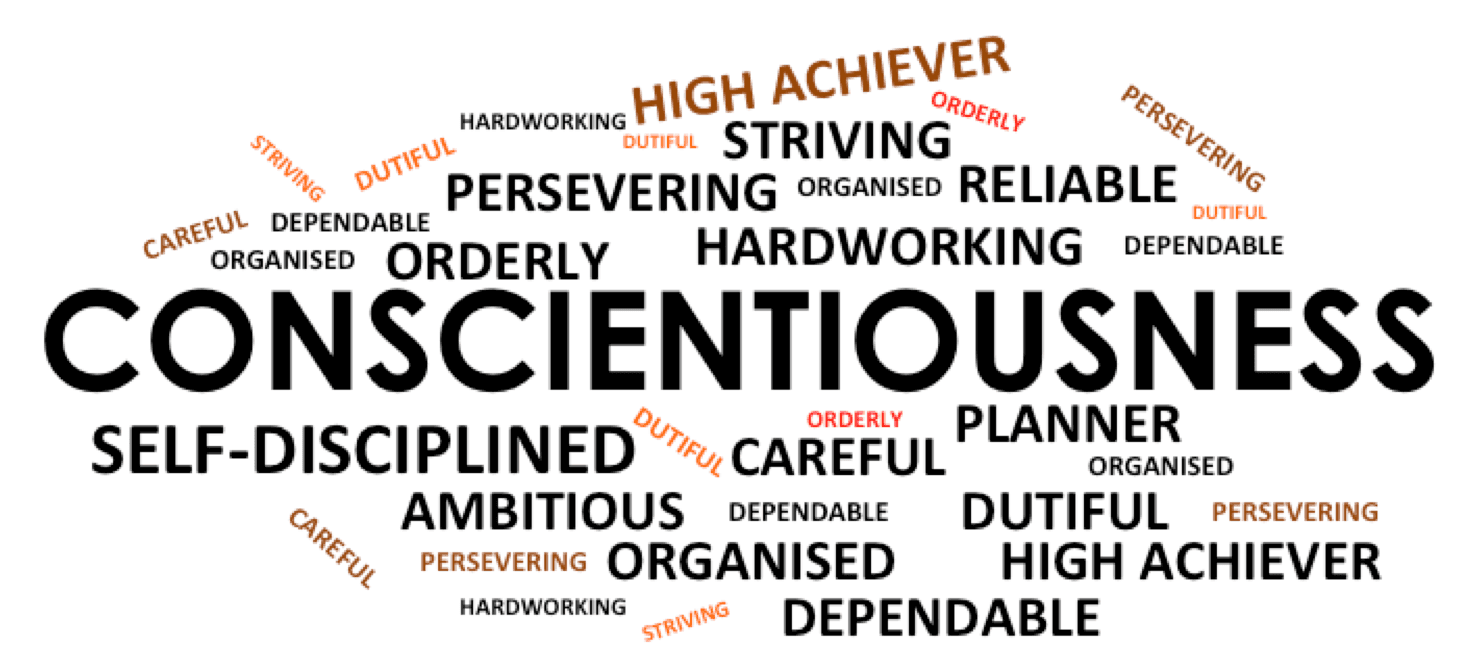
Conscientiousness is one of the Big Five Personality Traits — the most comprehensively validated model of personality available [32] — and represents the degree to which individuals are achievement-oriented, self-motivated, persevering, hard-working, thorough, orderly, punctual, dependable, responsible, and self-disciplined [1–3]. Where other traits describe how we relate to people (Agreeableness), the social world (Extraversion), emotion (Emotional Stability), or ideas (Openness), Conscientiousness describes how we relate to work itself — to goals, plans, obligations, and standards. In a fundamental sense, it is the personality trait most aligned with the question: Can I rely on this person to follow through?
Individuals high in Conscientiousness tend to set themselves high standards, strive consistently to achieve their goals, and are well-organised. They plan ahead, keep commitments, finish what they start, and are rarely distracted. In contrast, individuals low in Conscientiousness tend to be disorganised, easy-going, and sometimes careless [1–3, 13]. These dispositional differences have measurable consequences at both the individual and team level.
2.1 Two Distinct Aspects: Industriousness and Orderliness
Research has successfully subdivided conscientiousness into two separable aspects, each with its own profile of outcomes [Peterson, 2017]:
Industriousness is the goal-directed, effort-driven dimension. Industrious individuals carry out their plans, avoid wasting time, finish what they start, and maintain focus without becoming distracted. The hallmark indicator is not ‘plan things’ but ‘carry out my plans’ — a distinction that turns out to be psychologically important. Planning without execution is not conscientiousness; it is wishful thinking. Industriousness is the bridge between intention and action.
Orderliness is the structure-seeking, rule-following dimension. Orderly individuals keep things tidy, follow schedules, like routines, insist on details, see that rules are observed, and are bothered — in a way that reflects genuine moral judgment — by disorder and messiness in others. Orderliness is associated with heightened disgust sensitivity: an evolved tendency to respond negatively to signs of contamination or violation of order, extended by orderly individuals into social and moral domains [Peterson, 2017]. These two aspects share the broad label of conscientiousness but have meaningfully different expressions. Industriousness drives output and achievement. Orderliness drives compliance, structure, and norm enforcement. Individuals vary considerably in the relative strength of their industrious and orderly tendencies — and those differences matter for role fit and team dynamics.
2.2 The Measurement Challenge
Conscientiousness is unusual among personality traits in that it can be reliably assessed not only through self-report but through other-report — colleagues’ and managers’ ratings of an individual’s conscientiousness predict behaviour as well as the individual’s own ratings, and the combination of both provides greater predictive validity than either alone [Peterson, 2017]. This is practically significant: unlike traits susceptible to impression management, conscientiousness tends to be visible to others through observable proxy cues — hard-working behaviour, reliability, and follow-through — in ways that moderate the self-report faking problem [Frontiers, 2024].
Despite its predictive power, conscientiousness has resisted efforts to explain why it works so well. Research found zero correlation between conscientiousness and prefrontal cortex executive function — despite this being the theoretically obvious candidate — and no advantage on laboratory tasks requiring attention or delay of gratification [Peterson, 2017]. It predicts real-world outcomes with remarkable power through a mechanism that, at a biological level, remains largely unexplained. This should temper any overconfident application.
3. The Evidence Base: What Conscientiousness Predicts
The evidence for the benefits of conscientiousness is substantial, consistent, and well-replicated. At moderate-to-high levels, conscientiousness predicts positive outcomes across virtually every dimension of individual and team performance [4–9, 13–17]:
- Goal achievement and perseverance: High-conscientiousness individuals set high standards, invest sustained effort in pursuit of goals, and persist through setbacks [1, 11, 13, 17–19].
- Task commitment: Conscientious individuals maintain focus on task requirements and sustain commitment to team objectives over time [20, 21].
- Cooperation and backing-up: Conscientiousness is positively associated with cooperative behaviour and with backing-up behaviours — providing support and assistance to team members who are struggling, particularly important in interdependent team contexts [19; Morgeson et al., 2005].
- Adaptability: Moderate-to-high conscientiousness predicts adaptive performance in the face of task change, because conscientious individuals bring the same diligence to new requirements as to familiar ones [18].
- Work engagement: Recent research (Wu et al., 2024) confirms conscientiousness as a significant positive predictor of work engagement (β = 0.44), consistent with the Conservation of Resources (COR) framework — conscientious employees invest personal resources in goal pursuit and draw on those resources to sustain engagement under pressure.
- Team performance: Multiple independent meta-analyses confirm elevated conscientiousness is positively related to team performance: Bell (2007) ρ = 0.14; Peeters et al. (2006) ρ = 0.20; Carter et al. (2019) r = 0.08 — with effects consistently stronger in professional field settings than laboratory studies [Bell, 2007; Peeters et al., 2006; Carter et al., 2019].
These effects are also contextually moderated. Conscientiousness is reported to be the most consistent Big Five predictor of job performance [Barrick and Mount, 1991] and is relatively insensitive to the moderating influence of many other variables compared with other traits [Matthews et al., 2003]. It predicts life success broadly — financial achievement, career progression, and health-related behaviour — with greater reliability than almost any other psychological construct [Peterson, 2017].
Conscientiousness continues to predict life success — in terms of financial and career achievement — better than almost any other psychological construct. After IQ, it is probably the second-best predictor of important outcomes that psychologists have ever identified. — Jordan B. Peterson, Lecture 7 (2017)
4. The Dark Side: When Conscientiousness Becomes a Problem
The assumption that more conscientiousness is always better is not supported by the evidence. Both extremes of the spectrum create predictable problems, and the relationship between conscientiousness and performance is now understood to be curvilinear rather than linear.
4.1 The Too-Much-of-a-Good-Thing Effect
At the extreme high end, the same qualities that drive outstanding individual performance become liabilities. Beyond a threshold, performance begins to decline as conscientiousness increases further [Le et al., 2011; Carter et al., 2014]. Excessively conscientious individuals can be overly rigid, inflexible, and compulsive perfectionists who pay too much attention to small details while overlooking more important goals [Mount et al., 2008; Tett, 1998]. They are more prone to self-deception and rigidity, which may inhibit the acquisition of new skills or knowledge, ultimately reducing performance in dynamic environments [LePine et al., 2000; Martocchio and Judge, 1997].
This curvilinear dynamic has been empirically demonstrated using ideal-point measurement models. Carter et al. (2014) showed that such models reveal the curvilinear link between conscientiousness and job performance 100% of the time, whereas conventional dominance-based models produce mixed results, explaining why this phenomenon has been underestimated in prior research. The implication: there is a performance ‘sweet spot’ at moderately high, but not maximal, levels of conscientiousness. Both original doctoral research [Keca, 2019] and the broader literature confirm the principle that ‘too much, too little, and too different’ can each be counter-productive to team outcomes [Grant and Schwartz, 2011; Le et al., 2011; Vergauwe et al., 2017].
The orderliness aspect is especially implicated at extremely high levels. Heightened orderliness and disgust sensitivity are associated with clinical presentations including Obsessive-Compulsive Disorder (OCD) and, in certain forms, Anorexia Nervosa — disorders of excessive order-seeking and contamination avoidance turned inward in maladaptive ways [Peterson, 2017]. At sub-clinical levels, the same dynamics manifest as excessive perfectionism, controlling behaviour, and the kind of rigid rule-enforcement that erodes team morale and inhibits creative flexibility.
4.2 Presenteeism: A Newly Identified Dark Side
Recent research (Wu et al., 2024) has identified presenteeism — working while sick or impaired — as a significant mechanism through which conscientiousness can produce negative outcomes. Conscientious employees are more likely to attend work even when unwell (β = 0.25), and this presenteeism partially offsets their engagement advantage. The mechanism is consistent with COR theory: conscientious employees’ strong commitment to obligations depletes their personal resources, which ultimately undermines sustained engagement. Perceived Organisational Support (POS) was found to moderate this relationship — providing support and recognition to conscientious employees reduces the presenteeism cost and sustains the engagement benefit.
4.3 Low Conscientiousness: Moral Disengagement and the Sucker Effect
At the low end of the spectrum, the consequences for teams are equally predictable and damaging, operating through the mechanism of moral disengagement within group contexts:
- Social loafing — reducing individual effort in group contexts on the implicit assumption that others will compensate [22–24].
- Shirking — actively avoiding assigned or implicitly committed tasks [25].
- Free riding — benefiting from collective output without contributing proportionately [24, 25].
The research evidence on the group-level consequences is consistent: social loafing, shirking, and free riding produce poor social cohesion, unproductive conflict, demoralisation among high-conscientiousness colleagues, and measurable performance loss [11, 13, 19, 22–26]. Critically, the presence of low-conscientiousness individuals does not merely reduce their own contribution. It triggers the sucker effect (Hart et al., 2001): a social dynamic in which even highly conscientious team members begin to reduce their effort in response to the perceived inequity of the exchange [Keca, 2019]. The performance damage cascades beyond the individual responsible to the team as a whole.
A high-conscientiousness team, conversely, creates a self-reinforcing context in which effort is encouraged, and loafing is discouraged. High-conscientiousness individuals communicate strong behavioural expectations through proscriptive performance norms (Cialdini and Trost, 1998) and engage in backup behaviours (Morgeson et al., 2005), thereby activating conscientiousness-consistent effort in those predisposed to behave that way [Keca, 2019; Mohammed and Angell, 2003].
5. Trait Activation: When and Where Conscientiousness Is Expressed
Trait Activation Theory (TAT) [Tett and Guterman, 2000; Tett and Burnett, 2003] provides the key theoretical mechanism for understanding when and how conscientiousness is expressed in practice. TAT holds that personality traits are latent propensities for behaviour — they exist as tendencies, not certainties. For a trait to be expressed, the situation must provide trait-relevant situational cues that activate it. Intrinsic satisfaction is gained from expressing one’s traits, just as eating satiates hunger [Tett et al., 2013]. Traits and situations are, in this sense, two sides of the same coin [Eysenck and Eysenck, 1985].
The implication is significant: simply selecting for high conscientiousness does not guarantee conscientious behaviour. The work environment must contain the right cues — goal-relevant tasks, clear accountability, and meaningful consequences — to activate the trait. In weak situations, where norms and consequences are absent or ambiguous, even conscientious individuals show less consistent expression of the trait. In strong situations — where expectations are clear, standards are visible, and obligations are explicit — conscientiousness is reliably activated and expressed [Mischel, 1977; Meyer et al., 2010].
5.1 Team-Level Trait Activation
At the team level, TAT produces a particularly important dynamic. High elevations of a team personality trait create a social context that contains the relevant cues for expressing that trait. A highly conscientious team develops strong team norms (Kirkman et al., 2004) around effort, reliability, and follow-through — norms that create situational pressure on individual members to match the prevailing standard. Homogeneous teams generally develop stronger norms than diverse ones [Forsyth, 2018], and team identification increases commitment to shared goals [Hogg and Turner, 1987].
The activation mechanism also explains the sucker effect. When a team member exhibits low conscientiousness — withholding effort in a team whose norms demand it — this constitutes a trait-relevant cue that activates a different set of behaviours in the conscientious members: the desire to restore equity by reducing their own contributions [Hart et al., 2001; Keca, 2019]. The situational strength of the group norm has been undermined; trait activation shifts accordingly. This is why the negative effect of conscientiousness variance cascades across the team rather than remaining confined to the individual responsible.
5.2 Situation Strength and Conscientiousness
Trait Interaction Theory [Mischel, 1977; Meyer et al., 2010] complements TAT by establishing that the strength of a situation determines how much individual personality drives collective behaviour. In strong situations — where norms, rules, accountability, and consequences are clear and salient — most people behave similarly regardless of their personality. In weak situations — where few or no constraints operate — personality becomes the primary determinant of behaviour. For conscientiousness, this has direct implications: organisations that wish to activate conscientious behaviour should focus on creating strong situational contexts. Clear goal setting, explicit accountability, visible standards, and meaningful feedback collectively create the situational conditions in which conscientiousness is most reliably expressed.
The same logic applies at the team level. A team with a collectively high-conscientiousness profile creates a situationally strong environment that activates goal-focused behaviour even in members who are less dispositionally conscientious. Conversely, a team with high conscientiousness variance creates a weak situation — undermining the norm-setting power of its conscientious members and reducing the activation of conscientious behaviour across the team [Keca, 2019; Mohammed and Angell, 2003].
6. Conscientiousness in Team Contexts
Conscientiousness is primarily a task-based criterion [27] — it describes how individuals relate to work obligations. But it is far from socially neutral. Research has documented several important relationships between conscientiousness and team dynamics:
Wanberg, Kanfer and Banas [29] found that conscientiousness predicted higher levels of proactive social behaviour. Hurtz and Donovan [9] found that conscientiousness predicted interpersonal facilitation — the social behaviours that support smooth team operation: communicating effectively, fulfilling social role expectations, and following through on commitments to colleagues. Blumberg [31] found that conscientiousness is linked to both task and social roles within groups — suggesting its influence extends beyond pure task performance into the relational fabric of team functioning.
Conscientiousness also relates to the transition processes that effective teams undertake at the outset of a task [28] — identifying goals, clarifying resources, establishing methods, allocating responsibilities. Conscientious team members are more likely to invest in these early structuring activities, and this investment pays dividends throughout the task cycle.
6.1 The Variance Effect: Why Similarity Matters More Than Level
The most important and least widely understood practical implication of conscientiousness research concerns not individual trait levels but within-team variance. Van Vianen and De Dreu [17] found that where members of a team have similar levels of conscientiousness — regardless of whether those levels are high, moderate, or low — teams experience significantly greater social cohesion. Where conscientiousness levels are dissimilar across team members, the consequences are predictable and severe: poor social cohesion, unproductive conflict, demoralisation, and performance loss [11, 19].
Original doctoral research with knowledge-work teams in distributed organisations [Keca, 2019] significantly extended this finding. Using a polynomial regression and response surface analysis approach, the study found a significant convex quadratic main effect between mean team conscientiousness and performance, consistent with the curvilinearity literature. More importantly, it demonstrated that variance in team conscientiousness had a greater negative influence on performance than low elevation alone. Performance was worse when team conscientiousness was low, and variance was higher than when both elevation and variance were low. Analysis of simple slopes showed that performance is optimised when team conscientiousness elevation is high, and variance is low.
Multiple independent meta-analyses corroborate the directional finding that conscientiousness diversity is negatively related to team performance: Bell (2007) ρ = −0.03; Peeters et al. (2006) ρ = −0.24; Carter et al. (2019) r = −0.12; van Dijk et al. (2012) r = −0.09 [Bell, 2007; Peeters et al., 2006; Carter et al., 2019; van Dijk et al., 2012]. Effects are stronger in professional field settings than in laboratory studies. A 2024 review of team composition literature (Frontiers in Psychology, 2024) further noted that because conscientiousness is detectable through observable proxy cues — hard-working behaviour, reliability, follow-through — conscientiousness variance is more likely to be noticed by team members than many other deep-level differences, compounding its social effects beyond mere task-performance loss.
The mechanism is straightforward. When team members have markedly different levels of conscientiousness, they bring fundamentally different expectations for what ‘doing the job properly’ means. The high-conscientiousness member who arrives early, prepares thoroughly, and follows through on every commitment experiences the low-conscientiousness colleague who does none of these things as a source of profound frustration and inequity. Trait Activation Theory explains why this cascades: the situational cue of observed free riding activates the sucker effect, and the social exchange relationship breaks down. Conflict follows; team performance declines — not because of any failure of individual competence, but because of a personality-level incompatibility that was both predictable and avoidable.
Optimal team configuration: Select members with similar conscientiousness levels — moderate-to-high, if possible, but consistently similar. High variance in conscientiousness among team members reliably predicts breakdown in cohesion, conflict, and performance losses that exceed the impact of low levels alone.
6.2 Person-Team Fit and Trait Composition
Trait-oriented approaches to team composition distinguish between two personality characteristics: overall team trait elevation and trait elevation variability within the team [Barrick et al., 1998; Mohammed and Angell, 2003; Neuman et al., 1999]. These, uniquely or in combination, have a highly differentiated effect on performance.
For conscientiousness specifically, supplementary fit — selecting members whose conscientiousness levels are similar— is the composition strategy the evidence supports. This is in direct contrast to traits such as Neuroticism, where complementary fit and heterogeneity are generally beneficial [Keca, 2019]. The implication for practice is significant: absent deliberate team selection and composition interventions, teams will tend to form around individuals with broadly similar personalities via homophily and Similarity Attraction processes — but whether that natural similarity happens to be conscientious similarity depends on organisational context and leadership culture, not on chance.
7. Conscientiousness and Organisational Success
Successful organisations need two complementary types of people: those who generate and those who execute. Highly conscientious individuals — particularly those who are also high in cognitive ability — are exceptional at implementation, management, and delivery. They ensure that commitments are met, processes are followed, and quality is maintained [Peterson, 2017].
But conscientious people are not typically the ones who generate novel ideas and creative directions in the first place. That role falls more naturally to individuals high in Openness to Experience — the Big Five trait most associated with creativity, tolerance for ambiguity, and entrepreneurial thinking. Highly open individuals are good at changing direction and spotting opportunities, but they are often poor at follow-through and process discipline. High conscientiousness and high openness are complementary, not competing, capacities. Organisations that leverage this complementarity — combining conscientious implementers with open innovators — are better positioned to sustain both creative ambition and operational excellence [Peterson, 2017].
The implications for promotion decisions are significant. The skills that drive individual success at lower organisational levels — diligence, thoroughness, rule-following, consistent output — are not the same skills required for effective leadership. Promotions based purely on conscientiousness, without assessing adaptability, tolerance for ambiguity, and the ability to work with diverse others, frequently place individuals in roles that do not suit their trait profile. The inflexibility that characterises extreme conscientiousness is a particular risk in leadership roles where navigating complexity, uncertainty, and interpersonal difference is paramount [Le et al., 2011; Keca, 2019].
8. Recent Research: Extending the Evidence Base
The conscientiousness-performance literature has continued to develop since the foundational meta-analyses of the early 2000s. Several recent findings are particularly relevant to practitioners:
8.1 The Curvilinear Relationship Is More Pervasive Than Previously Recognised
Carter et al. (2014) demonstrated, using ideal point measurement models rather than conventional dominance-based scoring, that the curvilinear relationship between conscientiousness and job performance is detectable 100% of the time. Conventional measurement approaches, which treat personality as a unidimensional scale in which more is always better, systematically miss this nonlinearity. The methodological implication is important: organisations using standard self-report instruments to select for conscientiousness may be over-selecting, particularly for roles requiring flexibility, creativity, and collaborative judgement. The optimal level is not simply ‘as high as possible’ but is context-specific and bounded above as well as below.
8.2 Conscientiousness Diversity Has a Consistently Negative Effect
A comprehensive 2024 review of team composition research (Frontiers in Psychology, 2024) synthesised meta-analytic evidence and confirmed that conscientiousness diversity consistently negatively relates to team performance across multiple independent studies. The review also confirmed that conscientiousness is one of the most observable deep-level traits — detectable through proxy cues in task environments — making it particularly salient in team contexts. Conscientiousness variance is not only damaging but is noticed and responded to in ways that amplify its social effects: through the sucker effect, through norm erosion, and through the progressive deterioration of the social exchange relationships on which team performance depends.
8.3 Team Personality Traits Are Contextually Moderated
A 2024 meta-analysis (Journal of Research in Personality) updating previous work confirmed that team-level personality traits are weakly related to team performance at the aggregate level (r = −0.05 to 0.13), with the standard deviation of team members’ neuroticism scores showing the strongest association. This finding underscores a critical point: the conscientiousness-performance relationship at the team level is neither simple nor universal. It is shaped by situational moderators — including, as Trait Activation Theory predicts, the strength of the situations teams operate within, the nature of their task interdependence, and the degree to which their environment activates or suppresses trait-relevant cues. This is precisely why acontextual single-trait selection rules are less valuable than compositional approaches that account for situation strength.
9. Practical Recommendations
9.1 Use Other-Report Alongside Self-Report Assessment
Conscientiousness is one of the Big Five traits for which other-report assessments are most valid. Seeking structured input from colleagues and former managers — specifically about follow-through, reliability, and consistency under pressure — provides meaningful additional information. The combination of self and other report outperforms either alone, and because conscientiousness is expressed through observable behavioural cues, those who have worked closely with an individual are well-placed to provide reliable ratings [Peterson, 2017].
9.2 Target Consistency, Not Maximisation, in Team Composition
When building or adjusting teams, aim for similarity of conscientiousness levels across members rather than the highest possible average. A team with consistently moderate-to-high conscientiousness will outperform one that mixes highly conscientious with low-conscientiousness members. Where high variance cannot be avoided, manage it actively through explicit norm-setting, structured task allocation, and accountability mechanisms that create situational strength — making expectations concrete and the consequences of non-compliance visible.
9.3 Design Work Situations That Activate Conscientiousness
Consistent with Trait Activation Theory, conscientious behaviour is most reliably expressed in strong situational contexts that contain trait-relevant cues. Clear goal setting, explicit accountability, visible performance standards, and structured feedback collectively create the conditions in which the conscientious individual’s natural tendencies are activated and rewarded. Environments with weak situational constraints — unclear goals, inconsistent accountability, ambiguous expectations — do not reliably activate conscientiousness, even in highly conscientious individuals.
9.4 Distinguish Industriousness from Orderliness in Role Fit
Innovation-facing roles benefit most from industriousness: the ability to execute on plans matters more than insistence on procedure or protocol. Operations and compliance roles benefit from both, particularly orderliness. Leadership roles require maintaining order, especially the ability to tolerate ambiguity, imperfection, and deviations from procedure that managing diverse people inevitably produces. A leader whose orderliness drives intolerance of deviation or perfectionist standards will not lead well.
9.5 Support Highly Conscientious Employees Deliberately
High-conscientiousness individuals may deplete their personal resources through presenteeism and over-commitment to obligations. Providing meaningful Perceived Organisational Support (POS) — recognition, resource availability, managerial support — reduces this depletion, sustains engagement over time, and prevents the hidden costs of conscientiousness from accumulating [Wu et al., 2024]. Equally, providing evidence-based feedback on the dark side of the trait — framed as a function of profile rather than personal criticism — creates the self-awareness that is the precondition for behavioural adjustment.
10. Conclusion
Conscientiousness is among the most important and most misunderstood personality traits in organisational psychology. Its benefits are real, well-evidenced, and consistent — but they are not unconditional, and they do not scale linearly with level.
The relationship between conscientiousness and performance is curvilinear. At the extremes — both high and low — it becomes a liability: through rigidity, perfectionism, and excessive orderliness at the high end; through social loafing, shirking, and free-riding at the low end. In teams, the critical variable is not the average level but the variance. Original doctoral research confirmed what meta-analytic evidence had suggested: conscientiousness variance is more damaging to team performance than low elevation alone, because the sucker effect triggers withdrawal even among the most conscientious members.
Trait Activation Theory provides the unifying framework. Conscientiousness is a latent propensity, not a guaranteed behaviour. It is expressed when the situation provides the right cues — clear goals, visible accountability, explicit norms, meaningful consequences. Team-level trait homogeneity at the conscientious end creates the situational strength that activates the trait across members. Variance undermines that situational strength, and the trait is suppressed — or worse, replaced by the equity-restoring withdrawal of effort that characterises the sucker effect.
The practical message is clear. Build teams with consistent conscientiousness levels. Design work environments that create strong situational cues for conscientious behaviour. Distinguish the two aspects of the trait — industriousness and orderliness — and fit them to context. Support highly conscientious individuals deliberately. And invest in the personality literacy that allows conscientious people to deploy their genuine strengths without imposing their standards on others in ways that corrode the relationships that make teams work.
"It’s not plan things. It’s carry out my plans. Those actually turn out to be importantly different." — Jordan B. Peterson, Lecture 7 (2017)