1. The Extraversion Assumption
If you have ever wondered why senior leadership teams so often seem to be high-conflict, political environments populated by assertive, attention-seeking individuals — now you know. The explanation is extraversion: the Big Five personality trait most closely associated with leadership emergence, social confidence, and the pursuit of status. Most organisations implicitly select for it. Most performance cultures reward it. And yet the research evidence is clear: more extraversion is not always better, either for individuals or for the teams they inhabit.
Extraversion is a fundamentally important trait. It enables the smooth functioning of social mechanisms within teams, is strongly linked to intra-team processes and contextual performance [1] and is the most consistent Big Five predictor of leadership outcomes [Judge et al., 2002]. But it also carries a well-documented dark side — one that tends to be invisible at first meeting and becomes increasingly apparent as interpersonal interactions deepen over time. Understanding extraversion requires holding both realities: a genuine social asset and a predictable source of team dysfunction when present in excess or poorly managed.
2. What Is Extraversion?
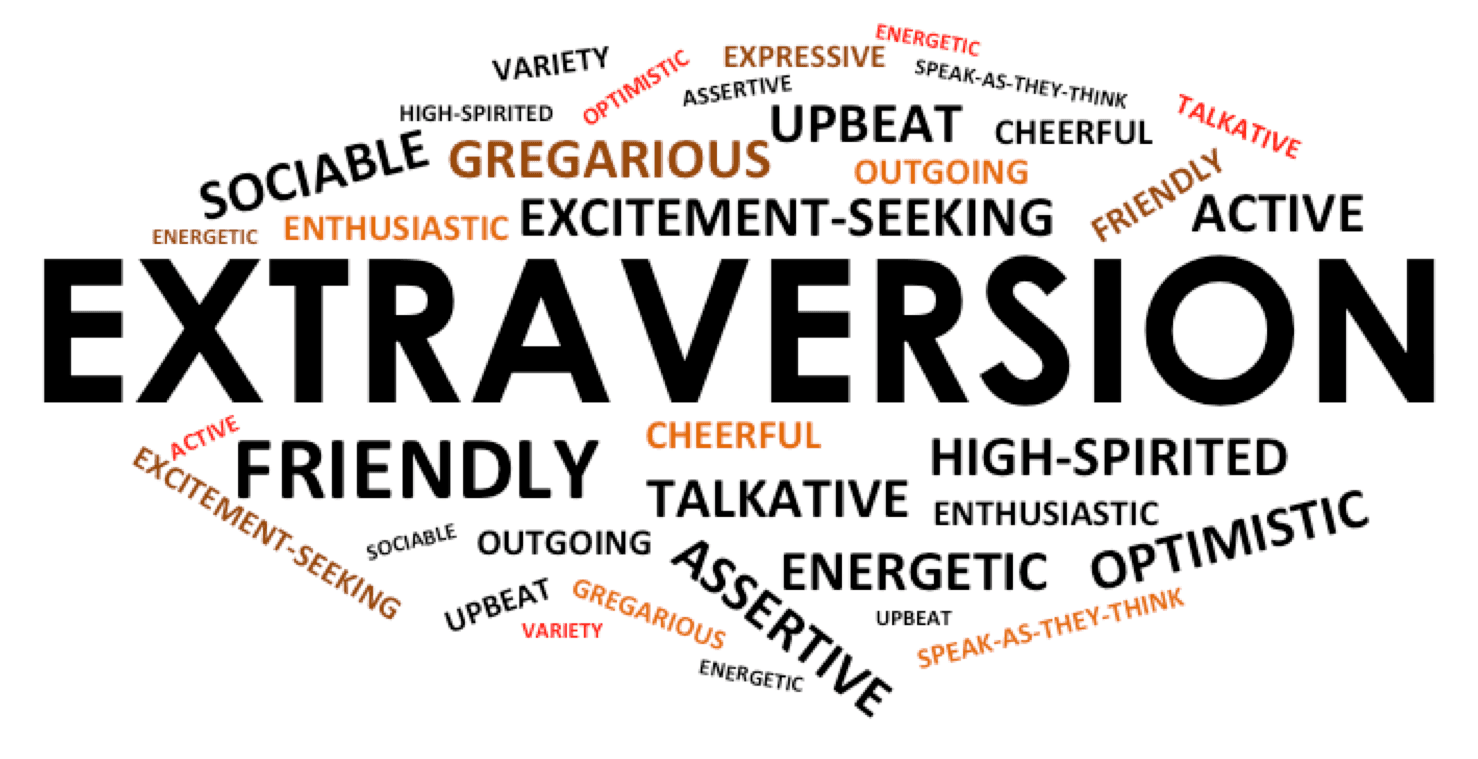
Extraversion is the Big Five personality trait most closely associated with positive affectivity — the tendency to experience and express positive emotion. It is characterised by assertiveness, activity, friendliness, enthusiasm, energy, positivity, sociability, chattiness, high spirits, and a generally outgoing nature [2]. Extraverts crave excitement and stimulation; they are energised by social interaction and seek out opportunities to engage with others. Introverts — those low in extraversion — are, by contrast, reserved, serious, reflective, and prefer privacy or the company of a small number of close friends [2]. They have lower social skills in the narrow sense [11], find social interactions less immediately rewarding [14], and attain lower initial status in social groups [13] — though, as later sections discuss, this picture reverses significantly over time.
At a deeper level, extraversion can be understood as a solution to a fundamental psychological problem: how much to value the present [Peterson, 2017]. Extraverts weight the present more heavily and discount the future more steeply — a tendency that is measured in experimental psychology through delay discounting paradigms: given the choice between a smaller reward now or a larger reward later, extraverts are more likely to choose the immediate option. This bias toward present exploitation explains both their social energy and their greater tendency toward impulsive behaviour — gambling, risk-taking, and novelty-seeking. It is also evolutionarily rational: the future is genuinely uncertain, and the optimal degree of future-discounting depends on how unpredictable the environment is. Extraverts’ temperamental bias toward the present is a legitimate adaptive strategy in certain environments [Peterson, 2017].
2.1 Two Distinct Aspects: Enthusiasm and Assertiveness
Building on Peterson and colleagues’ Big Five Aspect Scale [DeYoung and Quilty], extraversion subdivides into two empirically separable aspects, each driven by a distinct motivational foundation [Peterson, 2017]:
Enthusiasm is the affiliative, warmth-driven dimension. Enthusiastic individuals make friends easily, warm up quickly to others, reveal themselves openly, show positive emotion freely, and laugh often. Enthusiasm is fundamentally motivated by the pursuit of social affiliation — the reward of connection, belonging, and positive relationships. Enthusiastic people cannot tell you everything about themselves; their basic emotional set-point is to be smiling at people [Peterson, 2017]. In team contexts, enthusiasm lubricates social interaction, creates psychological safety for others to express themselves, and generates the warm interpersonal climate that enables collaborative working.
Assertiveness is the dominance-driven, status-seeking dimension. Assertive individuals take charge, influence people, lead the way, share their opinions forcefully, and act first in any situation. Assertiveness is motivated by the pursuit of social status—the rewards of influence, authority, and recognition [Peterson, 2017]. It is assertiveness, not extraversion in general, that most closely maps onto what organisations commonly identify as leadership — though this is a significant oversimplification, since effective leadership also requires the vision of openness, the reliability of conscientiousness, and the emotional stability that is the inverse of neuroticism [Peterson, 2017].
These two aspects are meaningfully distinct in their team-level consequences. In teams, Enthusiasm activates warmth, cohesion, and affiliation-seeking. Assertiveness activates dominance, competition for status, and potential conflict. The same overall extraversion score can represent very different team-level dynamics depending on which aspect is dominant.
2.2 Positive Emotion and Its Excess
Extraversion is the positive-emotion counterpart to neuroticism’s negative emotion. These represent separate neural systems [Peterson, 2017]: the question of how happy one should be when things are going well, and the question of how upset one should be when things are going wrong, have no single right answer. The optimal calibration of positive emotion depends on the environment.
The goal, however, is not to maximise positive emotion. Peterson’s insight is clinically grounded: people in manic phases of bipolar disorder are overwhelmed with positive emotion, with negative emotion reduced to near zero. The result is grandiose plans, financial recklessness, and serious downstream consequences [Peterson, 2017]. At a sub-clinical level, extreme extraverts who discount the future heavily and act almost exclusively in pursuit of present impulses make poor long-term decisions — for themselves and, when in leadership positions, for the organisations they lead.
3. The Evidence Base: What Extraversion Predicts
The evidence for the benefits of extraversion in social and team settings is well-established across multiple domains:
- Interpersonal facilitation: extraversion is linked to establishing close relationships, stimulating group discussion [8, 9], fostering climates of open expression [5], and producing the contextual performance that supports effective team working [1].
- Decision quality: the discussion stimulation and social facilitation of extraverted team members contribute positively to the quality of team decision-making and problem-solving [10].
- Leadership emergence: extraversion is the most consistent Big Five predictor of leadership emergence, leadership effectiveness, and transformational leadership across multiple meta-analyses [Judge et al., 2002; Hogan et al., 1994]. Organisations consistently select extraverted individuals into leadership roles, and extraverts who receive leader assignments tend to be effective energisers of their teams.
- Leader work engagement: recent research (PLOS ONE, 2022) found that leader extraversion predicts team performance via the mechanism of leader work engagement: extraverted leaders invest energy in their leadership roles, which translates into motivational influence on team members. This effect is particularly strong when situational clarity is low — consistent with Trait Activation Theory.
- Team viability: teams that are generally high in extraversion tend to have higher team viability — the disposition to continue working together in the future — because extraverted individuals find the social environment of teamwork rewarding and are energised by it [4].
The personality trait is also highly genetically influenced: extraversion is one of the most heritable of the Big Five traits. Personality can be shifted by environment, but the law of diminishing returns applies sharply — it is far easier to adjust the job to the person than the person to the job. This makes genuine self-understanding of one’s position on the extraversion spectrum practically valuable [Peterson, 2017].
"It’s a lot easier to adjust the job to you than to adjust you to the job. So, it’s useful to know what your proclivities are because then you might be able to find a place where the hand that you’ve been dealt can be optimally played." — Jordan B. Peterson, Lecture 3 (2017)
4. The Dark Side: When Extraversion Becomes a Problem
Despite the social benefits of extraversion, the research evidence is consistent: high extraversion in excess — and particularly multiple high extraverts in the same team — is predictably damaging to team performance and cohesion.
4.1 The Too-Many-Leaders Problem
Because extraverts are talkative, assertive, and predisposed to dominant behaviours [22], having a large number of dominant individuals in the same team will likely lead to unproductive conflict over leadership, decision-making authority, and influence over strategy [5, 8, 23]. The result is a team composed of all leaders and no followers [4, 5] — a pattern that is highly visible in senior leadership teams, which are characteristically conflict-ridden precisely because of the disproportionate representation of highly assertive individuals. Dominant team members tend to engender less positive interpersonal relations [Driskell et al., 1993] and are less likely to attend to the task inputs of other team members in decision-making [Driskell and Salas, 1992].
4.2 Task Displacement: Social Interaction Over Goal Achievement
High extraverts are more motivated by the social interaction that teamwork provides than by completing task goals [15]. The team’s social environment is, in itself, rewarding for them; the task is secondary. This creates a consistent dynamic in highly extraverted teams: social activity displaces task completion, discussion flourishes but goal pursuit suffers, and performance declines [5, 8]. The very quality that makes extraverts energising in social contexts — their enthusiastic engagement with other people — becomes a distraction from the purposeful, goal-directed work that teams exist to produce.
4.3 The Downfall of Extraverts: Status Dynamics Over Time
Perhaps the most important and counterintuitive finding in the extraversion literature is the dynamic nature of status in groups over time. Bendersky and Parikh Shah (2013) found a striking reversal: extraverts gain high status quickly at the start of team life, based on their confidence, assertiveness, and social facility. But as teams interact over time, that status declines. The negative attributes of high extraverts — inability to listen, unreceptiveness to the input of others, combative and negatively competitive behaviour — become increasingly apparent as interaction deepens, and the initial social impressiveness wears off [19, 20, 21]. This is particularly acute where high degrees of interdependent working force sustain social interaction [21: p. 389]. The extrovert who looked like a leader at the first meeting has, six months later, lost significant status to the conscientious and the neurotic alike.
Curvilinear research (Frontiers in Psychology, 2021) confirms this at the socialisation level: extraversion has a curvilinear relationship with social acceptance, such that the relationship is significantly positive from lower to moderate levels of extraversion, but the positive relationship levels off — and does not continue to improve — at higher levels. Extreme extraverts are perceived as less reliable, sometimes uncooperative, and overly impulsive [Quilty et al., 2014].
4.4 Visibility as Liability: Conflict Attraction
Extraverts are highly visible in social groups [24]. Their talkative, assertive presence makes them noticeable in a way that introverts are not. This visibility can draw them into conflict — making them a target for negative affect from other team members [25] — and creates the political dynamics that characterise high-extraversion leadership environments. Placing highly extraverted individuals in situations that do not provide adequate opportunity for social interaction exacerbates this: frustrated extraverts will redirect their energy into game-playing and political behaviour that serves neither their own nor the team’s best interests [Keca, 2015].
5. Trait Activation: When and Where Extraversion Is Expressed
Trait Activation Theory (TAT) [Tett and Guterman, 2000; Tett and Burnett, 2003] provides the theoretical framework for understanding how and when extraversion is expressed in team settings. TAT holds that traits are latent propensities: they are not constantly active but are activated by trait-relevant situational cues. For extraversion, the most powerful activating cues are opportunities for social interaction, affiliation, and status-seeking.
In a team context, this has a self-reinforcing dynamic. A highly extraverted team creates an environment rich in social cues that activate extraverted behaviour across all members. Through Similarity Attraction, extraverted teams tend to recruit extraverted members [Keca, 2019], compounding this homogeneity over time — a dynamic known as Homophily. The result is an increasingly extraverted team culture in which the Sociability and Dominance facets of extraversion are continuously activated, sustaining both the social energy and the interpersonal friction that characterise high-extraversion groups.
Conversely, an extroverted individual on an otherwise introverted team finds their extroversion suppressed. The weak social situation — low in interaction cues and social stimulation — does not provide the prompts needed to activate their extraversion. This creates dissatisfaction and demotivation for the extravert, undermining their performance and ultimately driving them to seek more socially stimulating environments [Keca, 2019].
5.1 Situational Strength and Leader Extraversion
Recent research (PLOS ONE, 2022) explicitly tested the interaction between leader extraversion and situational strength, finding that the advantage of leader extraversion on team performance through work engagement is strongest when goal clarity and process clarity are low. In high-clarity situations — where goals and processes are well defined — extraverted leadership provides less incremental value: the situation itself provides direction, reducing the need for the extravert’s energising influence. In low-clarity situations — ambiguous, uncertain, rapidly changing environments — the extravert’s energy, initiative, and social facilitation fill the vacuum most effectively.
This is precisely the prediction of Trait Activation Theory: trait-relevant situational cues must be present for the trait to be expressed and to produce its characteristic outcomes. Goal ambiguity and process uncertainty are trait-relevant cues for assertiveness, activating the extravert’s take-charge, first-to-act orientation. Structured, well-governed situations suppress this activation, making the extravert no more effective than a moderately extraverted colleague.
6. Extraversion in Team Contexts
The team-level research on extraversion presents a more nuanced picture than the individual-level benefits suggest. Extraversion functions as a complementary trait in teams: some extraversion is highly beneficial, the right configuration matters, and the relationship between extraversion elevation and team outcomes is curvilinear.
6.1 The Curvilinear Relationship with Team Outcomes
Peeters et al. (2006) found a curvilinear relationship between extraversion elevation and team performance, where intermediate levels of extraversion produced the best outcomes [27]. Barry and Stewart (1997) found that intermediate levels of extraversion elevation [5] and extraversion elevation variation [29, 30] were associated with higher team performance. The conventional recommendation in the LinkedIn article [Keca, 2015] holds: seed the team with individuals who tend toward extraversion but ensure there is dissimilarity in extraversion levels within the team as a whole.
Original doctoral research [Keca, 2019] confirmed and extended this picture. The study found a significant concave (inverted-U) curvilinear main effect between Mean Team Extraversion and Team Cohesion (p = .023), consistent with the theoretical prediction that moderate extraversion elevation optimises team cohesion. More importantly, it found a significant negative linear interaction between Mean and Deviation Extraversion on Team Viability (p = .002) and a similar pattern on Team Cohesion, where variance in Team Extraversion is HIGH, increases in Extraversion are associated with significant decreases in both Team Viability and Team Cohesion. Conversely, where variance in Team Extraversion is LOW, an increase in Extraversion is associated with an increase in both outcomes.
This finding challenges the majority of the personality-performance literature, which typically reports that variance in Team Extraversion is beneficial to team outcomes. The Keca (2019) results suggest the opposite: homogeneity of Team Extraversion at the high pole activates extraverted behaviours through trait-relevant situational cues, strengthening group norms and enabling shared leadership — which is associated with positive team outcomes [Carson et al., 2007]. The key caveat is that this depends on which facets of extraversion are being activated: Warmth, Gregariousness, and Positive Emotions may complement team cohesion, while Assertiveness/Social Dominance may not [Keca, 2019].
Optimal team configuration: Include individuals who tend toward extraversion but with measured variation across the team — one clearly dominant extravert, a mix of moderate extraverts, and some moderate introverts. Multiple high extraverts create leadership conflict and status competition. High variance in extraversion between members is associated with decreased team viability and cohesion.
6.2 Extraversion Interactions with Other Traits
Extraversion does not operate in isolation. The original article [Keca, 2015] highlighted three practically significant trait-on-trait dynamics:
- Extraversion and Introversion extremes: Individuals at the extremes of extraversion tend not to interact well socially. The stereotype clash between high-extraversion and high-introversion functions (e.g., sales and IT) is one of the most visible and predictable sources of cross-functional tension in organisations, creating both communication failures and mutual misunderstandings of working styles.
- Extraversion and Conscientiousness: High extraverts often have challenging relationships with those who are highly conscientious. The social focus of the extravert conflicts directly with the task focus of the conscientious individual: the extravert wants to engage, discuss, and connect; the conscientious individual wants to complete, follow through, and meet standards. This conflict is a consistent driver of unproductive friction in mixed-profile teams.
- Extraversion and Emotional Stability: Judge and Erez (2007) found that the combination of extraversion and emotional stability better predicted performance among customer-facing staff than either trait alone — the social energy of the extravert combined with the stability and poise of the emotionally stable individual producing particularly effective interpersonal performance.
6.3 The Undervalued Introvert
The organisational bias toward extraversion is well-documented and well-deserved in some respects: extraverts do emerge as leaders, do energise social interaction, and do sustain team viability. But it carries high costs. Introverted individuals bring a distinct and complementary set of qualities that organisations consistently underestimate and under-select: depth of thought, quality of listening, reflective decision-making, sustained focus, and the capacity for deep one-on-one relationships rather than broad shallow networks.
Research in 2024 (Forbes; SCIRP) confirms that introverted leaders often prove superior in leadership roles characterised by proactive, high-initiative team members who benefit from coaching and deep engagement rather than energetic direction-setting. Introverts’ systematic thinking, careful analysis, and willingness to listen before deciding to make them particularly effective in environments requiring careful deliberation. In an era of hybrid and remote working, where the extraverts’ social advantage is reduced and where deep written communication and autonomous working are rewarded, the introvert’s natural strengths are increasingly aligned with the conditions of modern knowledge work.
Peterson’s practical advice is well-grounded: the world may currently favour extraverts, but each personality profile has environments in which it is optimally played. Finding that environment is more valuable than attempting to change one’s temperament [Peterson, 2017].
7. Recent Research: Extending the Evidence Base
7.1 Leader Extraversion and Team Performance: A Situationally Moderated Relationship
A 2022 study published in PLOS ONE examined a moderated mediation model of how leader extraversion affects team performance. Across 226 leader-team pairs, leader extraversion was positively associated with team performance (r = .25, p < .01) through the mechanism of leader work engagement: extraverted leaders invest energy in their roles (β = .32, p < .01), which translates into team performance (β = .25, p < .01). Crucially, this effect was moderated by situational clarity: the positive effect of leader extraversion on work engagement was significantly stronger when goal clarity and process clarity were low, and weaker when they were high. This provides direct empirical support for the Trait Activation prediction that extraverted leadership is most valuable under conditions of ambiguity — and less differentiating in structured, clear environments.
7.2 Curvilinear Effects on Socialisation
A 2021 study (Frontiers in Psychology) examined the too-much-of-a-good-thing effect of extraversion on social outcomes in a sample of 371 participants. The study found that extraversion had a curvilinear relationship with social acceptance: positive from lower to moderate levels but levelling off at higher levels. At extreme elevations, very high extraverts were perceived as less reliable, more impulsive, and less cooperative, thereby reducing the social acceptance advantage. A parallel curvilinear relationship was found for depression outcomes. These findings extend the too-much-of-a-good-thing framework — previously most strongly established for conscientiousness — to the social and wellbeing outcomes of extraversion.
7.3 The Rise of Introversion in Modern Organisations
Converging evidence from 2023–2025 research and practitioner analyses has identified a shift in the conditions that favour introversion in professional settings. The growth of remote and hybrid working models — noted by 2023 data showing that approximately 60% of US companies adopted flexible models by 2023 — has disproportionately benefited introverted individuals, who report significantly less anxiety in remote work settings and are able to manage their energy levels more effectively without the depletion of open-plan office environments. Organisations that deliberately design for cognitive diversity — creating environments where both introverted and extraverted employees can deploy their natural strengths — consistently outperform those that implicitly select for one type.
8. Practical Recommendations
8.1 Compose Teams for Complementarity, Not Maximisation
The evidence is unambiguous: the optimal team configuration is not the most extraverted team, but one with intermediate and varied extraversion levels — sufficient social energy to foster collaboration, insufficient dominance density to generate status conflict. The practical target: one clearly high-extravert member, a range of moderate extraverts, and some moderate introverts whose reflective qualities provide depth and quality control to the team’s deliberations.
8.2 Manage Variance Actively
High variance in extraversion within a team — mixing extreme extraverts with strong introverts — is associated with significant decreases in team viability and cohesion [Keca, 2019]. Where such variance cannot be avoided, actively manage the fault lines by creating structured interaction processes that moderate the extraverts’ social dominance and create space for introverted team members to contribute their distinctive qualities through channels that suit their working style (written input, prepared contributions, smaller group settings).
8.3 Design Roles to Match Extraversion Profile
Peterson’s insight that it is far easier to adjust the job to the person than the person to the job is directly actionable. Roles requiring sustained social interaction, energetic relationship-building, and rapid status establishment (client-facing, business development, change leadership in ambiguous environments) suit high extraverts. Roles that require deep analytical focus, careful preparation, and systematic quality control suit both moderate extraverts and introverts. Mismatching personality to role not only reduces individual performance but generates the predictable frustration and game-playing that characterises misplaced high extraverts.
8.4 Don’t Confuse Leadership Emergence with Leadership Effectiveness
Organisations systematically select extraverts into leadership roles because extraverts emerge as leaders — they are visible, assertive, and compelling at first impression. But leadership emergence and leadership effectiveness are not the same thing. The downfall of extraverts over time in group settings — as their inability to listen, their combativeness, and their status-seeking become apparent — is a direct consequence of selecting for the wrong signal. Structured leadership assessment processes that evaluate performance evidence over time, seek 360-degree input, and explicitly assess qualities such as listening, reflection, and followership alongside assertiveness will produce a more balanced and ultimately more effective leadership pipeline.
8.5 Leverage Situational Design to Activate Extraverted Leadership
Consistent with Trait Activation Theory, extraverted leaders are most effective when situational clarity is low: ambiguous goals, uncertain processes, emergent strategy. In these conditions, the extravert’s energy, initiative, and social facilitation fill the vacuum most productively. In highly structured, well-governed environments, extraverted leadership provides less incremental value — the situation itself provides direction. Match the situational design of the leadership role to the leader's personality profile, rather than assuming that extraverted leadership is universally superior.
9. Conclusion
Extraversion is among the most socially consequential personality traits in organisational life. Its benefits are real: it energises social interaction, predicts leadership emergence, fosters collaborative climates, and sustains team viability. But its costs are equally real and predictable: high extraversion in excess generates conflict over status and leadership, displaces task focus with social activity, and leads to the downfall of extraverts as their negative attributes become apparent over time.
The curvilinear evidence — confirmed by both meta-analytic research and original doctoral research [Keca, 2019] — shows that intermediate levels of extraversion, with variation across team members, produce the best team outcomes. High variance in extraversion is damaging to team cohesion and viability. And the finding that homogeneity of high extraversion, through Trait Activation, can reinforce extraverted behaviours across the team challenges the conventional wisdom that extraversion variance is beneficial.
The practical message for leaders and organisations is threefold. Compose teams for complementarity, not maximisation. Match roles and situational design to extraversion profiles rather than assuming that more extraverted is always better. And recognise the significant, consistently undervalued contributions of introverted individuals — whose qualities of deep thinking, careful listening, and reflective decision-making are becoming increasingly aligned with the demands of complex, knowledge-intensive, and distributed work.
"It’s a lot easier to adjust the job to you than to adjust you to the job." — Jordan B. Peterson, Lecture 3 (2017)