1. The Trust Deficit
These are extraordinary times. Organisations, institutions, and societies are confronting a convergence of crises that share a common thread: the behaviour of people in positions of power and influence. Corporate scandals have become commonplace, political dysfunction paralyses government, and growing inequality has created a pervasive disaffection with ‘the system’. Even the most optimistic find it difficult to argue against the proposition that trust — in institutions, organisations, and each other — is in universal decline.
What does this have to do with personality? Everything. People are at the forefront of all of these circumstances. Our personality traits influence how we think, feel, and behave; how we develop and maintain relationships; and whether we sustain or undermine the social structures and norms that require our voluntary compliance. Personality underpins the behaviours that determine whether organisations thrive or fail, whether relationships endure or break down, and whether trust is built or eroded.
The evidence is sobering. Around 45% of marriages fail [ONS], and 85% of employees routinely deal with workplace conflict. These are not anomalies — they are the predictable outcome of environments in which personality dynamics are neither understood nor actively managed. If we want different outcomes, we need to look more clearly at what drives behaviour. That requires understanding personality — including its darker dimensions.
Despite more than a century of scientific research into personality [24], organisations have largely failed to translate that knowledge into meaningful practice. Each new corporate scandal triggers more regulation, more policy, more bureaucracy — which addresses the symptoms while leaving the causes untouched. This article argues that the path forward begins with a more honest and nuanced understanding of personality, particularly the traits we find most difficult to discuss.
2. Bright and Dark Personality: The Spectrum Problem
A useful starting point is recognising that all personality traits lie on a spectrum and that, at their extremes, they can produce maladaptive behaviour. This applies equally to traits we typically regard as positive. Bright traits — such as conscientiousness, extraversion, and agreeableness — are generally associated with desirable outcomes, but at their extremes they too carry a dark side.
Early work classifying personality in terms of traits was undertaken by Carl Jung, and built upon by Myers-Briggs and others. The most widely researched model today is the Five-Factor Model (Big Five) [24], comprising Conscientiousness, Extraversion, Agreeableness, Emotional Stability, and Openness to Experience. This model provides the best available framework for predicting organisationally relevant behaviours, including leadership, performance, team cohesion, and counterproductive work behaviour.
2.1 The Bright Side: What the Big Five Tells Us
Consider the nuance required. A highly conscientious individual sets high standards, strives for goal achievement, and is well organised — but they may also be inflexible, resistant to change, and intolerant of those with lower standards [25, 26]. Teams with inconsistent levels of conscientiousness are particularly prone to moral disengagement — social loafing, shirking, and free-riding — all of which erode cohesion and performance [12–19].
Extraversion — perhaps the most widely recognised trait — is strongly linked to interpersonal facilitation and leadership emergence [62, 67–69]. Yet teams with too many high extraverts experience elevated conflict and diminished task focus [71]. Their desire for social interaction can distract from goal achievement, and, over time, their tendency to dominate can erode status [74].
Agreeableness is the trait most directly associated with interpersonal effectiveness — predicting cooperation, conflict resolution, and open communication [47–51]. But highly agreeable leaders, though popular, can be ineffective under pressure or when difficult decisions are required. Conversely, low agreeableness may be an asset in high-stakes, short-horizon situations while being deeply corrosive to team cohesion over time [57].
Even neuroticism, widely regarded as an undesirable trait, has a counterintuitive upside: anxious individuals often exceed initial performance expectations by investing disproportionate effort in preparation and task mastery [75]. The point is not that these traits are good or bad — it is that they are complex, context-dependent, and double-edged. The same logic applies, with even greater consequence, to the Dark Triad.
2.2 The Dark Side: Beyond Bright Traits
Personality researchers distinguish between traits that are broadly socially desirable (bright) and those that are broadly socially undesirable (dark) — and traits that carry both positive and negative implications depending on context and intensity [22, 23]. The Dark Triad occupies the far end of the dark spectrum: three interrelated but distinct trait clusters — Narcissism, Machiavellianism, and Psychopathy — each of which has been studied extensively in clinical populations but has received far less empirical attention at sub-clinical levels in normal working populations [11].
This knowledge gap has real consequences. We understand the least about some of the most impactful and potentially destructive aspects of human behaviour in organisational settings. Importantly, these traits should not be viewed solely as negative. Some of the most successful leaders on the planet score highly on one or more of these dimensions — and their achievements, as well as their failures, are closely tied to that trait profile. The challenge is to understand them more clearly, not to stigmatise them.
3. The Dark Triad: Definitions and Organisational Prevalence
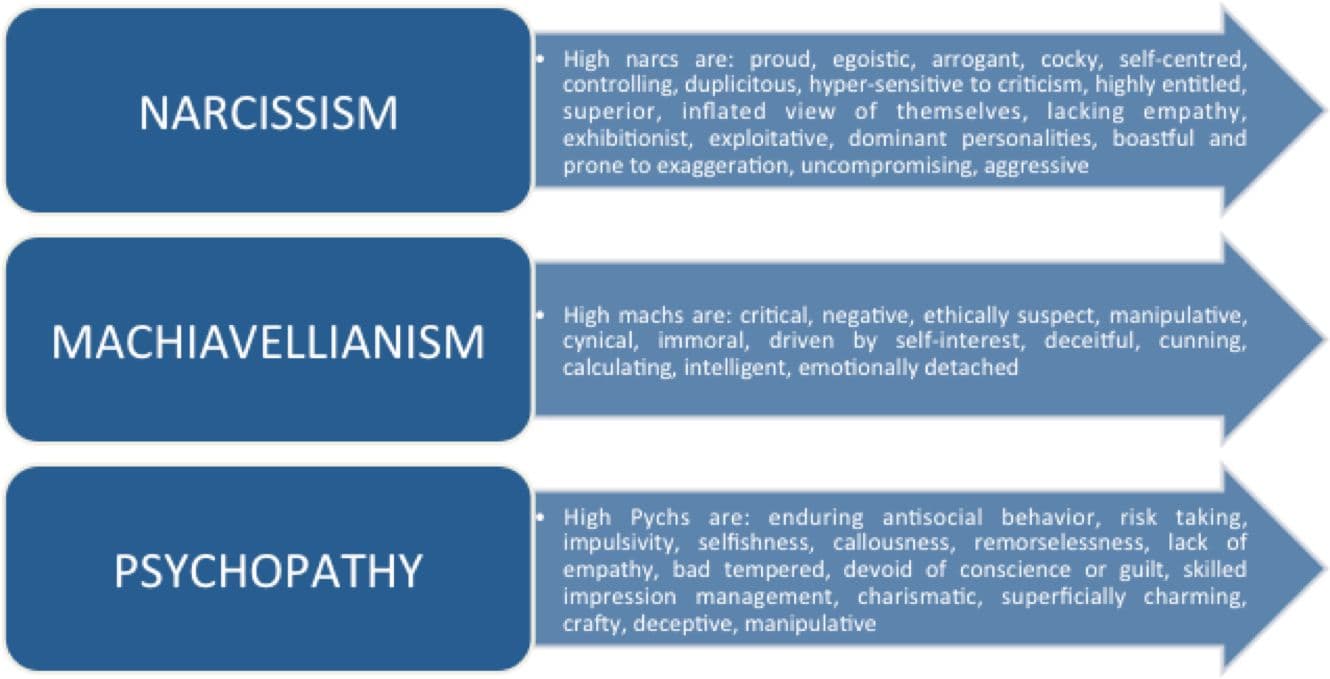
The term Dark Triad was introduced by Paulhus and Williams [11] to describe three overlapping but distinct personality constructs: Narcissism, Machiavellianism, and Psychopathy. While each has a clinical form classified as a personality disorder, research has established that sub-clinical variants are present in the general and organisational population to a degree that has been significantly underestimated. Organisational researchers have documented that these traits are becoming stronger and more prevalent compared with 25 years ago [5], with competitive and materialistic pressures in western society creating environments that increasingly select for and reward dark trait expression [2–5].
3.1 Narcissism
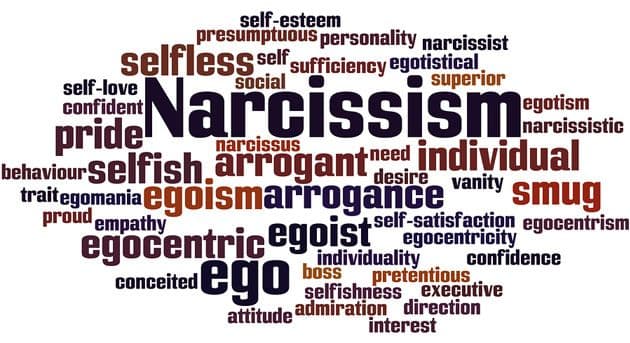
The concept of Narcissism originated with Freud [100] and derives from the myth of Narcissus, the figure who fell into unrequited love with his own reflection. Psychologists differentiate between a healthy degree of self-confidence and the extreme expression associated with Narcissistic Personality Disorder (NPD) [104], in which narcissism is so intense that it produces consistently maladaptive behaviour.
At the sub-clinical level, high trait narcissists (‘high narcs’) are characterised by arrogance, a sense of entitlement, a need for admiration, lack of empathy, exploitativeness, and hypersensitivity to criticism [106]. They are boastful, prone to exaggeration, and tend to pursue relationships instrumentally — seeking partners and colleagues who can provide the admiration they crave and discarding those who cannot [107]. Self-aggrandisement is the hallmark: they fantasise about control, unlimited success, and admiration, and make decisions based on self-interest rather than organisational or collective benefit [108].
When criticism cannot be deflected or ignored, narcissists can respond with intense aggression. An extreme clinical example is the case of Brian Blackwell, the teenager who killed his parents in response to a threatened ego. While the vast majority of sub-clinical narcissists never approach such extremes, the pattern of aggression in response to threat is a consistent feature of the trait [109, 110].
In organisational terms, the picture is not straightforwardly negative. Narcissistic leaders can be charismatic, compelling, and effective at creating a positive first impression [178]. Their drive for self-promotion often accelerates their ascent into leadership roles [179]. However, prolonged exposure consistently produces a different picture: antisocial behaviours become apparent, relationships deteriorate, and those beneath them experience belittlement and exploitation [180–183]. Research shows narcissistic CEOs are associated with bold, attention-grabbing strategic decisions that produce highly variable performance outcomes — significant successes and significant failures — compared with less narcissistic counterparts [162].
3.2 Machiavellianism

Machiavellianism takes its name from Niccolò Machiavelli, the 16th-century political theorist whose treatise The Prince offered a framework for acquiring and retaining power through strategic manipulation, deception, and the subordination of moral scruple to pragmatic outcome [109]. Christie and Geis [111] translated this into a personality construct measurable through psychometric assessment.
Of the three Dark Triad traits, Machiavellianism is unique in that it is not classified as a clinical disorder even at its most extreme. High Machs are characterised by strategic manipulation of others for personal gain, a cynical view of human nature, belief in the effectiveness of deceptive tactics, and an ends-justify-the-means moral framework [112]. They are cunning, observant, and often effective in unstructured or politically complex environments — but their success tends to decrease as organisational structure increases [116–123].
The fundamental problem with high Machs in organisations is that manipulation, when detected — and it tends to be detected over time — destroys trust. Social Exchange Theory [109] predicts that sustained organisational relationships depend on reciprocity. High Machs invest in that reciprocity only instrumentally — maintaining the performance of cooperation while pursuing private gain — and this corrodes the relational fabric of teams and institutions, regardless of their authority level or the collectivism of the culture in which they operate [166].
There is, however, a conditional positive. Many qualities associated with Machiavellianism — political savvy, emotional detachment in decision-making, ability to form and manage complex social alliances — are genuine leadership assets when the individual also possesses strong social effectiveness [172]. Within government, high Machs have been shown to serve longer in elected office and achieve more when paired with high intelligence [161]. The challenge is that the conditions enabling sustainable Machiavellian success are rare, and the corrosive effects of manipulation tend eventually to outweigh the short-term advantages.
3.3 Psychopathy
Psychopathy is arguably the most studied personality disorder in clinical psychology, and it is the Dark Triad trait most associated with destructive organisational outcomes [152]. Like Narcissism, it exists on both a clinical and sub-clinical spectrum [124–126]. At the sub-clinical level, the Corporate Psychopath — or Organisational Psychopath — is an individual who possesses sufficient impulse control to function in professional environments while exhibiting the characteristic features of psychopathy: lack of empathy and remorse, superficial charm, emotional shallowness, callousness, and disregard for social norms and the welfare of others [21, 97–99].
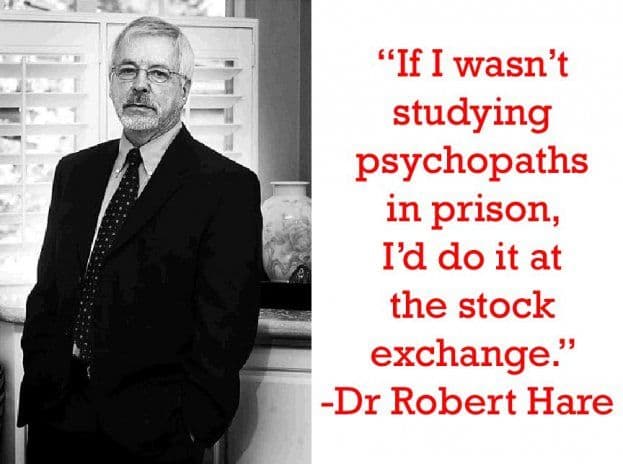
"Not all psychopaths are in prison. Some are in the boardroom." — Robert Hare [130]
The prevalence of corporate psychopaths is disputed, partly because ethical constraints make organisational research difficult [136]. Clinical psychopathy affects approximately 1% of the general population [127]. Research by Babiak and Hare [134] found that between 3.5% and 4% of senior executives exhibit psychopathic traits — significantly higher than the general population rate. Other studies suggest that between 5% and 15% of workforces may include individuals with psychopathic characteristics [154]. Anecdotal evidence even suggests that at least one major UK financial institution has historically screened positively for psychopathic traits in leadership selection.
Corporate psychopaths are reportedly the product of modern organisational conditions: rapid change, high staff turnover, and selection processes that reward surface charm while failing to detect the underlying trait profile [10]. The consequences for organisations are severe. Psychopathic leaders are associated with diminished corporate social responsibility [146], reduced employee wellbeing, increased counterproductive work behaviour, and a contagion effect: subordinates who observe and internalise the dysfunctional behaviours of psychopathic role models replicate those behaviours — particularly when they appear to yield success [155–157].
4. Dark Traits in Context: Interaction with the Big Five
Understanding dark traits in isolation is insufficient. Their organisational impact is significantly shaped by how they interact with the broader personality profile and situational variables. Dark traits do not operate in a vacuum — they are expressed, moderated, and amplified by context.
All three Dark Triad traits are negatively associated with trait Agreeableness [160] — which is intuitive, since the prosocial, cooperative, and empathic qualities of agreeableness are essentially the inverse of dark trait characteristics. Beyond this shared negative relationship, each dark trait has a distinct pattern of interaction with the remaining Big Five traits [161]:
- Narcissism and Psychopathy are positively associated with Extraversion — explaining the charismatic, attention-seeking, and socially dominant surface behaviours of both high narcs and corporate psychopaths.
- Machiavellianism and Psychopathy are negatively associated with Conscientiousness — meaning that despite their surface effectiveness, high Machs and psychopaths are generally less organised, disciplined, and persistent in goal pursuit than their self-image suggests.
- Narcissism and Machiavellianism are positively associated with Neuroticism — contributing to the emotional volatility, defensiveness, and hypersensitivity to criticism that characterise both traits.
- Psychopathy is negatively associated with Neuroticism — producing the characteristic emotional flatness and imperviousness to stress that makes psychopathic individuals simultaneously impressive under pressure and dangerously lacking in empathic response.
These interaction patterns have important practical implications. A high narc with strong extraversion and low conscientiousness presents very differently from one with high conscientiousness and moderate emotional stability. Organisational psychologists must consider the full trait profile — not just the presence of a dark trait — when assessing risk and potential.
5. Dark Personality in the Workplace: What the Research Reveals
Relationships in the workplace are fundamentally structured around Social Exchange — the implicit reciprocity that sustains cooperation: I will work hard, be reliable, and support you in return for fair recognition, compensation, and development. High trait Dark Triad individuals systematically undermine this exchange. They are disagreeable, emotionally uncommitted, prone to overlook obligations, and indifferent to the ideal of reciprocity [109]. High Machs do not invest effort they do not expect to be rewarded; high narcs regard social rules as applying to others, not to them; psychopaths are indifferent to the wellbeing of colleagues and the social fabric of teams [148].
The research on workplace outcomes is nuanced. O’Boyle et al. [109] found that Machiavellianism and Psychopathy are weakly negatively associated with job performance, while Narcissism produces a more complex picture: narcissistic leaders are associated with highly variable performance rather than consistently poor performance [162]. What is consistent across all three traits is that their negative effects compound over time, are amplified in collaborative, interdependent roles, and are particularly acute in environments where trust and reciprocity are fundamental to sustained performance.
Two situational factors significantly shape how dark traits are expressed: Trait Interaction and Trait Activation [190, 192]. Trait Interaction theory holds that the strength of a situation — the clarity and salience of its behavioural norms — determines the degree to which individual personality drives behaviour. In strong situations with clear rules and meaningful consequences, even high Dark Triad individuals may comply. In weak situations with few constraints, dark trait expression is far more likely. Trait Activation theory [190] extends this by arguing that traits remain dormant unless activated by trait-relevant cues in the environment. A psychopathic leader in a highly structured, well-governed organisation will be less destructive than the same individual in a low-oversight, rapidly changing environment where their impulsivity and callousness face no meaningful check.
The implication is significant. Organisations that wish to mitigate the risks associated with dark personality traits should focus not only on assessment and selection, but on the design of the organisational environment itself — the structures, norms, oversight mechanisms, and cultural cues that either constrain or activate dark trait expression.
6. The Measurement Challenge and Its Limits
A persistent obstacle to progress in this area is the unreliability of conventional personality assessment. Self-report questionnaires, which remain the dominant tool, require participants to respond genuinely. But individuals — particularly those with dark traits — are motivated and often skilled at managing the impression they create [185]. High Machs are more willing to fake responses in employment interviews [168]; psychopaths are skilled impression managers by definition; narcissists lack the self-awareness to report accurately.
A second challenge is that personality traits are not as stable as we tend to assume. Traits interact with situational variables, fluctuate in response to life events and relationships [186–188], and are modulated by neurobiological systems including hormones and neurotransmitters [203–206]. Drawing hard conclusions about future behaviour from a single self-report assessment is scientifically problematic. This has led some researchers to question whether psychometric testing for recruitment selection is defensible at all [185].
The most defensible approach combines multi-method assessment (including 360-degree feedback from those with extended direct exposure), structured observation in relevant situations, and an understanding of the organisational context within which behaviour will occur. The goal is not to ‘identify psychopaths’ but to develop a richer, more evidence-based understanding of the personality dynamics at work in any team or organisation — and to use that understanding to design more effective environments.
7. Practical Recommendations
Understanding the Dark Triad does not require treating these traits as uniformly pathological. The aim is nuanced, evidence-based awareness that allows organisations to manage risk, reduce avoidable harm, and unlock the genuine strengths that often accompany dark trait profiles. The following recommendations are grounded in the research evidence:
7.1 Move Beyond Binary Labelling
Avoid the instinct to label behaviours as simply ‘toxic’. Labelling without understanding changes nothing and risks discrimination against individuals on the basis of misunderstood traits. The goal is to understand the causes of behaviour — not simply to catalogue its effects. This requires investment in personality literacy at leadership and HR levels.
7.2 Strengthen Organisational Situations
Dark trait expression is suppressed in strong situational contexts with clear, meaningful norms and consistent governance. Organisations should examine whether their culture and structure create sufficient situational strength to constrain dark trait expression, particularly in senior leadership roles where oversight is weakest and the consequences of unchecked dark traits are most severe. Bureaucracy alone is ineffective — it adds cost without changing behaviour. Meaningful situational strength requires genuine consequence and genuine relationships.
7.3 Use Multi-Method Assessment
Single-point self-report psychometric testing is an inadequate basis for high-stakes talent decisions. Multi-method approaches — combining structured behavioural interviews, 360-degree assessment, observed performance in situationally relevant scenarios, and longitudinal performance data — provide a more reliable and defensible basis for understanding the trait profiles of individuals in, or being considered for, positions of significant influence.
7.4 Embed Personality Development
Personality literacy — the capacity to understand one’s own trait profile and its impact on others — should be treated as a core component of leadership development, not an optional add-on. Individuals who understand their own dark trait tendencies are better positioned to manage the behaviours associated with those tendencies, particularly in high-pressure situations where trait activation is most likely.
7.5 Partner with Researchers
One of the persistent barriers to progress in this field is organisations' reluctance to participate in empirical research. The evidence, based on sub-clinical dark trait populations in working environments, remains thin precisely because access is limited. Organisations that partner with researchers gain a competitive advantage: better understanding of their own dynamics, access to evidence-based practices, and the ability to influence a field that directly affects their performance.
8. Conclusion
The Dark Triad presents one of the most significant unexplored opportunities in organisational psychology. Its three constituent traits — Narcissism, Machiavellianism, and Psychopathy — are not rare aberrations. They exist on a spectrum, they are present at sub-clinical levels across the working population, and their prevalence is demonstrably increasing in a Western cultural context that rewards competitive, self-serving behaviour [5].
The consequences for organisations — in the form of failed leadership, broken trust, dysfunctional team dynamics, corporate governance failures, and the very culture crises that consume enormous management attention — are substantial. So too is the opportunity. Organisations that develop personality literacy, design environments that limit dark-trait expression, and use evidence-based assessment and development will be better placed to build the ethical, inclusive, and resilient cultures the challenges of the coming decade demand.
The study of personality is not new. But its application in organisations has been timid, partial, and often compromised by the very traits this article examines. If we want different outcomes, we have to be willing to look more clearly at what drives behaviour — even, and perhaps especially, when what we see is uncomfortable. That willingness is the beginning of change.
"If we want a different world, we have to start by looking in the mirror — even if we don’t like what we see."