1. Introduction: The Knowledge Transfer Problem
The fields of personality psychology and team research have, between them, accumulated more than 150 years of rigorous empirical knowledge. Yet the practical impact of that knowledge on organisational performance remains, at best, modest. Long-standing knowledge transfer failures have left management practitioners dependent on untested frameworks and intuition — often with predictably mixed results.
This gap has real consequences. Dysfunctional team dynamics, poor leadership climate, declining mental health, loss of motivation, and various forms of moral disengagement are not random misfortunes — they are predictable outcomes of environments in which personality dynamics are neither understood nor managed [1–3]. The paradox is that the knowledge needed to address them exists. What is lacking is the will and the framework to put it into practice.
This article draws on two intersecting bodies of research — personality science and organisational team dynamics — to illuminate the mechanisms through which individual personality, situational context, and team composition interact to shape behaviour and performance. It is written for a general professional audience, not for clinicians or academics: the goal is usable insight, not academic completeness.
"Nobody goes to work with the intention of having a bad day. Nobody looks for a job that makes them unhappy. Most people want to understand how they can be more successful. Why not help them — by sharing the knowledge we have about personality?"
2. A Changing Landscape: What Teams Are Up Against
Three structural shifts are fundamentally reshaping the conditions in which teams operate, and each of them places heightened demands on personality-related behaviours.
2.1 The Knowledge Economy and Task Complexity
The transition to a knowledge economy increases task uncertainty and cognitive complexity at every level of the organisation [39–42]. This places greater demands on the quality of social interaction between team members: when work is ambiguous, the quality of communication, coordination, and mutual trust becomes a primary determinant of outcome. Personality differences that might be manageable in simple, routine work environments become significant performance variables in complex ones.
2.2 Globalisation, Diversity and Virtual Working
Globalisation fragments core processes, increases functional and cultural diversity, and distributes teams across geographies and time zones [43–48]. The result is a profound increase in the complexity of social interaction. Survey data suggest that more than 66% of employees now work virtually at least some of the time [65,66], and 80% of survey participants expect that trend to continue [67]. Between 65% and 95% of knowledge workers participate in multiple teams simultaneously [68,69] — a structural condition that generates role conflict, goal ambiguity, motivational loss, and stress [70–76].
The performance consequences are striking. The Gartner Group found that 50% of virtual teams fail to achieve their goals [77]; more recent research suggests failure rates as high as 82% [78]. These teams struggle to build the shared understanding of goals, trust, and social cohesion that are prerequisites for effective performance [79–83]. The problem is not technology — it is the personality dynamics that technology-mediated communication simultaneously amplifies and obscures.
2.3 Collaboration Overload
The time managers and employees spend in collaborative activities has grown by more than 50% over the past two decades [61]. The assumption driving this growth — that more collaboration produces better outcomes — is not well supported by the evidence. Knowledge workers are spending so much time in collaborative activity that they cannot complete their core work within normal working hours [62]. De-layering of hierarchical structures has produced flatter organisations with larger teams — but team size and interaction volume have an exponential relationship [53–60], and the associated coordination costs rapidly exceed the collaborative benefits. More is not better. Effective collaboration requires fewer, higher-quality interactions — which, in turn, requires a clear-eyed understanding of the personality dynamics shaping those interactions.
3. Personality: The Hidden Variable
The extent to which individuals and teams respond productively or destructively to these environmental pressures depends, to a significant and underappreciated degree, on the distribution of personality traits within the organisation. Personality determines motivation, shapes social behaviour, and — through its interaction with situational variables — defines the range of behaviours an individual will express in any given context.
3.1 What Personality Is and What It Is Not
Personality is best understood as an individual’s characteristic patterns of thought, emotion, and behaviour, together with the psychological mechanisms underlying those patterns [107,108]. It is not a fixed set of labels or types. It is a dynamic system of traits, each measured on a continuous scale, that interacts constantly with the environment to produce observable behaviour.
This has two practical consequences that are frequently overlooked. First, extreme positions on any trait — whether high or low — tend to produce maladaptive behaviour; what is valued in moderation becomes a liability at the extreme. Second, because traits interact with situational variables to produce behaviour, the same individual will behave differently across different contexts. Understanding personality without understanding the situational environment in which it operates is, at best, incomplete.
3.2 The Case of Madeline G. — When Self-Knowledge Fails
The gap between self-perception and behavioural reality is one of the most consequential and underappreciated problems in organisational life. A striking illustration is provided by the case of ‘Madeline G.’, reported by Costa and Piedmont [111] in their interpretation of an NEO PI-R Five Factor Model assessment.
Madeline, a high-performing civil rights lawyer at a prestigious New York firm, regarded herself as warm, trustworthy, altruistic, and conscientious. Her husband completed the same assessment with Madeline as the subject. The discrepancy between their respective profiles was extraordinary: he described her as very low in trust, warmth, and altruism, and low across all facets of conscientiousness — dutifulness, self-discipline, competence, and deliberation. In the intervening years between assessment and publication, Madeline had been asked to leave her firm by mutual agreement with her employer, and her husband had left her — both outcomes she had not anticipated.
The case illustrates a phenomenon that is far from unusual: the individual who is most oblivious to their personality makeup is often simultaneously the most insensitive to the individual differences of those around them. Self-awareness is not a luxury in organisational life. It is a foundational competence — and one that cannot be reliably developed without accurate, well-framed personality data.
3.3 Personality Traits and Mental Health: The Spectrum Problem
A persistent obstacle to productive engagement with personality psychology is the clinical framing that dominates public understanding. The conventional model is binary: you either have a disorder, or you do not. This misrepresents how personality actually works. Every trait — including those with clinical labels such as narcissism, psychopathy, and neuroticism — sits on a continuous spectrum, and sub-clinical variants of those traits are present in the general population at significant levels.
The American Psychological Association’s alignment of DSM-5 with the Five Factor Model [115–122] is a significant development precisely because it recognises this reality. The practical implication for organisations is that they cannot wait for clinical thresholds to be crossed before engaging with personality-related behaviour. The many shades of grey between normality and disorder are where most of the performance loss, relational conflict, and mental health deterioration actually occur. Approximately 15–39% of the general population has a personality disorder of sufficient severity to impair normal functioning. The probability that any organisation’s workforce is unaffected is low.
4. The Five Factor Model: A Framework That Actually Works
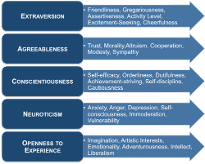
The Five Factor Model (FFM) — also known as the Big Five — is the most extensively researched model of personality available, and the only one that has demonstrated consistent reliability and validity across cultures and languages [157–165]. Its five traits — Extraversion, Agreeableness, Conscientiousness, Emotional Stability (or Neuroticism), and Openness to Experience — each measured on a continuous scale, provide a comprehensive framework for understanding human motivation and behaviour in organisational settings.
This matters because not all traits — or combinations of traits — are complementary to performance and other positive outcomes. A few illustrations make this concrete:
- Conscientiousness is the trait most reliably associated with job performance across roles and industries — but very high conscientiousness produces rigidity and inflexibility that undermines adaptation and team cohesion.
- Extraversion is associated with social confidence, network building, and leadership emergence — but very high extraversion in client-facing roles can damage relationships, and extraverts perform poorly on tasks requiring sustained vigilance, such as audit work.
- Agreeableness is universally valued as a social trait — but is systematically underrepresented in leadership, and highly agreeable individuals face real disadvantages in competitive professional environments.
- Emotional Stability (low neuroticism) is commonly associated with leadership effectiveness — but the associated emotional detachment overlaps with psychopathic traits that require separate consideration.
- Openness to Experience drives creativity and adaptability — but very high openness in execution-focused environments can create misalignment and frustration.
The FFM is also the basis on which DSM-5 psychiatric classifications are now aligned [115]. This is not an academic footnote: it means that the same framework that explains everyday personality variation also provides the most clinically validated language for understanding pathological extremes. That is a powerful and practically useful property.
In contrast, the Myers-Briggs Type Indicator (MBTI) — the most widely used personality assessment in organisations today — was originally developed for use with schoolchildren and has well-documented limitations in statistical reliability and predictive validity [30–37]. Its continued dominance in corporate settings, despite the existence of a substantially superior alternative, is one of the more puzzling features of contemporary people practice.
5. Trait Activation and Trait Interaction: Why Context Is Everything
5.1 Trait Interaction
Trait Interaction theory explains that behaviour is not produced by personality alone — it is produced by the interaction between personality and the situational environment [143–146]. In strong situations, where constraints on behaviour are explicit (whether through clear norms, close supervision, or high stakes), personality differences have relatively little influence on behaviour: most people conform. In weak situations, where constraints are absent or ambiguous, personality becomes the primary driver of behaviour.
The practical implication is important: a personality assessment score cannot be evaluated in isolation. A high score for disagreeableness or neuroticism is not a fixed prediction of behaviour — it is a description of a disposition that will or will not manifest depending on the situational context. Strong supervisory relationships, high job satisfaction, clear role expectations, and positive team dynamics all moderate the expression of potentially disruptive traits. Ignoring the situation while focusing on the trait produces inaccurate predictions and unfair conclusions.
5.2 Trait Activation
Trait Activation Theory (TAT) [109,110] builds on this by explaining that personality traits only express themselves as behaviours when the situation provides a trait-relevant cue. An extravert will only behave in characteristically extraverted ways when the social opportunity to do so is present. An agreeable individual will only express altruistic behaviour when another person’s need is visible and salient. Remove the cue, and the trait remains dormant.
This has profound implications for work design and culture management. If an organisation wants more empathic behaviour, more collaborative behaviour, or more creative behaviour, the most effective intervention is not to select for those traits or train them in — it is to design the situational conditions that activate them. Trait Activation Theory provides the theoretical foundation for why environmental design is consistently more powerful than training or selection in producing sustainable behavioural change.
6. Dark Personality Traits: The Misunderstood Dimension
The Dark Triad — comprising Narcissism, Psychopathy, and Machiavellianism — is among the most stigmatised terrain in personality psychology. The pejorative weight of the labels causes most professionals to reject any personal association with them, which is both psychologically understandable and factually mistaken.
Like all personality traits, Dark Triad characteristics exist on a continuous scale. Sub-clinical variants are present in the general population at levels that are considerably higher than commonly assumed. Research consistently finds that individuals with elevated Dark Triad traits are disproportionately represented in professions requiring high social influence, competitive drive, and strategic thinking — including law, finance, medicine, media, and management [106,124–135]. Approximately 4% of CEOs meet clinical criteria for psychopathy; estimates of the broader organisational prevalence of sub-clinical psychopathic traits range considerably higher.
This is not a counsel of despair. Dark Triad traits, at sub-clinical levels, are associated with genuine organisational advantages: high ambition, persuasiveness, strategic acuity, and the capacity to maintain composure under pressure. The problem arises when strong situational constraints are absent: without adequate checks, individuals with elevated dark traits default to self-serving, manipulative, or exploitative behaviours that impose significant costs on colleagues, clients, and the organisation. The challenge is not to exclude such individuals — that is both impractical and counterproductive — but to maintain the strong situational conditions that constrain their dark expression while directing their genuine strengths productively.
One consequence that receives insufficient attention is the impact on recruitment. Individuals with elevated Dark Triad scores — particularly those high in psychopathy and Machiavellianism — are exceptionally adept at impression management [25–29]. They are, in effect, expert performers in precisely the evaluative context that recruitment relies upon. The practical consequence is that standard personality assessments used for selection purposes may systematically favour the very candidates they are designed to screen out.
7. Homophily: How Organisations Become Less Diverse Over Time
The social-psychological phenomenon of Homophily — the tendency of individuals to associate with and bond with those who are similar to themselves — has been robustly demonstrated across more than 100 studies. Similarity Attraction Theory [138–140] explains that people are attracted to those with similar and complementary personality profiles, and this dynamic operates actively within organisations.
The organisational consequence is both predictable and underappreciated: despite stated commitments to diversity, organisations frequently become more personality-homogenous over time. Leadership teams develop trait monocultures. Dominant personality types create cultural norms that selectively retain similar individuals and gradually exclude those who differ. What presents in the annual engagement survey as ‘cultural misalignment’ or ‘communication breakdown’ is often, at its root, the product of a workforce whose personality composition has drifted away from the diversity of thought, approach, and motivation that performance requires.
The practical antidote requires active, personality-informed people practice — in recruitment, team composition, and development — not merely diversity commitments at the level of visible demographic characteristics. Personality diversity, including neurodiversity, is a performance variable. The growing recognition that autism spectrum characteristics are significantly more prevalent in technical, analytical, and data-intensive roles than previously understood [22,137] is one example of the practical implications of this principle for organisations with large populations of knowledge workers.
8. Practical Recommendations
The following recommendations are grounded in the evidence reviewed above. They are designed for leaders, HR practitioners, and organisational development professionals seeking to translate personality science into practical people strategy.
Recommendation 1: Replace MBTI with the Five Factor Model
The MBTI is not fit for purpose as an organisational people management tool. The FFM provides a more reliable, more valid, and more clinically grounded framework that is supported by a vastly larger evidence base. The transition requires investment in training and facilitation capability, but the improvement in the quality of insights available to leaders, teams, and individuals is substantial. Development and coaching applications should use FFM-based instruments; selection applications should be approached with the caution outlined below.
Recommendation 2: Use Personality Assessment for Development, Not Selection
As with all personality state instruments, FFM assessments taken under the evaluative conditions of recruitment are unreliable predictors of stable trait profiles [24]. More fundamentally, individuals with elevated Dark Triad traits are likely to perform well under exactly these conditions. Personality assessment is, however, a genuinely powerful tool for self-awareness, team dynamics, leadership development, and coaching — where its use is developmental, voluntary, and accompanied by skilled interpretation.
Recommendation 3: Design Situations to Activate Desirable Traits
The most evidence-consistent intervention for improving personality-related behaviour at work is environmental design, not individual change programmes. Applying Trait Activation Theory means identifying which situational cues activate the traits an organisation needs — and systematically building those cues into the work environment through role design, team composition, management practice, and culture. This is a more powerful and more sustainable lever than training or selection alone.
Recommendation 4: Address Dark Trait Risk Through Strong Situations
Attempting to identify and exclude Dark Triad individuals through selection is both unreliable and wasteful. The more effective approach is to maintain strong situational constraints — clear ethical standards, transparent accountability mechanisms, robust governance, and management practices that consistently reinforce prosocial norms. Strong situations suppress the expression of dark traits while preserving the genuine performance advantages they can provide.
Recommendation 5: Audit Team Composition for Personality Diversity
Leadership teams and project groups should be periodically assessed for personality composition, with particular attention to trait monocultures — especially in Agreeableness, Extraversion, and Conscientiousness. The homophily dynamic means that problematic convergence typically occurs gradually and invisibly. Active monitoring and intentional composition decisions are the only reliable countermeasure.
9. Conclusion
Organisations are navigating environments of genuine complexity — distributed teams, knowledge work ambiguity, collaboration overload, cultural diversity, and the growing prevalence of mental health challenges in the workforce. Personality science provides a rigorous, evidence-based framework for understanding how these challenges manifest and how they can be addressed. It has been underused for too long.
The knowledge transfer gap between what psychology knows and what management practice applies is not a technical problem. It is a practical one: the research is inaccessible to practitioners, the tools in widespread use are of poor quality, and the stigma attached to personality trait labels deters honest engagement with the phenomena those labels describe.
Closing that gap requires personality literacy at the leadership level, replacing inadequate assessment tools with validated alternatives, and applying Trait Activation and Trait Interaction theory to the design of work environments, teams, and cultures. None of these things is beyond the reach of organisations willing to engage seriously with the science.
Understanding personality — one’s own, and that of the individuals with whom one works — is not an academic exercise. It is a foundational leadership competence, a prerequisite for building high-performing teams, and one of the most effective tools for creating workplaces where people can genuinely do their best work.