
Abstract
This article asks: when people at work watch someone being treated badly and do nothing, what is most likely holding them back, what does it cost, and what makes one of them stop going along with it?
It is written for the person in the room and for the person who runs it. It sets out five reasons decent people stay quiet, each with the signs that point to it and the move it calls for. They are everybody waiting for somebody else, the learned belief that speaking changes nothing, the real cost of speaking, the way observers decide whether the target deserved it, and the rules a team and an organisation set without writing them down. It then sets out what the evidence says about the first and second person to act.
The evidence is drawn from research on workplace bystanders, employee silence and voice, conformity and obedience, moral disengagement and the organisational conditions under which people report wrongdoing, with a deliberate sweep of work published from 2024 to 2026; every practical move is labelled for how well it is supported, and the briefing is candid that the most useful move, being the first or second person to act in a workplace, has not been tested there. A late chapter covers the people most often mislabelled in this situation, including the reader.
Keywords: toxic workplace; bystander effect; workplace bystanders; employee silence; employee voice; speaking up; pluralistic ignorance; moral disengagement; conformity; obedience; retaliation; psychological safety; organisational psychology.
PART I. THE ROOM
Chapter 1: Eight People on the Call
1.1 The Monday Meeting
The scenarios below are composite. They draw on recurring patterns in research and advisory practice, and they describe no real, identifiable person or organisation.
Every Monday at nine, a regional sales director at a logistics company runs the pipeline review, eight people on a video call working through the quarter's forecast account by account, and when the second-year analyst who builds the forecast presents her numbers, he stops her on the third slide, calls the figure for the largest account a fantasy and asks whether she has actually read the client plan. Then he laughs at his own question, and the rest of the call looks at their notes.
It is not the first time, and everyone on the call knows it. It happened in some form most weeks of the last quarter, and it happens to nobody else. On each occasion, the meeting has moved on to the next account within a minute, as though what everybody had just watched had not occurred. Nobody says anything.
By lunchtime the analyst has three private messages. The finance business partner, who is senior to her and works with the director every week, writes that it was out of order and asks if she is all right. A peer in account management writes the same thing with an emoji, and a sales manager who reports to the director writes nothing except ugh. None of the three said a word on the call.
1.2 Private Sympathy, Public Silence
The pattern in 1.1 has a shape worth naming, because it is the shape the rest of this briefing explains: the people who watched disapproved of what they saw, said so to the person it was done to, and said nothing when it could have made a difference. Each of them would describe themselves, accurately, as a decent colleague. That combination is common, and it is clearly not hypocrisy in any simple sense. People who witness mistreatment at work tend to react against the person doing it and still don't intervene, which a 2025 pooling of the research found when it brought the studies together (Lyubykh, Zhong, Vuong, Robinson & Hershcovis, 2025).
Stated plainly, the problem is this: everybody in the room could see what one person was doing to another, most of them thought it was wrong, and nobody said anything until it was too late to matter.
1.3 The Question That Leads Nowhere
The question people tend to ask afterwards is what is wrong with the people who stayed silent, and in my experience, it leads nowhere useful. It produces one of two answers: that they are cowards, or that they secretly agree with the director. Either answer turns a pattern in a room into a verdict about the people in it, which is the same move the previous briefing in this series warned against when the subject was one difficult colleague.
The more useful questions are about the room: what each person believed the others were thinking, what had happened the last time somebody spoke, what speaking would have cost and who would have paid it, and what the organisation had taught them about whose business this was. Those questions have answers; the answers are different for each person on the call, and they point to things that can be changed.
Chapter 2: What Going Along Looks Like
2.1 Common, and Not What It Seems
Start with how ordinary this is, because the analyst in 1.1 is likely to feel that her case is unusual and her colleagues are likely to feel that their silence was. In an interview study of 40 professionals, 34 said they had at some point stayed silent about a concern at work, and the most common reason they gave was the fear of being seen or labelled negatively (Milliken, Morrison & Hewlin, 2003).
Silence does not usually mean indifference. Observers tend to disapprove of the person behaving badly, the 2025 pooling found, and their reactions towards the target are mixed, which is a more uncomfortable finding than simple apathy would be (Lyubykh, Zhong, Vuong, Robinson & Hershcovis, 2025), and a second pooling published the same year, of how third parties perceive mistreatment, reports patterns its authors describe as running against what existing theory predicted (Hill, Colquitt, Burgess, Priesemuth & McClain, 2025). People in the room are not simply failing to notice; they notice and then do something other than intervene. That is the puzzle.
2.2 Four Ways of Going Along
Going along takes more than one form, and the differences matter, because what helps in one case can make another worse.
Staying silent in the room. The most common form, and the one in 1.1: everybody sees it, and nobody says anything at the moment it happens, although several may offer sympathy afterwards.
Staying out of it. A quieter form, in which people avoid the target, stop copying them into things or decline to be seen with them, sometimes because they fear being tainted by association. In a study of 161 Dutch government employees, the anticipated stigma of being associated with a bullied colleague lowered people's intention to help (Mulder, Pouwelse, Lodewijkx & Bolman, 2014).
Joining in. Less common and more damaging, in which observers who decide the target deserved it take the perpetrator's side, laugh along or exclude the target themselves (Mitchell, Vogel & Folger, 2015).
Going along with the instruction. The form in which the person behaving badly is senior and the bad behaviour includes asking others to do something, and people comply. A conceptual argument that has shaped the field holds that destructive leadership depends on followers who go along and on settings that allow it as well as on the leader (Padilla, Hogan & Kaiser, 2007), and a later taxonomy sets out the different kinds of followers who do so (Thoroughgood, Padilla, Hunter & Tate, 2012).
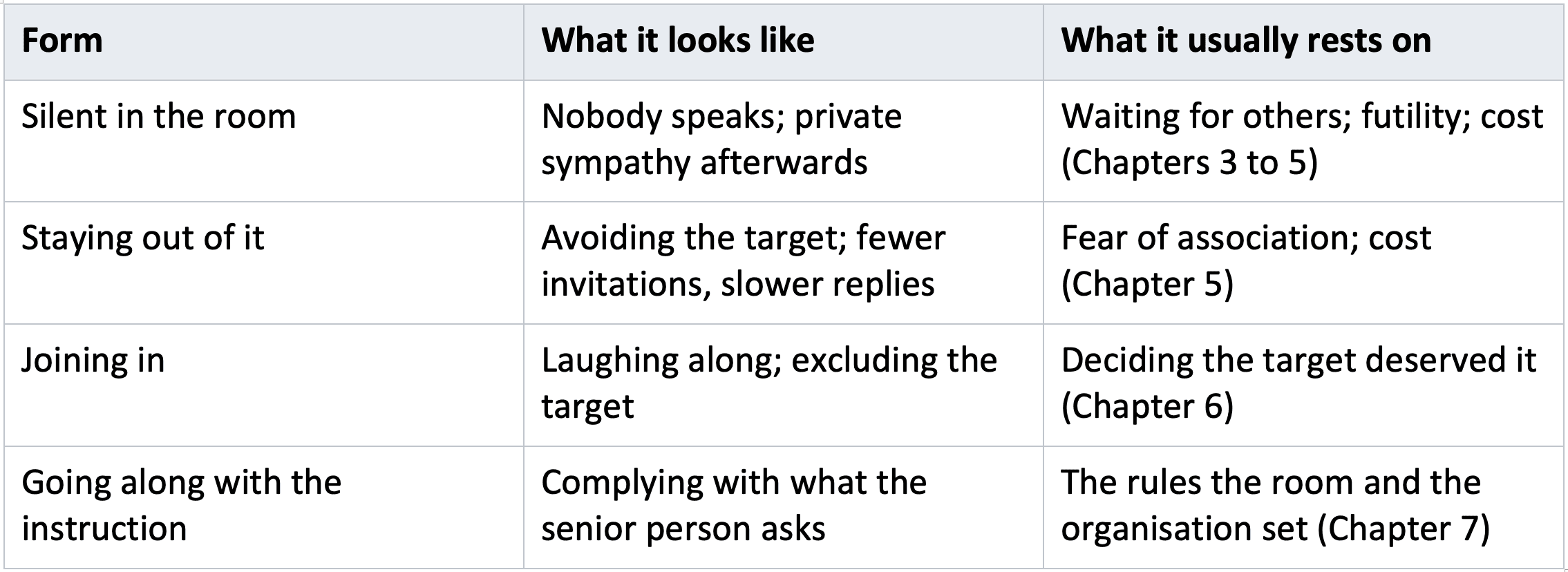
Evidence status: the four forms are each described in the research cited. The table's mapping of form to cause is judgement from practice, built on that research rather than tested diagnostically.
2.3 What It Costs
The cost to the target is obvious, and the previous briefing in this series set out how much low-level mistreatment adds up to. The cost to people who watch is less obvious and better evidenced than most organisations assume. A systematic review of 24 studies from 13 countries found that witnessing bullying at work was linked to poorer mental health, lower job satisfaction and a stronger intention to leave, although most of the studies were single-point surveys of convenience samples (Nielsen, Einarsen, Parveen & Rosander, 2024). The 2025 pooling went further and found that witnessed mistreatment made a distinct and sizeable contribution to how employees felt and behaved, beyond any mistreatment they had suffered themselves (Lyubykh, Zhong, Vuong, Robinson & Hershcovis, 2025).
So the eight people on the call are not bystanders in the sense of being unaffected. Based on this evidence, the pipeline review is wearing down everyone in it. In my experience, the first people to leave a team like that are rarely the target; they’re usually observers with other options.
PART II. WHY DECENT PEOPLE STAY QUIET
Chapter 3: Everybody Is Waiting for Somebody Else
3.1 The Insight
Each person in the room tends to assume that the others are less bothered than they are, and each waits for somebody better placed to act. The result is a room full of people who privately agree with one another and publicly behave as though nobody minds, which is the first thing that makes going along feel normal rather than chosen. Each is wrong about the others.
3.2 What the Evidence Says
The best-known version of this is the bystander effect, the finding that a person is less likely to help when other people are present, partly because responsibility feels shared and therefore smaller, which is called diffusion of responsibility. A meta-analysis, which combines the results of many earlier studies rather than running a new one, of 105 results from more than 7,700 participants confirmed the effect overall and found it weaker when the situation was seen as dangerous, when the perpetrator was present and when the bystanders were not strangers to one another (Fischer et al., 2011).
The second mechanism is quieter and closer to the boardroom. Pluralistic ignorance is the state in which most members of a group privately reject something while each believes the others accept it. In a large study of outside directors at medium-sized companies in the United States, directors of poorly performing firms underestimated how far their fellow directors shared their concerns about the strategy. That made them less likely to raise those concerns, and it made a change of strategy less likely (Westphal & Bednar, 2005).
The real-world picture is more hopeful than the classic finding suggests. In CCTV footage of public conflicts in the United Kingdom, the Netherlands and South Africa, at least one bystander, and typically several, did something to help in nine of ten conflicts, and the more bystanders were present, the more likely it was that somebody intervened (Philpot, Liebst, Levine, Bernasco & Lindegaard, 2020). That study is of streets rather than offices, and I would not stretch it further than that.
How solid is this: evidenced, from a meta-analysis of the bystander effect, a large study of company boards and a cross-national study of real conflicts. None of them studied a meeting at work in which one person mistreats another.
3.3 What It Means for You
Two things follow, and the first should change how you read the silence in 1.1. The person sitting next to you in the room is more likely to agree with you than their silence suggests, because their silence comes from the same assumption about you that yours produces about them. Second, a crowd matters less than the classic story claims. The Fischer pooling found the effect weaker among people who know one another, and colleagues know one another, while the CCTV study found that more onlookers meant more help, not less; on that evidence, the problem in a meeting is less the number of people present than the fact that each of them is waiting for a signal that nobody is giving.
3.4 What It Looks Like in Practice
The tell is the private message afterwards. If three people on the call message the target within the hour, the room was not indifferent: it was waiting, and each person in it assumed the others were not bothered; in my experience, the same is visible in the corridor after a board meeting in which a weak proposal passed, when two directors discover that both of them had doubts and neither said so. Judgement from practice, consistent with the evidence above.
Chapter 4: It Will Not Change Anything
4.1 The Insight
A good deal of silence at work is learned rather than chosen, and it comes from the experience of speaking up and seeing nothing happen. Fear certainly matters, and Chapter 5 addresses it, but the person who has decided speaking is pointless is harder to reach than the person who is afraid, because reassurance about safety does not answer their objection.
4.2 What the Evidence Says
In the interview study in 2.1, the reasons people gave for staying silent included being labelled negatively (30 per cent), damaging a relationship (27.5 per cent), the belief that speaking would make no difference (25 per cent) and fear of retaliation (22.5 per cent) (Milliken, Morrison & Hewlin, 2003). Futility sat alongside fear rather than behind it. On these figures, it was given as a reason almost as often as being labelled, and more often than retaliation.
The experimental evidence is sharper. In two experiments involving 654 people, those repeatedly shown that speaking up changed nothing became less likely to use new opportunities to speak and felt increasingly helpless. The authors describe the pattern as learned helplessness: repeated failure teaches a person that acting is pointless (Andrieu, Milhabet, Denis-Noël & Steiner, 2024).
Speaking up and staying silent have different drivers. Combining earlier studies with a six-month panel study, one team found that speaking up and staying silent behave as separate things rather than as opposites. The belief that speaking will make a difference was more closely tied to speaking up, and psychological safety, the shared sense that it is safe to take interpersonal risks in a group, was more closely tied to silence (Sherf, Parke & Isaakyan, 2021). People also carry taken-for-granted rules about when not to speak, which predicted silence at work beyond other known predictors across four studies (Detert & Edmondson, 2011).
How solid is this: evidence from an interview study, two experiments, a combined analysis with a panel study and a four-study programme. The percentages from the interview study come from only 40 people and should be read as an indication rather than a rate.
4.3 What It Means for You
It explains the sales manager's ugh in 1.1. He reports to the director; he may have raised something before, and if nothing happened, then he has every reason to believe nothing will happen now, which is a judgement about the organisation rather than a failure of nerve.
It also explains why the usual organisational response falls flat. An announcement that the company has an open-door policy and values speaking up addresses safety. If the silence in the room is driven by futility, the announcement answers a question nobody was asking. What answers futility is evidence that the last person who spoke changed something.
4.4 What It Looks Like in Practice
The tell is history. Ask what happened the last time somebody raised a concern about the person concerned and listen for the word pointless rather than the word scared. In my experience, the quietest teams are not always the most frightened; they are often the teams where a concern was raised, warmly acknowledged, and then disappeared. Judgement from practice, consistent with the evidence above.
Chapter 5: It Costs the Person Who Speaks
5.1 The Insight
The fear of speaking up is not irrational, because speaking up can cost the speaker, and the cost falls hardest on people with the least power. The person most able to bear that cost is usually the person with the most standing in the room, which is the practical point of this chapter.
5.2 What the Evidence Says
In a field study and two experiments, managers rated employees who spoke up to challenge the way things were done as worse performers, and endorsed their ideas less, than employees who spoke up in support of existing plans (Burris, 2012). A review of what happens to people who raise ethical concerns inside their organisation found that they meet both positive and negative responses and that colleagues often feel ambivalent about them (Chen & Treviño, 2023).
The costs are larger when the concern is serious. A pooling of 26 samples covering 18,781 people found that the factors studied related more strongly to whether people intended to blow the whistle than to whether they actually did (Mesmer-Magnus & Viswesvaran, 2005). A study at a large military base in the United States found that perceived retaliation against whistleblowers depended on their power and support, with different patterns for women and men (Rehg, Miceli, Near & Van Scotter, 2008). The fear of association in 2.2 belongs here too, because it is a cost of helping rather than reporting (Mulder, Pouwelse, Lodewijkx & Bolman, 2014).
Power changes the calculation. Across three studies, including experiments and a field study, observers with more power were more likely to intervene when they witnessed incivility and more likely to confront the perpetrator directly, because they felt more responsible (Hershcovis et al., 2017).
How solid is this: supported by experiments, field studies, and a pool of 26 samples. Most studies of retaliation rely on self-reports, and none followed a bystander who intervened in a meeting.
5.3 What It Means for You
The finance business partner in 1.1 is the person in the room for whom speaking costs least. She is senior to the analyst, works with the director every week, and he relies on her numbers, which, on the Hershcovis evidence, makes her the observer most likely to feel responsible and best placed to act. She also said nothing.
The analyst's peer and the sales manager are in a different position. For the sales manager in particular, a challenge to his own boss in front of the team is exactly the kind of voice the Burris studies found rated down. Asking him to speak first means asking the person with the most to lose to carry the risk for everybody else.
5.4 What It Looks Like in Practice
The tell is who sent private messages and who didn't. People who would pay a high price for speaking tend to offer sympathy privately, if at all, while people who would pay a low one tend to offer it privately as well, which is the gap worth closing; in my experience, the most senior person in a room underestimates their own power to change it and overestimates the risk to themselves, often by a wide margin. Judgement from practice, consistent with the evidence on power.
Chapter 6: They Probably Deserved It, and It Is Not My Business
6.1 The Insight
Observers do not simply see mistreatment; they read it, and the reading decides what they do. The most important part of the reading is a judgement about whether the target deserved it, and once that judgement is made the observer can go along with a clear conscience, which is why it is the most corrosive of the five reasons. It is also the hardest to see in yourself.
6.2 What the Evidence Says
Co-workers who believed a colleague deserved hostile treatment from a boss tended to feel contentment and to exclude that colleague, while those who believed it undeserved tended to feel anger, support the colleague and act against the supervisor (Mitchell, Vogel & Folger, 2015). In two experiments, observers of incivility reacted against the person who started it, while their reactions to the target were largely unaffected (Reich & Hershcovis, 2015). The type of mistreatment shapes how people read the situation. In two vignette studies with 578 participants, bystanders were least likely to support a target when the bullying was about work, such as unfair criticism of their performance, or took place online, and were a little more likely to defend a friend (Coyne et al., 2019), and in a study of 194 workers, people who doubted they could make a difference were less likely to intervene, and the perceived severity of the bullying mainly drove whether they helped in public (Hellemans, Dal Cason & Casini, 2017).
The justifications people use have a name. Moral disengagement is the set of reasoning moves by which people switch off their own moral standards for a particular situation, for example by telling themselves it is not their responsibility, that the target brought it on themselves or that it is not really so bad. This tendency has been linked to unethical behaviour at work across a series of studies (Moore, Detert, Treviño, Baker & Mayer, 2012). A meta-analysis found that abusive treatment by supervisors and a political climate were associated with more of it (Ogunfowora, Nguyen, Steel & Hwang, 2022).
The justification also lasts. One account of workplace bystanders argues that a bystander who does nothing tends to justify the inaction afterwards, and that the justification carries into the next incident (Ng, Niven & Hoel, 2020).
How solid is this: evidence as to how observers read deservingness, from field and experimental studies; evidence as to moral disengagement and unethical behaviour; theory as to the carry-over from one incident to the next.
6.3 What It Means for You
The director's criticism in 1.1 is framed as being about the work, which is exactly the framing the Coyne studies found drew the least support. She should have read the client plan is a sentence an observer can say to themselves in a second, and it turns a public humiliation into a performance conversation that is none of their business.
It also explains why the third week is harder than the first. On the Ng account, each Monday on which nobody speaks makes it easier not to speak the following Monday. By then, each person has told themselves why it was acceptable to stay quiet last time, and that speaking now would admit the last time wasn't acceptable either.
6.4 What It Looks Like in Practice
The tell is the word but. It was harsh, but the forecast was wrong. He is abrasive, but he gets results. I would not have said it like that, but she does need to toughen up.
In my experience, the sentence before the but is the observer's honest reaction, and the sentence after it is the justification that lets them stay out of it. When you hear yourself say one, notice which half you are acting on. Judgement from practice, consistent with the evidence on deservingness and moral disengagement.
Chapter 7: The Room Sets the Rules
7.1 The Insight
People go along with what the room and the organisation have taught them is normal, and most of that teaching is done by design choices that nobody thinks of as being about behaviour at all. Reward systems, visible responses to past complaints, and what senior people tolerate in front of others set the rules more reliably than any values statement.
7.2 What the Evidence Says
Groups shape individual conduct. In a study of 187 employees in 35 work groups across 20 organisations, people's antisocial behaviour at work rose with their group's antisocial behaviour, and those who behaved better than their colleagues were less satisfied (Robinson & O'Leary-Kelly, 1998). In the classic line-judgement experiments, participants went along with a unanimous group's plainly wrong answer on 36.8 per cent of critical trials (Asch, 1956). A meta-analysis of 133 studies in 17 countries found that conformity on that task had declined in the United States since the 1950s and was higher in more collectivist cultures (Bond & Smith, 1996).
The organisation's own stance matters, and recent work shows how much. Across four studies, one covering 3,050 workers in 113 organisations, employees who saw their organisation as morally disengaged were more likely to stay silent and act unethically on its behalf (Fida et al., 2025). In another four studies, people were less likely to report a team member's unethical behaviour when rewards were team-based than when they were individual, because they felt less moral anger, and the effect disappeared when the wrongdoer was in a different team (Hu, Adam, Desai & Mo, 2024).
And what an organisation does, rather than says, closes gaps. In three studies of how observers respond to sexual harassment at work, one with 341 participants, women felt more empathy for the target and intervened more than men. In organisations that showed strong intolerance of harassment, however, men and women alike intervened more and stayed silent less (Kim, Park & Liang, 2026). A field study and an experiment found that top management's value messages built the intention to report wrongdoing, while whether that intention became an actual report depended on concrete accountability systems and protection against retaliation (Vadera, Tenbrunsel & Diekmann, 2025).
How solid is this: evidenced by field studies, experiments, a 133-study meta-analysis and several 2024 to 2026 multi-study papers. The Asch figure comes from a laboratory task with strangers, and I would not treat it as a rate for meetings at work.
7.3 What It Means for You
It changes where the problem in 1.1 lives. If the sales team is paid on a pooled team target, the Hu studies suggest that people on the call may feel less anger at the director's conduct than they otherwise would, because his results are their results. That is a design choice, not a character flaw in eight people.
It also changes what a leader can do. A statement that the company does not tolerate bullying builds an intention, on the Vadera evidence. What turns that intention into action is a system people can see working: a route for concerns that isn't the director's own line, and a visible consequence when one is raised.
7.4 What It Looks Like in Practice
The tell is what happened the last time. If a senior person has behaved like this before and kept their standing, or if a previous complaint about them led to a quiet word and nothing else, the room has learned the rule, and nobody had to state it; in my experience people read an organisation's tolerance from three things: who gets promoted, who gets moved sideways after a complaint, and whether the most senior person present in a meeting lets a remark pass. Judgement from practice, consistent with the evidence above.
PART III. WHAT MAKES ONE OF THEM STOP
Chapter 8: The First Person Changes the Room, and the Second Matters as Much
8.1 The Insight
Going along is far more fragile than it looks, and it tends to break, in fact, when one or two people visibly refuse. The evidence on the first person is weaker than the popular story suggests, and the evidence on the second is stronger, which is the most practical finding in this briefing.
8.2 What the Evidence Says
The strongest evidence is older and comes from laboratory research. In a variation of the obedience experiments in which two peers, working alongside the participant, refused to continue, only 4 of 40 participants went on to the end, against 26 of 40 in the version with no peers at all; when the two peers obeyed instead, obedience barely moved, at 29 of 40 (Milgram, 1965). The author described the finding as showing that group pressure can liberate as well as constrain.
One refusal on its own may not be enough. In a partial replication run more than forty years later with 70 adults, obedience was only slightly lower than in the original studies, and participants who saw a single confederate refuse obeyed as often as those who saw no refusal at all (Burger, 2009); read together, the two studies suggest that what breaks the pattern is not a lone objector but the sight of more than one person refusing, which makes refusal look like a reasonable option rather than an eccentric one.
Real-world evidence points in the same direction. In the CCTV study in 3.2, intervention in public conflicts was the norm, and typically several people acted rather than one (Philpot, Liebst, Levine, Bernasco & Lindegaard, 2020). The account of workplace bystanders in 6.2 argues that each bystander's response shapes how others read the situation (Ng, Niven & Hoel, 2020), which is the mechanism by which one person acting could make a second more likely to act.
How solid is this: evidenced in the laboratory as to two peers refusing and as to one refusing model not being enough; evidenced in public settings as to intervention by several people being common. No evidence base for the workplace: I could not find a study at work that tests whether one person acting changes what the others in the room do.
8.3 What It Means for You
The burden on the first person is smaller than it feels. On the Milgram evidence, the first person does not have to change everybody's mind; they have to make refusal visible, and the second person makes it normal. That turns the question in 1.1 from who will be brave enough into which two people will agree beforehand, which is a far easier question for decent people to answer. It usually has an answer.
It also explains the private messages. Each of the three people who wrote to the analyst was, in effect, a second person waiting for a first, and each believed the others would not follow. Had any two of them discovered that before the meeting, the arithmetic in the room would have been different.
8.4 What It Looks Like in Practice
The first move rarely needs to be a confrontation. A sentence that changes the direction of the meeting is enough to show the room that somebody has noticed: let us take that one offline, I have been through the numbers with her, and they look reasonable to me.
A second voice saying “agreed” within a few seconds turns one person's interruption into a view the room holds. In my experience, the second voice is the one people forget to arrange and the one that does most of the work. Judgment from practice, consistent with the laboratory evidence on peers who refuse; the workplace version is untested.
PART IV. BEFORE YOU ACT
Chapter 9: The People You Will Mislabel, Including Yourself
Everything so far describes a pattern and why it happens. This chapter is about the cases in which the pattern is misread, and one of those cases is the reader. If this briefing leaves you more confident about who in the room is complicit, it has failed.
9.1 The One Who Helped Where You Could Not See
Not every bystander who said nothing in the meeting did nothing. A qualitative study of bystanders to workplace bullying described thirteen different roles they can take, ranging from those who join in to those who act to protect the target in less visible ways (Paull, Omari & Standen, 2012). The colleague who stayed quiet on the call may have raised it with the director's boss that afternoon, and you would not know.
9.2 The One for Whom Speaking Costs More
The cost of speaking is not shared equally, and Chapter 5 showed it falls hardest on people with the least power. A junior colleague, someone on a temporary contract, or someone already treated as an outsider may pay a price for intervening that you would not, and judging their silence by what yours would cost is the wrong comparison.
9.3 The One Who Knows More Than You Do
Sometimes the silence is informed. A colleague may know that a formal complaint is already in progress, that the target has asked people not to intervene, or that the director's own manager is already dealing with it, and staying quiet in the meeting may be the right call. Before deciding that a colleague is part of the problem, it is worth asking what they knew.
9.4 The One Who Intervened Badly
People who do step in do not always do it well. An intervention that humiliates the perpetrator in return, or that speaks for the target without asking them, can worsen the target's position. The evidence on what happens after an intervention is thin: a scoping review of 85 articles found that outcomes after intervention are not widely measured, with benefits reported for targets and few for the people who intervene (Jennings, Zhao, Faulkner & Smith, 2024). A clumsy intervention is still worth more than none, in my judgement, but it is a different thing from a good one.
9.5 The One Behaving Badly
This boundary is categorical, and the whole series holds it. Nothing in this briefing is about what the director in 1.1 is. His behaviour can be described, recorded and acted on, and the previous briefing set out how. Whether it reflects any trait or condition is not something a colleague can know, and diagnosing a personality disorder or any other clinical condition apart from difficult behaviour is the work of a qualified clinician who has assessed the person, not someone who has watched them in meetings.
The same clearly applies to the people who went along: going along is something people do in a situation, not a type of person, and in the baseline condition of one obedience study, 26 of 40 ordinary participants went on to the end (Milgram, 1965).
9.6 And You
The hardest case is your own. Hindsight makes the right moment to speak look obvious, and in my experience people tend to overestimate in advance how readily they would intervene and to underestimate afterwards how much the room shaped what they did; I could not find a workplace study that compares what people predict they would do as bystanders with what they then do [NEEDS SOURCE: predicted versus actual bystander intervention at work], so I state that as judgement from practice rather than as a finding.
It is not a reason for guilt about the last meeting. It is a reason to decide before the next one what you will do, because the decision made in the moment is the one the room makes for you.
PART V. WHAT TO DO
Chapter 10: If You Are in the Room
Evidence status, stated per move. Some moves rest on evidence about power, peers who refuse and the reading of deservingness. The rest are judgments from practice built on that evidence. No one has tested this as a workplace intervention by a bystander in a meeting.
10.1 Decide Before the Meeting
The most useful move costs nothing and happens before anything goes wrong. If you have watched the same thing happen in the same meeting more than once, decide in advance what you will do the next time, and decide the exact words. The reasons in Chapters 3 to 6 all operate in the few seconds after the remark, and a decision made in those seconds is a decision made under the room's rules.
One test for the words you choose: could you say them in the same tone you would use to correct a factual error? If so, they are about the behaviour and the work, and the room can follow them. If they need more heat than that, they are about the person, and the room will retreat from them. Judgment from practice.
10.2 Prefer the Small Move That Interrupts
In my experience, most effective interventions in a meeting are small. Redirect the conversation (let us come back to that account once we have the latest figures), take the issue offline (I have been through her numbers; I will pick it up with you after), or ask a neutral question that slows the moment down (what would you need to see to be comfortable with that figure?). None of them accuses anybody, and each shows the room that somebody has noticed.
The training evidence is consistent with a preference for indirect moves. In an experiment with 100 participants comparing two ways of practising responses to sexual harassment, practice in virtual reality raised people's intentions to use indirect, non-confrontational responses and changed nothing else, although behaviour itself was not measured (Rawski, Foster & Bailenson, 2022). Evidenced as to intentions only; judgement from practice as to the specific moves.
10.3 Find the Second Person in Advance
On the evidence in Chapter 8, what most reliably breaks going along is the sight of more than one person declining to go along. So before the next meeting, talk to one colleague who you think shares your view, and agree that if one of you speaks, the other will back it within seconds. That conversation will likely reveal, as the boardroom study in 3.2 predicts, that the other person was more concerned than you assumed (Westphal & Bednar, 2005). That is worth two minutes.
For the finance business partner in 1.1 that means a two-minute call with the analyst's peer in account management on Sunday evening or Monday morning, agreeing who will say what if the director starts again. Evidenced in the laboratory as to peers who refuse (Milgram, 1965); judgement from practice as to the move.
10.4 If You Have the Power, Use It
Observers with more power are more likely to intervene and to confront the perpetrator, because they feel more responsible (Hershcovis et al., 2017). If you are the most senior person in the room after the person behaving badly, you are the person for whom speaking costs least and achieves most, and the others are, in fact, very likely waiting for you.
That does not mean a public dressing-down. It means using standing the others lack: a redirection the director cannot easily dismiss, and a private conversation afterwards in which you describe what you saw in terms of behaviour and its effect on the work. Evidenced as to observer power and intervention; judgement from practice as to the form.
10.5 Check In With the Target, and Ask What They Want
Afterwards, talk to the person on the receiving end, and ask before acting on their behalf. Some targets want the behaviour challenged formally, some want it handled quietly, and some want to be left alone for now; doing what they want is part of the help. A scoping review of bystander intervention research found that targets benefit when somebody intervenes (Jennings, Zhao, Faulkner & Smith, 2024).
The previous briefing in this series set out how to keep a four-week record of a colleague's behaviour, and a bystander's own dated note of what they saw adds a second, independent account to the target's. Evidenced as to benefit to targets in general; judgement from practice as to the specific moves.
10.6 Three Refusals
Do not join the reading that the target deserved it. If you hear yourself say harsh, but, notice which half of the sentence you are acting on (6.4). Judgement from practice, consistent with Mitchell, Vogel and Folger (2015).
Do not tell the target to toughen up. It shifts responsibility for the behaviour onto the person least responsible, and it is the kind of justification moral disengagement research describes (Moore, Detert, Treviño, Baker & Mayer, 2012). Judgment from practice.
Do not wait for everybody to agree. You need one other person, not a consensus, and waiting for a consensus is how the room stays silent (Chapter 3). Judgment from practice, consistent with the evidence on pluralistic ignorance.
Chapter 11: If You Run the Room, or the Organisation
11.1 Watch What Happens to the First Person Who Speaks
Everybody else in the organisation is watching it too. If the first person to raise a concern is thanked and nothing changes, the futility evidence in Chapter 4 suggests fewer people will speak next time (Andrieu, Milhabet, Denis-Noël & Steiner, 2024). If they are quietly rated down, the voice evidence in Chapter 5 predicts the same, for a different reason (Burris, 2012).
So the leader's job when somebody speaks up is to close the loop visibly: say what was done, or why nothing could be, within a time the person would think reasonable. Evidenced as to futility and to the costs of voice; judgement from practice as to the remedy.
11.2 Make Intolerance Concrete
A declared value builds an intention, and a working system turns it into action. Top management's value messages built the intention to report wrongdoing, while accountability systems and protection against retaliation decided whether reports were made (Vadera, Tenbrunsel & Diekmann, 2025), and in organisations that showed strong intolerance of harassment, both men and women intervened more and stayed silent less (Kim, Park & Liang, 2026). Concrete means a route for concerns that must not run through the person being complained about, a named person who answers it, a visible consequence when a complaint is upheld, and a check, some months later, on what happened to the person who raised it. Evidenced as to accountability systems and organisational intolerance; judgement from practice as to the specific designs.
11.3 Check What Your Reward System Teaches
Team-based rewards made people less likely to report a teammate's unethical behaviour, because they felt less moral anger at it (Hu, Adam, Desai & Mo, 2024). That is not an argument against team rewards, which do other useful things; it is an argument for knowing that a pooled target quietly raises the price of objecting to the person who delivers most of it. Where the person behaving badly is also the person whose results fund everybody's bonus, a leader may want to add a route for concerns that is visibly separate from the team's chain of command. Evidenced as to team-based rewards and reporting; judgement from practice as to the remedy.
11.4 Ask the Question Nobody Is Asking
Pluralistic ignorance survives because nobody checks it. A leader who suspects that a team or a board is going along with something can ask privately, one person at a time, or collect a short anonymous read before the decision rather than after it, because the boardroom study found that directors underestimated their colleagues' concerns and stayed quiet as a result (Westphal & Bednar, 2005). Once people can see that their private doubt is shared, the reason for staying silent in Chapter 3 weakens. Evidenced as to pluralistic ignorance on boards; judgement from practice as to the remedy.
11.5 What Training Can and Cannot Do
Be sceptical of training on its own, because the most rigorous test located found no difference. In a randomised experiment, 35 anaesthetists attended a 50-minute speaking-up workshop and 36 did not, and in three simulated situations designed to call for speaking up, there was no reliable difference between the groups; the authors concluded that education alone was ineffective (Raemer, Kolbe, Minehart, Rudolph & Pian-Smith, 2016).
The wider picture is similar. A scoping review of bystander interventions against gender-based violence and harassment at work, which screened 11,302 references and included 14 studies, found that workshops with practice exercises can increase helpful bystander behaviour, but that the shortage of follow-up measurement makes long-term effects hard to judge (Nielsen, Hansen & Mikkelsen, 2025). In one healthcare organisation, 140 employees' attitudes improved after bystander training and then declined over two months, and participants named a lack of leadership support and accountability as the barriers (Kuntz & Searle, 2023). A meta-analysis of 19 interventions against bullying at work found some were associated with less bullying, but the studies had a notable risk of bias (Rodríguez-Muñoz, Díaz-Guerra, Antino, Duran & Sánchez, 2025).
Training gives people words and permission. On this evidence, it does little unless the organisation around it changes the reasons in Chapters 3 to 7, which is why it belongs after the other moves in this chapter and not instead of them. Evidenced by one randomised experiment, two reviews and one uncontrolled study.
11.6 A Worked Version
Here is the whole sequence for the pipeline review over one quarter, and none of it requires anybody to decide what the director is. Before the next Monday, the finance business partner calls the analyst's peer in account management and they agree that if the director starts on the analyst's numbers again, she will redirect and he will back her. When it happens on the third slide, she says she has been through the figures with the analyst and will pick up the largest account with the director afterwards; he says agreed, and the meeting moves on.
That afternoon she checks in with the analyst, who wants it raised but not as a formal complaint yet, and asks her to keep a dated record. The finance business partner then speaks to the director's own manager, describing four Mondays of behaviour and its effect on the forecast, and the manager, who had heard nothing until then, starts sitting in on the review.
The head of people, asked to look at the wider pattern, notes that the sales team is paid on a pooled target that the director delivers most of, and adds a route for concerns that runs outside the sales line. If the behaviour stops, the room has changed it. If it does not, there are now two dated accounts, a manager who has seen it for himself and a route that does not depend on anybody on the call being brave, so either outcome is information. Judgement from practice throughout; the sequence has not been tested.
Chapter 12: What This Changes
12.1 The Short Version
If you read nothing else, read this. Observers clearly care and still do not act. People who witness mistreatment at work disapprove of the perpetrator and tend not to intervene; in one study, 34 of 40 professionals stayed silent about a concern. Everybody waits for somebody else, and each underestimate how much others share their concern.
Silence is often learned: in experiments with 654 people, those shown that speaking changed nothing stopped speaking.
Speaking costs, and costs least for the powerful, who are also the observers most likely to step in. The organisation sets the rules: across 3,050 workers in 113 organisations, people stayed silent more where the organisation had switched off its own moral concern, and team-based rewards made people less likely to report a teammate. Two refusals change the room: when two peers refused, full obedience fell from 26 of 40 to 4 of 40. And training alone did not work in the one randomised test located.
12.2 So What Do You Do
Decide before the meeting, including the words, and prefer the small move that interrupts to the confrontation. Find the second person in advance, because the second voice may matter as much as the first. If you have the power, use it, and ask the target what they want before acting for them. If you run the room, watch what happens to the first person who speaks, make intolerance concrete, check what your reward system teaches, and treat training as the last move rather than the first.
12.3 What I Still Do Not Know
Four things remain open, and I would rather state them than resolve them by omission. Whether one person acting in a meeting at work makes others more likely to act, since the evidence comes from laboratories and streets and no workplace study I could find tests it.
What happens to the people who intervene at work, since the scoping evidence says it is rarely measured. Whether any training changes what people do in the room rather than what they say they intend, since the one randomised test found no difference. And whether the moves in Chapters 10 and 11 end a pattern once it is established, since none has been tested as a sequence.
This is the pattern in which the temptation to judge the people in the room is strongest, because their silence is so visible and so easy to call cowardice. It is also the pattern in which that judgement is least useful, because what the evidence offers is almost entirely about rooms, rules and the second person. What I would most like to have made harder is the confident sentence about what kind of people go along. What I would most like to have made easier is the two-minute conversation before the next meeting.