1. The Conscientiousness Paradox
Ask any hiring manager whether they would prefer a conscientious candidate to an unconscientious one, and the answer is always the same. Of course they would. The question seems almost too obvious to ask.
And yet organisations are consistently surprised by the consequences of conscientious people working together. They are surprised when a high-performing individual makes working life difficult for their team. They are surprised when a team of high achievers fails to gel. They are surprised when the diligent employee who never misses a deadline also fails to adapt to change. And they are repeatedly surprised by the predictable damage inflicted by those at the low end of the scale — the social loafers, the shirkers, the free riders who corrode team cohesion from within.
Conscientiousness is, in fact, a paradox. It is the personality trait that most reliably predicts success, and simultaneously the one whose misapplication — in selection, team composition, and leadership practice — generates some of the most preventable failures in organisational life. After IQ, conscientiousness is the second-best predictor of important life and career outcomes identified by psychologists [Peterson, 2017]. But its relationship with performance is curvilinear, not linear: the optimal level is moderately high rather than maximal, and both too much and too little create predictable, avoidable problems. And in teams, as original doctoral research has shown, variance in conscientiousness between members is more damaging to performance than low levels alone [Keca, 2019].
Understanding this trait properly — its structure, its spectrum, its interactions, and its limits — is one of the most practically valuable things an organisation can do.
2. What Is Conscientiousness?
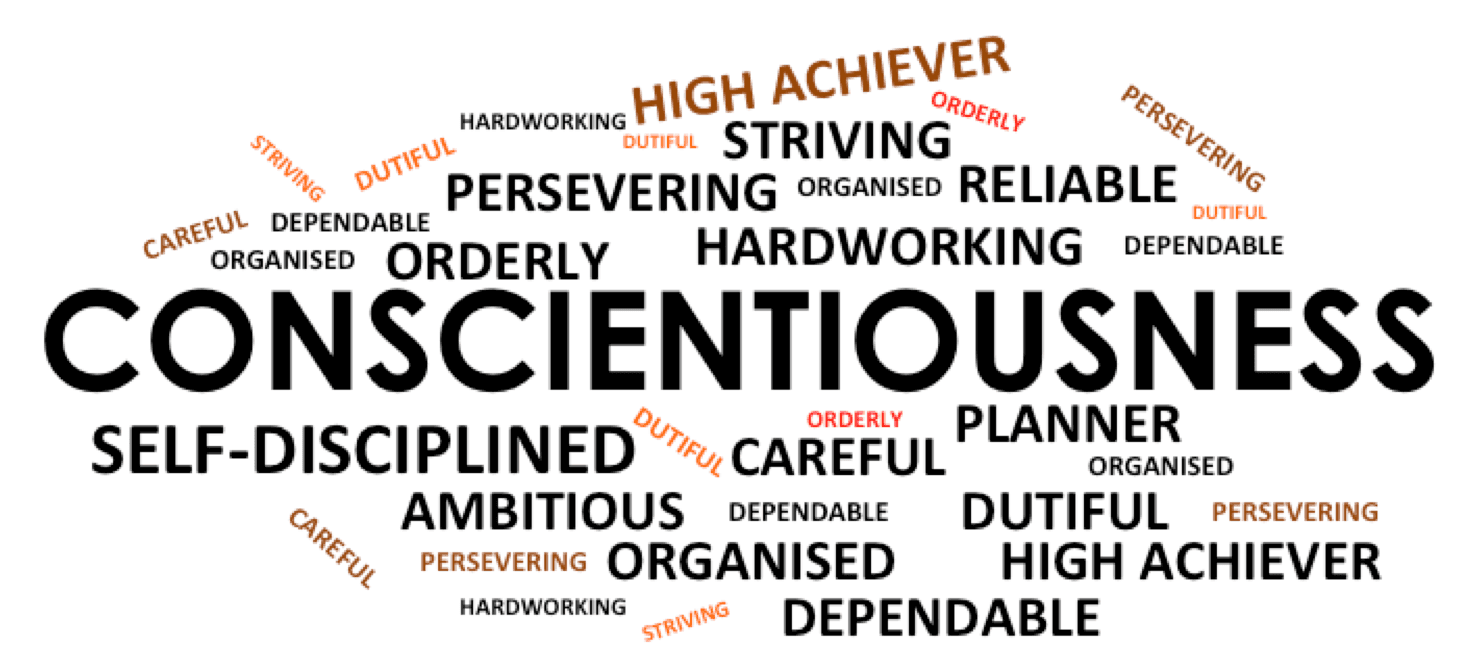
Conscientiousness is one of the Big Five Personality Traits — the most comprehensively validated model of personality available [32] — and represents the degree to which individuals are achievement-oriented, self-motivated, persevering, hard-working, thorough, orderly, punctual, dependable, responsible, and self-disciplined [1–3]. Where other traits describe how we relate to people (Agreeableness), the social world (Extraversion), emotion (Emotional Stability), or ideas (Openness), Conscientiousness describes how we relate to work itself — to goals, plans, obligations, and standards. In a fundamental sense, it is the personality trait most aligned with the question: Can I rely on this person to follow through?
Individuals high in Conscientiousness tend to set themselves high standards, strive consistently to achieve their goals, and are well-organised. They plan ahead, keep commitments, finish what they start, and are rarely distracted. In contrast, individuals low in Conscientiousness tend to be disorganised, easy-going, and sometimes careless [1–3, 13]. These dispositional differences have measurable consequences at both the individual and team level.
2.1 Two Distinct Aspects: Industriousness and Orderliness
Research has successfully subdivided conscientiousness into two separable aspects, each with its own profile of outcomes [Peterson, 2017]: