1. The Extraversion Assumption
If you have ever wondered why senior leadership teams so often seem to be high-conflict, political environments populated by assertive, attention-seeking individuals — now you know. The explanation is extraversion: the Big Five personality trait most closely associated with leadership emergence, social confidence, and the pursuit of status. Most organisations implicitly select for it. Most performance cultures reward it. And yet the research evidence is clear: more extraversion is not always better, either for individuals or for the teams they inhabit.
Extraversion is a fundamentally important trait. It enables the smooth functioning of social mechanisms within teams, is strongly linked to intra-team processes and contextual performance [1] and is the most consistent Big Five predictor of leadership outcomes [Judge et al., 2002]. But it also carries a well-documented dark side — one that tends to be invisible at first meeting and becomes increasingly apparent as interpersonal interactions deepen over time. Understanding extraversion requires holding both realities: a genuine social asset and a predictable source of team dysfunction when present in excess or poorly managed.
2. What Is Extraversion?
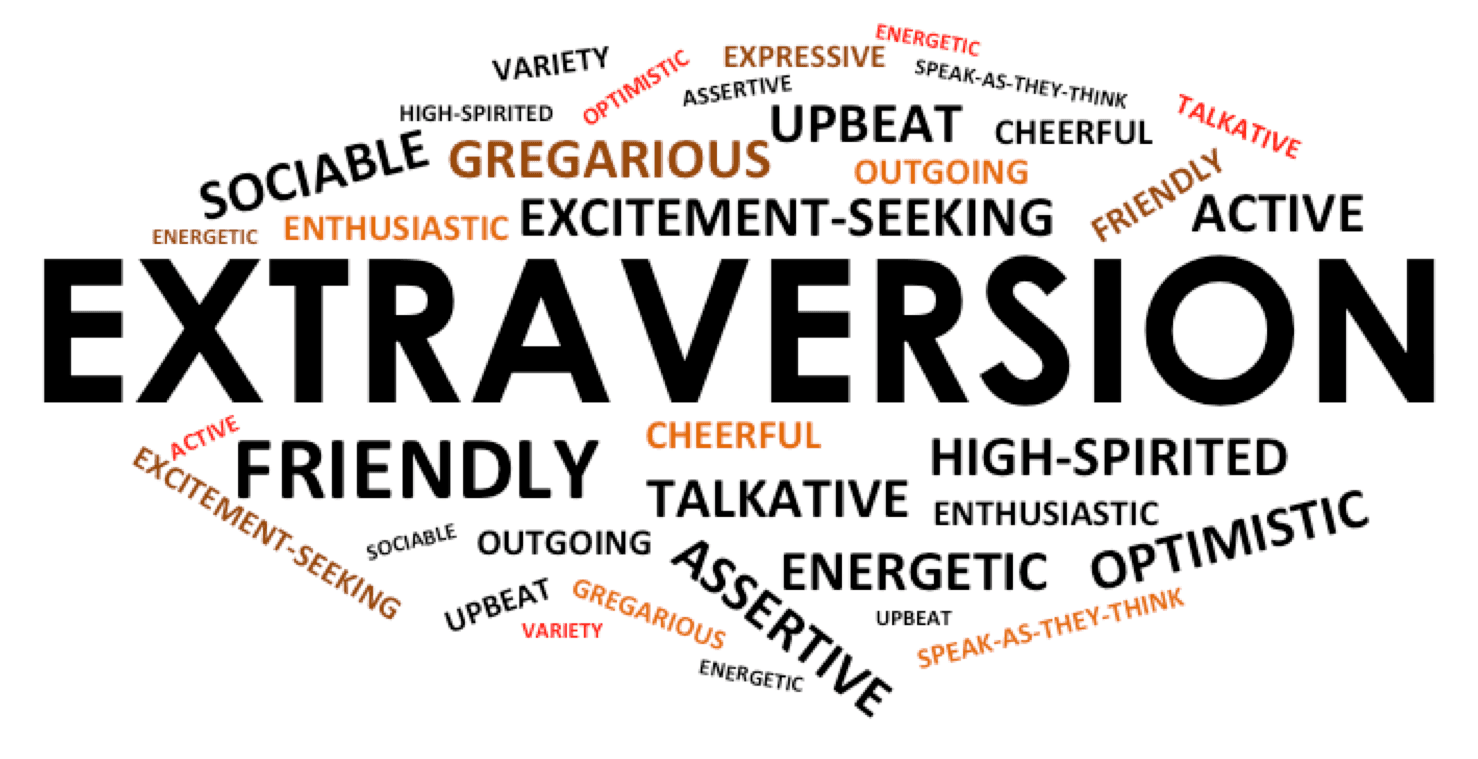
Extraversion is the Big Five personality trait most closely associated with positive affectivity — the tendency to experience and express positive emotion. It is characterised by assertiveness, activity, friendliness, enthusiasm, energy, positivity, sociability, chattiness, high spirits, and a generally outgoing nature [2]. Extraverts crave excitement and stimulation; they are energised by social interaction and seek out opportunities to engage with others. Introverts — those low in extraversion — are, by contrast, reserved, serious, reflective, and prefer privacy or the company of a small number of close friends [2]. They have lower social skills in the narrow sense [11], find social interactions less immediately rewarding [14], and attain lower initial status in social groups [13] — though, as later sections discuss, this picture reverses significantly over time.
At a deeper level, extraversion can be understood as a solution to a fundamental psychological problem: how much to value the present [Peterson, 2017]. Extraverts weight the present more heavily and discount the future more steeply — a tendency that is measured in experimental psychology through delay discounting paradigms: given the choice between a smaller reward now or a larger reward later, extraverts are more likely to choose the immediate option. This bias toward present exploitation explains both their social energy and their greater tendency toward impulsive behaviour — gambling, risk-taking, and novelty-seeking. It is also evolutionarily rational: the future is genuinely uncertain, and the optimal degree of future-discounting depends on how unpredictable the environment is. Extraverts’ temperamental bias toward the present is a legitimate adaptive strategy in certain environments [Peterson, 2017].
2.1 Two Distinct Aspects: Enthusiasm and Assertiveness
Building on Peterson and colleagues’ Big Five Aspect Scale [DeYoung and Quilty], extraversion subdivides into two empirically separable aspects, each driven by a distinct motivational foundation [Peterson, 2017]: