Abstract
The "bad apple effect" is the empirically supported proposition that a single group member who persistently withholds effort, expresses negative affect, or violates interpersonal norms can materially degrade the performance, cohesion and ethical conduct of the group around them (Felps, Mitchell & Byington, 2006). The underlying mechanism — emotional contagion, the largely non-conscious transfer of mood and affect between people — was independently demonstrated by Barsade (2002) in a controlled laboratory study using a trained confederate.
This article provides a critical appraisal of the effect rather than a restatement of its popular coverage. It distinguishes the peer-reviewed theoretical review that introduced the concept from the widely retold confederate experiment ("Nick the actor") that supplies its most quoted statistic — a 30–40% performance decline — and reports honestly that this specific figure, while consistently described by the researcher who ran the study, could not be traced to a peer-reviewed publication that states it. The article then moves from folklore to firmer ground: the personality-psychology literature on subclinical psychopathy and the Dark Triad, which supplies both prevalence data (Coid et al., 2009; Babiak, Neumann & Hare, 2010) and the largest meta-analytic evidence to date on the workplace consequences of psychopathic traits (Roth & Klehe, 2025, k = 166, N = 49,350), including the critical and under-reported distinction between primary and secondary psychopathy. Chapter 4 also situates that literature within the broader Dark Tetrad framework, which adds everyday sadism to the original Dark Triad.
The article then examines the organisational mechanisms by which a single difficult individual recruits the compliance of an otherwise decent workforce — ethical fading (Tenbrunsel & Messick, 2004), the toxic triangle of destructive leaders, susceptible followers and conducive environments (Padilla, Hogan & Kaiser, 2007) — and the economic evidence for intervention, including a Harvard Business School analysis of the cost of toxic employees relative to star performers (Housman & Minor, 2015) and a longitudinal case study of organisational collapse under a psychopathic CEO (Boddy, 2017). Contested ground is addressed directly: the case that the effect is overstated, the self-report and generalisability limitations of the underlying personality research, and the risk of the construct being used to informally diagnose ordinary colleagues. A short, explicitly flagged frontier section considers — without overstating the thin evidence available — how AI-mediated workplace tools might plausibly alter the same contagion dynamic.
Finally, the article translates the evidence into a defensible organisational framework: what to document, what genuinely helps a team recover, and why the structures that usually protect employees — hierarchy, tenure, likeability — are precisely the structures a genuinely damaging individual learns to use. The conclusion is that the bad apple effect is real, large, and considerably better evidenced at the level of mechanism than at the level of the specific statistic most people have heard.
Keywords: bad apple effect; emotional contagion; counterproductive work behaviour; sub-clinical psychopathy; Dark Triad; ethical fading; toxic triangle; toxic worker cost; organisational psychology; workplace deviance; Dark Tetrad; trait activation theory.
PART I — THE CLAIM AND WHERE IT CAME FROM
Chapter 1: The Idiom Before the Evidence
1.1 A Team Everyone Remembers
Almost everyone who has worked in a team of any size can, without much prompting, produce an account of one person who changed how the whole group felt.
It rarely takes the form of a single dramatic event. More often, it is described the way people describe weather: a shift in the atmosphere that arrived with someone's presence and lifted a little in their absence. Meetings that used to move became slower. Colleagues who used to offer opinions freely began qualifying everything or stopped offering them at all. Two people who got on well started sniping at each other over things that were not, on their face, worth sniping about. Nobody could point to a policy that had been broken. Everybody could feel that something had changed.
The idiom that captures this — a bad apple spoils the barrel — is old enough that its origin is difficult to date precisely, and it has survived because it describes something people keep noticing. What it did not have, until relatively recently, was a body of evidence to back it up. Organisational psychology spent much of the twentieth century more interested in what made teams effective than in what made them fail, and where it did study failure, it tended to look at structural causes — poor process, unclear goals, resource shortages — rather than at the behaviour of a single member.
That changed with a 2006 paper that gave the idiom a name, a mechanism, and eventually an experiment. This article is about what that body of work actually shows, where it is strong, and where — because the topic invites exaggeration and the story is genuinely good— it has been overstated, even by people with good intentions.
1.2 Three Familiar Patterns
Before turning to the evidence, it is worth naming three composite patterns that recur across accounts of this phenomenon, because a single vignette risks making the effect feel like one specific personality rather than a family of related behaviours. None of the three below describes a real, identifiable person or organisation; each is a composite drawn from patterns reported repeatedly enough, across the literature and in practitioner accounts, to be worth naming.
The first is the specialist whose output is genuinely excellent and whose conduct is genuinely corrosive — the technically brilliant colleague whose contempt for anyone who asks a "basic" question, or whose visible irritation when a meeting runs past their preferred pace, gets excused for years because their individual output is real and easy to point to, while the slow hollowing-out of everyone else’s willingness to collaborate with them is not.
The second is the chronic pessimist: not hostile, often well-liked as an individual, but reliably the first voice in any planning discussion to explain why an initiative will fail — a pattern that, consistent with the negativity-bias evidence in Chapter 3, does not need to be loud or frequent to shift a room’s risk appetite and energy over time.
The third is harder to spot precisely because it is designed to be: the colleague who is warm, even flattering, toward anyone with authority over them, while running a quieter pattern of exclusion, selective information-sharing, or plausible-deniability gossip toward peers. This is the pattern most likely to produce the credibility gap described in Chapter 7 — a manager who has only ever seen the first version may reasonably not believe reports of the second.
These are patterns, not diagnoses, and the caution in Chapter 9 applies to all three: a colleague matching one of these descriptions on a single occasion is not evidence of anything. What the evidence in the chapters that follow addresses is what happens when a pattern like one of these is genuinely persistent, and nothing intervenes.
1.3 What This Article Is, and Is Not
This is not a character study of villains, nor a checklist for identifying the "bad apple" on your own team. It is an examination of a specific empirical claim: that the presence of one persistently negative group member produces measurable harm to the group, through a demonstrable psychological mechanism, at a scale worth taking seriously.
That claim needs to be kept separate from a much larger and looser one — that difficult people are secretly dangerous personality types, that every underperforming team has an identifiable culprit, or that removing one person reliably fixes group dysfunction. The research reviewed here supports a narrower and more useful set of conclusions than the popular retellings usually offer, and this article follows the evidence rather than the version of the story that travels best.
It is also worth saying plainly what this article does not claim about diagnosis. Persistent negative behaviour at work has many sources — burnout, an unmanaged mental health condition, a genuinely dysfunctional environment provoking a reasonable person into unreasonable behaviour, or, in a minority of cases, an enduring personality style that is unlikely to change regardless of the environment. Distinguishing between these requires more than a feeling that a colleague is difficult, and nothing in this article should be read as licence to label a colleague from a distance.
1.4 The Assumption Under Test
The assumption worth stating explicitly, because the research exists specifically to test it, is this: that groups are more powerful than individuals, and will therefore absorb, dilute or correct the behaviour of one difficult member rather than being shaped by it.
That assumption has real intellectual pedigree. A large literature on group dynamics, going back to early social-psychological work on conformity and cohesion, documents how individuals adjust their behaviour toward the norms of the group they are in — not the reverse. If that literature is the whole story, one difficult person should be a minor irritant, smoothed over by the much larger gravitational pull of the group's existing norms, its more numerous well-adjusted members, and whatever leadership is present to manage friction.
The bad apple research asks a pointed question of that assumption: what if, under some conditions, the causal arrow runs the other way? What if a single member's persistent negativity is a stronger predictor of group outcomes than the combined disposition of everyone else at the table?
Answering that question required moving from correlation — do teams with a difficult member perform worse, which could simply mean difficult people gravitate toward failing teams — to something closer to a causal test. That is where the empirical literature begins.
Chapter 2: The Study Behind the Phrase
2.1 What Felps, Mitchell and Byington Actually Did
The paper usually credited with putting the bad apple effect on a scientific footing is Felps, Mitchell and Byington's "How, When, and Why Bad Apples Spoil the Barrel: Negative Group Members and Dysfunctional Groups," published in 2006 in Research in Organisational Behaviour, a peer-reviewed annual review volume (Felps, Mitchell & Byington, 2006).
It is worth being precise about what kind of paper this is, because the precision matters for what can honestly be claimed from it. It is a review and integrative model, not a single new experiment. Felps and his co-authors — working from the University of Washington, where Felps was a doctoral student inspired partly by his wife's own account of a difficult colleague — synthesised roughly two dozen existing studies on group dynamics, conflict and social loafing into a single theoretical framework describing how one negative member's behaviour propagates through a team (University of Washington, 2007). This is a legitimate and influential form of scholarship — the paper has been cited well over 350 times — but it is a synthesis of prior evidence and a proposed mechanism, not itself a controlled experiment with a reported effect size.
2.2 The Three Behaviours
The paper's central contribution is a definition. Felps and colleagues proposed that a "negative group member" is someone who persistently exhibits one or more of three behaviours: withholding effort from the group (a form of social loafing that shifts the group's workload onto everyone else); expressing negative affect (chronic pessimism, complaint or hostility that colours the group's shared emotional tone); and violating important interpersonal norms (rudeness, ridicule, or behaviour that breaches the basic standards of respect a group has implicitly agreed to).
The theoretical model that follows traces how these behaviours produce downstream harm. They generate specific psychological states in teammates — perceptions of unfairness, negative feelings toward themselves, declining trust in the group and its processes. Those states, in turn, provoke defensive behavioural reactions: open conflict, withdrawal, or an unconscious drift toward matching the negative member's own mood and effort level, so as to protect against feeling exploited by comparison. The end state is a set of degraded group processes — less cooperation, less information sharing, less creative output — that, from the outside, look like a team that simply is not very good, when the underlying cause is the sustained presence of one member.
2.3 The Experiment Everyone Cites (and What It Actually Rests On)
The version of this research that most people have actually heard is not the 2006 review paper. It is a separate, later experimental study, and getting its evidential status right matters for the integrity of everything that follows in this article.
In the account that circulates widely — repeated across business books, leadership blogs, and a well-known 2008 interview on the US public-radio programme This American Life — Felps recruited an actor, "Nick," to be secretly embedded in forty-four-person groups completing a paid business-planning task. Nick was instructed to perform one of three negative roles across different groups: the Jerk (aggressive, dismissive of others' ideas), the Slacker (a withholder of effort), and the Depressive Pessimist (chronically doubtful and disengaged). Across nearly every group, teams containing Nick were reported to perform 30 to 40 percent worse than teams without him — a number Felps has repeated consistently in interviews and public talks over more than a decade (This American Life, 2008; Felps, as reported in Coyle, 2018).
This experiment is real in the sense that it was genuinely conducted, and its qualitative findings — that negative behaviour propagated to other team members, that teams argued more and shared information less, and that one team with an unusually skilled informal leader neutralised Nick's impact entirely — are consistent across every independent account of it. What could not be located, despite a specific search, is a peer-reviewed journal article reporting this experiment, with the 30–40% figure stated as the result. The figure appears reliably in secondary and tertiary sources — leadership blogs, business books, coaching sites — nearly all of which trace back to the same radio interview and to Felps's own subsequent retellings, rather than to a citable dataset with a stated methodology and statistical test.
This is not a reason to dismiss the finding. A researcher's own consistent, detailed account of a study he designed and ran is meaningful evidence, and the qualitative mechanism it describes is well supported by the independently replicated contagion research covered in the next chapter. But it is a reason to describe it accurately: as a widely and consistently reported experimental finding from the researcher who ran it, not as a statistic with the same evidential standing as a published, peer-reviewed effect size. Readers and content-makers who want to cite "30 to 40 per cent" should attribute it to Felps's own account rather than to a specific paper, because no such paper could be identified.
2.4 What the Review Established, Precisely
Stripping away the parts of the story that rest on secondary retelling, the 2006 peer-reviewed contribution establishes something narrower but still consequential: a coherent, evidence-synthesising theoretical model, built from dozens of prior empirical studies in group dynamics and organisational behaviour, showing a plausible and well-supported mechanism by which one persistently negative group member can produce disproportionate harm to a team's functioning. A companion survey referenced in the University of Washington's own account of the research found that the large majority of working adults could readily identify at least one such person from their own career, which speaks to the phenomenon's face validity even though a self-report survey of this kind cannot establish causation on its own (University of Washington, 2007).
What the review does not establish, on its own, is a precise effect size for how much a bad apple degrades performance in a typical team. For that, the field turns to a separate, independently developed body of research on the mechanism the review proposes: emotional contagion.
PART II — WHY ONE PERSON MOVES A GROUP
Chapter 3: The Mechanism of Contagion
3.1 Mood Is Not Private Property
The intuitive model most people carry of their own emotions treats mood as something private — generated internally, in response to one's own circumstances, and expressed outward as a side effect. The emotional contagion literature complicates that model considerably. Mood, on this evidence, behaves less like a private possession and more like something transmissible: people catch each other's emotional states through facial mimicry, vocal tone, posture and pacing, largely beneath conscious awareness, and the transmission happens whether or not anyone involved intends it (Hatfield, Cacioppo & Rapson, 1994, as synthesised in later organisational work).
This matters directly for the bad apple question, because it supplies the mechanism the 2006 review proposes but does not itself experimentally demonstrate. If mood transfers automatically between people in proximity, then a persistently negative group member need not say anything explicitly discouraging to affect a meeting's outcome. Their affect is doing work on the room independent of their words.
3.2 Barsade's Confederate Study
The most direct experimental test of this mechanism in a work-relevant setting is Sigal Barsade's 2002 study, published in Administrative Science Quarterly as "The Ripple Effect: Emotional Contagion and Its Influence on Group Behaviour" (Barsade, 2002).
Barsade's design addressed the causal weakness inherent in simple correlational studies. She used a trained confederate — a research assistant coached to display one of four combinations of mood (pleasant or unpleasant, high or low energy) — and embedded that confederate in small groups of MBA students completing a realistic managerial decision-making exercise, distributing a bonus pool among employees under a set of case constraints. Because the confederate's mood was assigned experimentally rather than occurring naturally, any resulting change in the group's mood and behaviour could be attributed to contagion rather than to some third factor that might otherwise explain why a difficult person and a difficult group co-occur.
The result was contagion, cleanly demonstrated: participants' moods measurably shifted toward the confederate's assigned mood, confirmed by both participants' own self-reports and independent outside coders rating videotape of the sessions who had no knowledge of the experimental condition. Group-level outcomes moved with it — individual attitudes toward the task, perceived group cooperation, and the amount of conflict that emerged during the decision-making exercise were all significantly affected by the mood the confederate had been assigned to display.
3.3 Why Negative Affect Outweighs Positive
A separate and consistent finding, both in Barsade's own work and in the broader affective-science literature that informs the bad apple model, is an asymmetry: negative emotional states tend to be more contagious, more attention-grabbing, and more durable in their physiological aftereffects than positive ones. This asymmetry is often summarised — including in commentary on the Felps research itself — as the observation that anger and its physiological correlates can persist for hours after the provoking event, considerably longer than positive states like contentment or amusement typically last once their trigger has passed.
This asymmetry has a specific implication for group composition that the "bad apple" framing captures well and that a simple additive model of team personality does not. If negative affect is stickier and more transmissible than positive affect, then a team is not simply the average of its members' dispositions. One reliably negative member and eight reliably positive members will not settle near "mostly positive" because the negative signal disproportionately influences the group's shared emotional state relative to its numerical share of the room. This is the empirical basis, however informally it is usually stated, for the folk claim that positive team culture is fragile in the presence of even a small amount of persistent negativity.
3.4 The Spillover Effect: Becoming the Bad Apple
The most striking qualitative observation across accounts of Felps's confederate experiment — and one consistent with the contagion mechanism rather than dependent on the contested 30–40% figure — is that teammates did not merely tolerate the negative confederate's behaviour. They began, without apparent awareness of doing so, to adopt it. When the confederate played the Jerk, other members became more critical and dismissive of each other. When he played the Slacker, effort visibly declined elsewhere in the group. When he played the Depressive Pessimist, other members' own expressions of doubt increased.
This spillover — sometimes called behavioural mimicry or, in earlier organisational-behaviour literature on workplace deviance, a form of social contagion of counterproductive conduct — is the mechanism that converts one person's disposition into a team-level outcome. It also explains why the effect resists a simple fix. Removing the original negative member after the group's norms have already shifted does not automatically restore the group's original state, because by that point the negative pattern has spread across multiple people rather than being concentrated in one person.
3.5 The Field Evidence: Twenty Organisations, Real Teams
Barsade's contribution is a controlled laboratory demonstration of the contagion mechanism; a fair question is whether the same pattern shows up outside a lab, in real teams doing real work. Robinson and O'Leary-Kelly's 1998 field study, published in the Academy of Management Journal under the title "Monkey See, Monkey Do: The Influence of Work Groups on the Antisocial Behaviour of Employees," answers that question directly (Robinson & O'Leary-Kelly, 1998).
The study surveyed 187 employees across 35 work groups in 20 different organisations, measuring both an individual's own antisocial workplace behaviour — damaging property, deliberately working badly or slowly, starting arguments, criticising colleagues — and the aggregate antisocial behaviour of that individual's immediate work group. The central finding was a clear positive relationship: employees whose coworkers behaved more antisocially were themselves significantly more likely to behave antisocially, independent of their own baseline disposition. This is the Barsade contagion mechanism, observed not in a single afternoon in a laboratory but across a cross-section of ordinary organisations, with the norm-setting influence running from the group's aggregate behaviour to the individual rather than the other way around.
A secondary finding from the same study is worth dwelling on, because it captures something the folk idiom misses entirely. Employees who behaved better than their group's prevailing norm — the people quietly declining to participate in a group's drift toward cynicism or corner-cutting — reported significantly higher dissatisfaction with their coworkers than those whose behaviour matched the group norm. Resisting a negative group norm, in other words, carries a measurable interpersonal cost of its own, which helps explain why the contagion effect tends to win out over individual resistance more often than the "just don't let it affect you" advice common in workplace culture would predict.
Chapter 4: Who the Bad Apples Actually Are
4.1 Beyond the Idiom: Dark Triad and Sub-Clinical Psychopathy
The Felps and Barsade research describes a behavioural pattern — withholding effort, negative affect, norm violation, contagious mood — without making strong claims about the underlying personality of the people who display it most persistently. Most people display some version of these behaviours occasionally, under stress or provocation, without being a "bad apple" in any durable sense.
A separate and much larger body of personality psychology research addresses a narrower and more consequential question: who displays this pattern chronically across situations, largely independent of circumstances? The relevant construct here is the Dark Triad — Machiavellianism, narcissism, and sub-clinical psychopathy — first proposed as a cluster of related but distinct socially aversive traits measurable in ordinary, non-clinical populations (Paulhus & Williams, 2002). Of the three, sub-clinical psychopathy has the largest and most directly relevant evidence base for workplace conduct, because it combines the interpersonal-affective features most associated with the bad apple's non-conscious pull on a room — superficial charm, callousness, low empathic concern — with the impulsive, norm-violating behavioural component that Felps's model describes directly.
4.2 From Triad to Tetrad: Where Everyday Sadism Fits
Paulhus and Williams's original 2002 formulation deliberately excluded a trait that later research would show to be a distinct, non-redundant predictor of exactly the conduct this article concerns. Erin Buckels, Daniel Jones and Delroy Paulhus's 2013 follow-up demonstrated, across two laboratory procedures, that everyday sadism — a subclinical tendency to find genuine pleasure in another person's distress, independent of any instrumental benefit to the person feeling it — predicted cruel behaviour that psychopathy, narcissism and Machiavellianism scores did not fully account for on their own. The finding extended the Dark Triad to what the field now generally refers to as the Dark Tetrad (Buckels, Jones & Paulhus, 2013).
The distinction matters specifically for the bad apple model. Felps's three core behaviours — withheld effort, negative affect, norm violation — do not require any enjoyment of the harm they cause; a chronically negative colleague may be miserable rather than gratified by the atmosphere they create. Where a colleague's norm violations are accompanied by visible enjoyment of a target's discomfort — the joke that continues after it has clearly stopped landing, the criticism delivered with evident relish rather than reluctance — sadism, not simply psychopathy, is the more precise construct, and the two traits' overlap is real but partial (Buckels, Jones & Paulhus, 2013).
A separate and more recent line of theory helps explain why sadism sits so comfortably alongside the three original Dark Triad traits rather than existing at a further remove from them. Moshagen, Hilbig and Zettler’s 2018 unifying model proposes a single underlying dispositional tendency — the "Dark Factor of Personality," or D — that they argue accounts for the shared variance across sadism, psychopathy, narcissism, Machiavellianism and several other socially aversive traits, with each specific trait representing a different behavioural expression of the same underlying tendency to maximise one’s own utility at others’ expense while maintaining a self-justifying belief system (Moshagen, Hilbig & Zettler, 2018). On this account, asking whether a difficult colleague is "more narcissistic" or "more sadistic" may be a less useful question than asking how strongly they sit on the D dimension overall — a reframing consistent with this article’s own caution, in Chapter 9, against over-precise labelling from a distance.
This article uses Dark Triad terminology through most of Chapter 4 because the great majority of the workplace-outcome evidence — Babiak, Neumann and Hare's corporate sample, Roth and Klehe's meta-analysis — was collected using Dark Triad instruments, predating the sadism-inclusive measures the field has developed since. Where the distinction affects how a finding should be read, it is flagged explicitly, including in the intervention guidance in Chapter 10.
A related profile, sometimes labelled the "dark empath," combines high cognitive empathy — an accurate read of what will hurt someone — with low affective empathy, meaning that accurate read carries no corresponding concern. That combination raises a distinct set of research questions from the Dark Tetrad addressed here, and this article does not attempt to cover it in depth; readers interested in how it manifests specifically in workplace manipulation should look to the companion Lane 1 treatment of the dark empath profile elsewhere in this series.
4.3 Prevalence: Households, Offices, and the C-Suite
The best available population estimate for psychopathy in a general community sample comes from Coid and colleagues' 2009 household survey of England, Wales and Scotland, using a validated screening version of the standard clinical instrument (the PCL: SV) in a representative sample of 638 adults. The weighted prevalence at the standard research cut-off was 0.6% (95% confidence interval: 0.2–1.6%) — genuinely rare in the general population, and broadly consistent with estimates from other Western countries (Coid et al., 2009).
That rate does not hold steady across organisational settings. Babiak, Neumann and Hare's 2010 study — the first to gain direct research access to a working corporate sample rather than relying on offender or community populations — assessed 203 corporate professionals selected by their own companies for management development programmes, using both the standard clinical instrument and a validated screening instrument. At the conventional research threshold for psychopathy, 3.9% of this corporate sample scored above the clinical cut-off, and 4.4% scored close behind it — a rate roughly six to seven times the general-population estimate, in a sample specifically composed of people their employers had judged worth investing in for further advancement (Babiak, Neumann & Hare, 2010).
That elevated rate at senior levels is corroborated, though with wider and less precise estimates, across the broader literature: figures commonly cited put psychopathic-trait prevalence among senior managers in the range of three to four times the general population, and separate survey work finds that a meaningful minority of employees — estimates vary roughly between one in twenty and one in eight, depending on the measure and sample — report having worked directly with someone they perceived as psychopathic (Caponecchia, Sun & Wyatt, 2012; Boddy, 2017). The width of that range is itself informative: it reflects genuine measurement disagreement in the field about where to draw the line between "difficult" and "psychopathic" using lay judgement, and readers should treat single-decimal-point versions of this figure with more scepticism than the confidence with which they are usually repeated.
A wider figure sometimes seen alongside this topic — sub-clinical psychopathic traits affecting as many as one in four employees in high-pressure workplace settings, alongside an aggregate annual cost of toxic conduct to the global economy running into the hundreds of billions — could not be traced to a specific primary study during the preparation of this article, despite a dedicated search. It is named here for completeness and rejected: readers who have seen a figure like this quoted elsewhere should apply the same scepticism this article applies to the 30–40% Felps figure in Chapter 2, and should ask, before repeating it, what source is actually being cited.
4.4 What the Largest Meta-Analysis Actually Found
The most authoritative current evidence on workplace consequences comes from a 2025 meta-analysis by Lenke Roth and Ute-Christine Klehe, published in the Journal of Applied Psychology — by a wide margin the largest synthesis of this literature to date, drawing on 166 independent samples and 49,350 individual psychopathy scores from studies published between 2008 and 2024 (Roth & Klehe, 2025).
The pattern the meta-analysis found is consistent and, in the authors' own words, substantially stronger than an earlier and more tentative meta-analysis had suggested (O'Boyle et al., 2012). Higher psychopathic traits were associated with meaningfully reduced task performance, meaningfully reduced organisational citizenship behaviour — the discretionary helping, information-sharing and extra-mile conduct that keeps teams functioning smoothly — and a substantial increase in counterproductive work behaviour, the deliberate acts (from petty sabotage to bullying to theft) that damage an organisation or its people. All three relationships held at both the level of simple meta-analytic averages and in a more rigorous structural model designed to test the underlying theory rather than just the raw associations.
4.5 Primary and Secondary Psychopathy: Not the Same Threat
The meta-analysis's most practically important finding is one that rarely survives into popular coverage of this topic: not all psychopathy behaves the same way at work, and the version most responsible for workplace harm is not the one popular culture usually pictures.
Personality researchers distinguish primary psychopathy — emotional coldness, low anxiety, calculated interpersonal manipulation, associated more with temperament than circumstance — from secondary psychopathy, characterised by impulsivity, poor emotional regulation, reactive hostility and heightened sensitivity to stress, more strongly linked to adverse life circumstances. Roth and Klehe's structural modelling found that the damage to task performance, citizenship behaviour and counterproductive conduct was overwhelmingly driven by secondary psychopathy; primary psychopathy's direct paths to these outcomes were mostly weak or statistically negligible by comparison (Roth & Klehe, 2025).
This is a genuinely counter-intuitive result worth sitting with. The culturally dominant image of the workplace psychopath is the cold, controlled, calculating operator — the primary type. The evidence suggests that the person doing more measurable damage to team performance and conduct is more often the reactive, poorly regulated, stress-sensitive colleague — someone whose difficulty looks less like calculated manipulation and more like a persistent inability to manage their own frustration. That distinction matters enormously for how organisations should think about intervention, a point this article returns to in Part V.
The same analysis found that moderators mattered too: the negative relationship between psychopathy and task performance was somewhat less pronounced among older employees than younger ones, tenure moderated the link to counterproductive behaviour (though only for employees in typical roles), and — perhaps most consequential for organisational design — psychopathic traits were more strongly linked to counterproductive behaviour among supervisors than among individual-contributor employees. Authority does not restrain this pattern. If anything, the evidence suggests it amplifies it.
4.6 The Comparison Table
The table below consolidates the primary/secondary distinction from Roth and Klehe (2025) against the population-prevalence figures earlier in this chapter, because the two are routinely conflated in popular coverage in ways the evidence does not support.
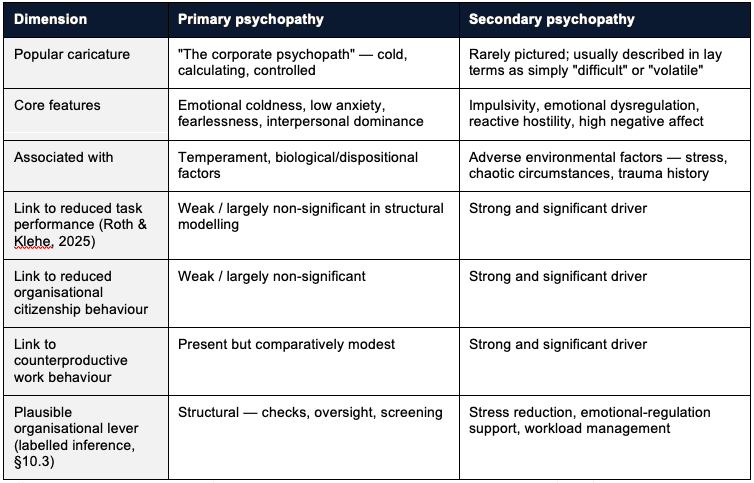
Effect-size directions and significance patterns are as reported in Roth and Klehe (2025); the "plausible organisational lever" row is this article's own reasoned inference from that pattern, not a tested intervention finding, and is labelled as such.
4.7 Reading the Table
The clearest implication is that the two constructs most easily collapsed into a single mental image — "the workplace psychopath" — point toward different practical responses. Primary psychopathy, the calculating and dispositionally stable form, is the harder problem to solve through support or environmental change, and the evidence base here favours structural responses: screening, oversight, and the checks-and-balances emphasis returned to in Chapter 7. Secondary psychopathy, the reactive and stress-linked form responsible for most of the measured workplace damage in the largest available meta-analysis, is at least plausibly more responsive to the kind of organisational-health interventions — manageable workload, psychological safety, access to support — that many organisations already have some infrastructure for, even if that infrastructure is rarely aimed deliberately at this population.
This is not a claim that difficult colleagues should be managed through therapy rather than accountability. It is a claim that the accountability structures most organisations reach for by default are calibrated to the primary-psychopathy caricature, while the meta-analytic evidence says most of the actual damage in ordinary workplaces is coming from somewhere else.
PART III — THE WORKPLACE
Chapter 5: The Business Case
5.1 The Harvard Toxic-Worker Study
If the personality-psychology literature establishes who the more extreme bad apples tend to be, a separate strand of research puts a number on what they cost — and the most rigorous attempt to do so treats the question as a straightforward comparison against the thing organisations spend the most money chasing: star talent.
Michael Housman and Dylan Minor's 2015 Harvard Business School working paper, "Toxic Workers," analysed a genuinely large dataset — more than 50,000 employees across eleven companies, combining pre-hire assessment data, detailed termination records, and daily performance metrics (Housman & Minor, 2015). They defined a "toxic" worker conservatively and behaviourally, as an employee ultimately terminated for serious misconduct — harassment, fraud, or comparable violations — rather than by personality score, which sidesteps some of the self-report concerns that apply to psychopathy-scale research. On that definition, roughly 5% of workers in their sample were toxic at some point in their tenure.
The comparison Housman and Minor ran is the paper's central contribution. They calculated that avoiding a single toxic hire saved an organisation approximately $ 12,489 in avoided induced turnover among colleagues who would otherwise have quit in response — a figure that excludes litigation costs, regulatory penalties, customer harm, and morale effects, all of which would push the true cost higher. By contrast, hiring a top 1% "superstar" performer added approximately $5,303 in value through direct productivity gains. Avoiding one bad apple was worth roughly two and a half times as much as landing one exceptional performer, using a methodology specifically designed to enable an apples-to-apples financial comparison.
The traits that predicted eventual termination for toxic conduct are also worth stating plainly, because they cut against a common assumption: workers who went on to be terminated for misconduct were, on average, more productive than their peers before their termination, more confident, more self-centred — and more likely to insist, in pre-hire assessment, that rules should always be followed without exception. That last finding is genuinely counter-intuitive. The rigid, rules-first respondent is not obviously who most managers would flag as a future integrity risk, and the paper's authors suggest this reflects overconfidence in one's own judgement about which rules are worth bending, rather than principled rule-following in practice.
5.2 A Single Case, Followed for a Decade
Aggregate cost figures can feel abstract. Clive Boddy's 2017 case study in the Journal of Business Ethics, "Psychopathic Leadership: A Case Study of a Corporate Psychopath CEO," is worth reading precisely because it is not abstract at all (Boddy, 2017).
The study is a single, qualitative case: two in-depth interviews and follow-up correspondence, over roughly two years, with a senior manager at a UK charity who worked under two consecutive chief executives — one independently assessed, using a validated psychopathy-in-management measure, as scoring at the very top of the scale, and one, the predecessor, assessed as displaying essentially none of the same traits. Because the same organisation and largely the same workforce experienced both leadership styles in succession, the case offers an unusually clean before-and-after comparison, even though — and these matters — it remains a single organisation, rated by a single primary respondent (with a second manager's independent rating offered as partial corroboration).
The reported outcomes are severe and specific. Staff sickness absence, attributed by the respondent to stress and a bullying management style, rose from a baseline of roughly once a month for one employee under the previous CEO to a daily occurrence among four employees under the new one — the paper calculates this, on standard working-year assumptions, as an increase of approximately 8,000%. Staff turnover accelerated sharply: 86% of the workforce present at the time of the psychopathic CEO's appointment had left within two years, and within three years turnover exceeded 100% — meaning some of the staff hired to replace the first wave of leavers had themselves already left. Within roughly a decade, the entire original staff complement had turned over. Alongside this, the organisation's self-reported creativity, innovation, fundraising performance and strategic direction were all described by the respondent as having collapsed, even as the CEO's own reporting to the board of trustees remained consistently positive.
5.3 What Gets Measured, and What Doesn't
Both of these sources deserve the same honest caveat that their authors also make. Housman and Minor's dataset, however large, defines toxicity by the blunt instrument of termination for serious misconduct, which will miss much of the subtler, chronic negativity that the Felps and Barsade research describes — the kind that never produces a disciplinary record because no single incident crosses a formal threshold. Boddy's case study, however vivid, is one organisation, one primary respondent, and a research design explicitly built for depth rather than generalisability; the author's own limitations section says as much.
Taken together, though, the two sources triangulate on the same conclusion from different directions. The large-N study finds that toxic conduct, even measured only at its most severe and formally documented threshold, is expensive enough to outweigh the value of star performance. The single-case study finds that when a genuinely severe instance goes unaddressed for years, the damage compounds to the point of organisational collapse. Neither source, on its own, would be sufficient evidence. Together, they describe the same phenomenon at two different resolutions.
Chapter 6: How Good People Participate
6.1 Ethical Fading
None of the damage described above happens in a vacuum. It requires, at minimum, the tacit cooperation — or at least the non-intervention — of colleagues, managers and boards who are not themselves psychopathic, are not withholding effort, and would, if asked directly, say they disapprove of what is happening around them. Understanding the bad apple effect at an organisational level therefore requires understanding why otherwise decent people go along with it or fail to stop it.
Ann Tenbrunsel and David Messick's influential 2004 concept of "ethical fading," published in Social Justice Research, offers the clearest account of the mechanism (Tenbrunsel & Messick, 2004). Their argument is that unethical behaviour in organisations is rarely the product of a conscious trade-off between ethics and self-interest. Instead, people engage in self-deception that removes the ethical dimension of a decision from view entirely, through four specific enablers: euphemistic language that reframes a harmful act in neutral or even positive terms (an aggressive manager is "results-driven"; a bullying pattern is "having high standards"); a slippery slope of incremental decisions, each one only marginally worse than the last, that produces a kind of ethical numbing to the cumulative pattern; systematic errors in how people attribute cause and blame, which tend to protect the observer's own sense of complicity; and self-serving constraints on how people define their own identity and role, which let a bystander conclude that intervening simply "isn't their job."
Applied to the bad apple context, ethical fading explains a pattern this article's evidence base repeatedly surfaces: colleagues and managers who can describe, in specific and consistent detail, behaviour that is plainly damaging, while simultaneously describing the person responsible in largely positive or exculpatory terms. It is not usually hypocrisy. It is the ordinary cognitive machinery by which people preserve a coherent, tolerable account of their own workplace while working inside conditions that would, described plainly, be intolerable.
6.2 Moral Disengagement: The Same Story from a Different Angle
A closely related and independently developed concept, Albert Bandura's moral disengagement, arrives at a similar conclusion from a different theoretical direction and is worth stating alongside ethical fading rather than folding it into it, because the two frameworks emerged from different traditions and are not simply restatements of each other (Bandura, 1999).
Bandura's account describes a set of specific cognitive mechanisms — moral justification (reframing harmful conduct as serving a worthy end), euphemistic labelling, advantageous comparison (judging one's own conduct favourably against a worse hypothetical), displacement and diffusion of responsibility (it was the organisation's decision, or everyone was involved so no one person is accountable), distortion of consequences (minimising or disbelieving the harm caused), and attribution of blame or dehumanisation directed at whoever was harmed. While Tenbrunsel and Messick's ethical fading concerns how the ethical dimension of a decision disappears from a person's perception before a choice is made, Bandura's framework concerns how a person who has already acted or witnessed an act subsequently neutralises their own moral response to it after the fact. Applied to a bystander in a bad apple scenario, moral disengagement explains the specific, recognisable language colleagues use to describe why they didn't intervene: "it wasn't really my place," "everyone deals with it their own way," "they've had a hard time, I try to give them the benefit of the doubt." Each is a textbook instance of one of Bandura's named mechanisms, operating quietly and, in most cases, without the speaker's conscious awareness that they are doing anything other than being reasonable.
6.3 The Toxic Triangle
A complementary and highly cited framework, Padilla, Hogan and Kaiser's 2007 "toxic triangle," published in The Leadership Quarterly, addresses a related but distinct question: not why bystanders rationalise harmful behaviour after the fact, but why destructive leadership is able to take root and persist in the first place (Padilla, Hogan & Kaiser, 2007).
Their model identifies three components that must converge, not one alone. Destructive leaders bring a recognisable cluster of traits — charisma deployed for self-interested rather than collective ends, a personalised (rather than socialised) need for power, narcissistic tendencies, and often a personal history that has taught them dominance is an effective survival strategy. Susceptible followers supply the second component, broadly of two kinds: conformers, who comply out of unmet needs, low self-esteem or immature values that make them receptive to a dominant figure's promises; and colluders, who actively participate because the leader's goals align with their own ambition, similarly self-interested values, or a personal history that makes them comfortable with the leader's methods. Conducive environments supply the third and, arguably, the most correctable component: instability, a perceived external threat, cultural values that valorise individual dominance over collective welfare, and — the factor to which this article's evidence base repeatedly returns — the absence of effective institutional checks and balances.
The toxic triangle's central insight for this article's purposes is structural rather than dispositional: removing one destructive individual, without addressing the followers who enabled them and the environment that permitted them, does not reliably fix the underlying vulnerability. On this model, a conducive environment will, in time, tend to produce or attract another destructive leader.
6.4 Cultural Capture and the Ethics Cartel (a Labelled Inference)
A newer strand of organisational research, less established than the frameworks above and still consolidating, extends this logic from a single destructive individual to a coordinated group. The proposition — sometimes described using terms like "ethics cartel," "mutual cover" and "cultural capture" in recent synthesising work on collective dark-trait leadership — is that where more than one high-dark-trait individual holds influence within an organisation, they can co-opt the language of ethics and corporate social responsibility to build a shared moral cover for misconduct, coordinate to protect one another during internal investigations or appraisals, and gradually reset the organisation's normalised standard of acceptable behaviour, such that ordinary employees experience a narrowing choice between silence, emotional withdrawal, or coerced participation.
This article flags this strand explicitly as newer and less independently verified than the core findings elsewhere in this chapter. It is included because the underlying logic follows directly and plausibly from the toxic-triangle model and the ethical-fading mechanism above, and because it captures a pattern practitioners in this space report anecdotally with some consistency. But readers should treat "cultural capture" and "ethics cartel" as a reasoned extension of better-established theory, worth watching rather than citing as settled fact, until a larger, more independently replicated evidence base accumulates behind them.
Chapter 7: Why Organisations Protect Them
7.1 The Successful Psychopath Paradox
A genuine puzzle sits underneath everything in this chapter so far: if the traits described above are this costly, why do organisations keep promoting the people who display them?
Part of the answer is that the traits most associated with workplace harm are frequently bundled, in the same individual, with traits organisations are specifically designed to reward at the point of hiring and promotion. Confidence reads as competence in an interview. Charm reads as leadership potential. A willingness to take credit and deflect blame reads, in the short term and to observers who are not the direct target, as decisiveness and resilience. Babiak, Neumann and Hare's corporate sample — recall, individuals their own employers had selected for management-development investment — is itself indirect evidence of this: a meaningfully elevated rate of psychopathic traits was present specifically among people their organisations had already judged worth promoting further.
The mismatch resolves once the evidence from Chapter 4 is taken seriously: the traits that predict short-term impressions of competence are not the same traits that predict long-term team performance and conduct, and standard hiring and promotion processes are much better instrumented to detect the former than the latter.
7.2 Age, Tenure and Hierarchy as Moderators
The Roth and Klehe meta-analysis's moderator findings, introduced in Chapter 4, deserve a second look here because they speak directly to organisational design rather than individual diagnosis. The finding that psychopathic traits predict counterproductive behaviour more strongly among supervisors than among individual contributors is, in effect, a finding that authority does not constrain this pattern — it may licence it. A supervisor's counterproductive conduct is also structurally harder for colleagues to challenge, harder for a single peer to document credibly, and more likely to be interpreted charitably by people above them in the hierarchy, who typically have less direct exposure to it than the people below.
7.3 The Absence of Checks and Balances
Padilla, Hogan and Kaiser's toxic-triangle model names this directly as the single most correctable of the three components: the presence or absence of institutional checks and balances is, on their account, the environmental factor most within an organisation's control, more so than culture (slow to shift) or external instability (often outside the organisation's control entirely).
Boddy's case study offers a concrete illustration of what the absence of that check looks like in practice. Board meetings, under the psychopathic CEO, became what the respondent in that research described as "rubber-stamping" exercises: position papers circulated in advance, discussion actively discouraged, and dissent from any single director treated as a problem to be managed rather than information to be weighed. The formal governance structure — a board, ostensibly there to provide exactly the oversight the toxic-triangle model calls for — remained nominally in place throughout the organisation's decline. What had been hollowed out was its actual function.
7.4 Why Some Environments Activate the Pattern
The findings in this chapter share an underlying logic that a specific, well-established personality psychology theory makes explicit. Robert Tett and Dawn Burnett's trait activation theory proposes that personality traits are not expressed uniformly across situations but are activated selectively by situational cues relevant to that trait, and that workplace environments can be usefully classified by how strongly and how consistently they supply such cues at the task, social and organisational level (Tett & Burnett, 2003).
Applied to this chapter’s evidence, a "weak" environment — ambiguous performance metrics, limited direct observation of interpersonal conduct, minimal consequence for norm violation — supplies few cues that would activate or constrain traits like impulsivity, low empathic concern or status-seeking, leaving the individual’s disposition, rather than the situation, as the main determinant of their behaviour. A "strong" environment — clear behavioural expectations, consistent consequences, visible oversight — actively constrains those same traits regardless of the underlying disposition. This gives the checks-and-balances argument in §7.3 a more precise mechanism than "oversight helps": specific structural features of a role or team either supply or withhold the situational triggers a given trait needs in order to be expressed as behaviour at all — which is also why the same individual can behave acceptably in one team and destructively in another without any change in their underlying personality.
PART IV — CONTESTED GROUND
Chapter 8: Does One Bad Apple Really Spoil the Barrel?
8.1 The Case For
The strongest form of the claim rests on convergence rather than any single study. Barsade's controlled experiment directly demonstrates the contagion mechanism through random assignment and independent observer coding, which rules out the obvious alternative explanation that difficult people and difficult groups simply seek each other out. The Felps review synthesises a substantial body of prior literature into a coherent account of how that mechanism compounds over time in real teams. The personality-psychology literature independently establishes that a meaningful and non-trivial minority of the working population carries traits — sub-clinical psychopathy chief among them — that predict exactly the behaviours (withheld effort, negative affect, norm violation) the model describes, at rates that rise rather than fall as one moves up an organisational hierarchy. And two independent economic analyses, using entirely different methods and datasets, converge on the conclusion that the resulting damage is large enough to outweigh the value of exceptional individual performance elsewhere on the team.
This is a genuinely unusual degree of convergence across methods — laboratory experiment, theoretical synthesis, large-sample personality meta-analysis, and applied cost accounting — pointing to the same underlying phenomenon from different directions. Few claims in organisational psychology have this much independent support.
8.2 The Case for Scepticism
The counter-case does not dispute the mechanism. It disputes the confidence with which specific figures are quoted and raises a structural concern about how the effect is applied in practice.
On the figures: as established in Chapter 2, the specific and most quotable statistic in general circulation — the 30–40% performance decline — rests on a researcher's own consistent account of an experiment rather than on a peer-reviewed publication reporting that number with a stated method and sample. This is not a small point. It is precisely the kind of gap between a compelling story and its documented evidential basis that this article's standing sourcing practice exists to catch, and readers who have encountered this figure presented as an established, citable research finding have encountered something less well-founded than its confident repetition suggests.
On application: a concept this intuitively satisfying is also unusually easy to misuse. "Bad apple" thinking can function as a convenient organisational narrative that locates dysfunction entirely in one individual's character, foreclosing the harder and more useful question of whether the environment — unclear roles, unmanageable workload, absent leadership, a culture that rewards exactly the traits Chapter 7 describes — made that individual's behaviour more likely, more visible, or more consequential than it would have been elsewhere. The toxic-triangle model exists specifically because destructive outcomes are rarely the product of one bad actor operating independently of followers and environment; a "just remove the bad apple" response that ignores the other two legs of that triangle risks solving the symptom while leaving the underlying vulnerability intact.
8.3 A Cautionary Parallel from an Adjacent Field
Before resolving the question, it is worth pausing to consider a cautionary tale from a closely related corner of organisational psychology, as it illustrates exactly the failure mode this article is trying to avoid.
In 2005, Barbara Fredrickson and Marcial Losada published a paper in American Psychologist claiming, with striking numerical precision, that teams and individuals whose ratio of positive to negative affect exceeded 2.9013-to-1 would "flourish," while those below it would "languish" — a threshold Losada had originally derived from his own earlier research specifically on high-performing business teams (Fredrickson & Losada, 2005). The claim was widely seized on: it appeared in a best-selling popular book, shaped corporate training programmes, and was cited in support of a major applied psychological resilience programme run across the entire United States Army. It was, for close to a decade, one of the most confidently repeated precise numbers in applied organisational psychology.
In 2013, a critique by Nicholas Brown, physicist Alan Sokal, and Harris Friedman, published in the same journal, demonstrated that the mathematics underlying the 2.9013 figure was not merely imprecise but fundamentally invalid — a misapplication of fluid-dynamics equations to human emotion data that could not support the specific number, or arguably any specific universal number, at all. Fredrickson and Losada formally withdrew the mathematical model underlying the figure later that year, while the paper's broader observational claims about the value of positive affect stood (Brown, Sokal & Friedman, 2013).
The lesson of this article is not that research on emotional dynamics in teams is untrustworthy — the contagion mechanism in Chapter 3 rests on a different and considerably more defensible evidentiary base. The lesson is narrower and directly applicable: a number's precision and its staying power in popular and even corporate-training circulation are not evidence of its validity, and a genuinely useful finding (that team affect matters, that negative affect is disproportionately influential) can survive intact even after its most quotable and precise-sounding statistic turns out not to hold up. This is exactly the posture this article has tried to take toward the 30–40% figure in Chapter 2: taking the underlying phenomenon seriously while declining to lend a specific number more authority than its sourcing can support.
8.4 Resolving It Honestly
The honest synthesis holds several things at once. The mechanism is real, independently demonstrated in both laboratory and field settings, and consistent with a substantial and growing body of personality and organisational research. The magnitude most people have heard quoted is a researcher's well-corroborated but not formally published estimate, not a peer-reviewed statistic, and should be presented that way — a caution the Losada episode shows is not merely pedantic. And the practical application of the concept carries a genuine risk of individualising what is often, on the toxic-triangle model, a three-part organisational failure — which does not make the individual's behaviour any less real or damaging but does change what an effective response needs to include.
Chapter 9: Is the Construct Sound?
9.1 The Self-Report Problem
A large share of the personality evidence cited in this article — the Dark Triad and psychopathy literatures particularly — relies substantially on self-report questionnaires, and this carries a specific complication for exactly this population. A trait cluster defined partly by manipulativeness, superficial charm and a willingness to present a favourable but inaccurate account of oneself is, definitionally, a trait cluster that may compromise the accuracy of self-report measurement of that same trait cluster. The Babiak, Neumann and Hare corporate sample addressed this in part by using clinician-administered and observer-informed instruments rather than pure self-report, which strengthens confidence in that specific dataset; not every study in this literature takes the same precaution, and readers evaluating any single psychopathy-and-workplace-outcomes study should check which measurement approach it used before weighting its findings heavily.
9.2 Generalisability: Students, MTurk Workers and Real Employees
A further limitation worth naming plainly concerns who these studies actually sampled. Barsade's contagion experiment used MBA students in a simulated exercise. Felps's confederate study used university students recruited for a paid task, not employees with careers, mortgages and reporting lines genuinely at stake. Several of the studies feeding the broader Dark Triad literature draw on online crowdsourced platforms with their own well-documented data-quality concerns. Of the evidence base this article draws on, Babiak, Neumann and Hare's corporate sample, Housman and Minor's employment-records dataset, Boddy's workplace case study, and the employee and supervisor samples underlying Roth and Klehe's meta-analysis are the sources with the strongest claim to describing real employees in real organisational stakes, and they are weighted accordingly throughout this article. Findings drawn only from student or laboratory samples are presented here as evidence for mechanism — how contagion and norm transmission work in principle — rather than as precise, generalisable estimates of real-world magnitude.
9.3 Base Rates and the Danger of Over-Labelling
A further and practically urgent caution concerns base rates. Even using the higher corporate-sample prevalence estimates from Chapter 4 — roughly 4% at senior levels, using the standard clinical research threshold — the large majority of any given team, including one containing a genuinely difficult person, does not consist of people meeting a clinical or subclinical threshold for psychopathy. Persistent negativity, withheld effort, and norm violation, the three behaviours the Felps model actually defines, have many causes other than an enduring dark-personality trait: an unmanaged mental health condition, burnout, a reasonable reaction to an unreasonable environment, or a personal crisis outside work that a colleague has not disclosed.
This matters because the language of "bad apples" and workplace psychopathy, once introduced into an organisation's informal vocabulary, tends to travel faster and further than the base-rate caveats that should accompany it. A manager or colleague equipped with this article's evidence base carries a genuine responsibility not to reach for a dark-personality explanation as the default account of a difficult colleague, when a base-rate-informed prior should assign that explanation a comparatively low probability relative to the more mundane and more common alternatives. The frameworks in this article are tools for recognising a genuine, evidence-based pattern when it is actually present — not a licence to diagnose from a distance.
9.4 A Frontier Worth Naming: Toxicity at Machine Speed
Everything in this article so far describes contagion between people. A newer and, as yet, far less evidenced question is what happens when a workplace's AI tools sit inside that same contagion loop — not as a neutral pipe carrying human behaviour unchanged, but as a system that can itself amplify or launder it.
Two recent findings are worth naming; with the caution their newness demands. Moshe Glickman and Tali Sharot's 2025 experimental series, involving 1,401 participants across a range of judgement tasks, found that interacting with a biased AI system measurably increased the bias of the human user afterward, and that this amplification was significantly larger than the equivalent effect of interacting with another biased human — in part because participants consistently underestimated how much the AI was actually influencing them (Glickman & Sharot, 2025). Applied to a bad apple scenario, this raises a specific and currently untested possibility: if a difficult colleague's hostile or self-serving framing of a situation is repeated back, validated, or subtly amplified by a workplace AI tool — a sentiment-summarising assistant, a performance-review drafting tool, a chat interface the colleague uses to rehearse a complaint — the resulting output could plausibly launder that framing into something that reads as more objective and more persuasive than the colleague's own account, without anyone involved intending it to.
A related and more explicitly named mechanism comes from Islam Borinca’s 2025 theoretical paper on algorithmic decision-making, which proposes that AI systems can function as "moral cover": a psychological permission structure in which a person attributes a biased or harmful outcome to "what the algorithm said" rather than to their own judgement, preserving their own sense of objectivity while the harmful outcome proceeds regardless (Borinca, 2025). It is worth being precise about what this paper does and does not show. Borinca’s argument and evidence base concern algorithmic decision-making in domains such as hiring, lending and criminal justice — not interpersonal workplace toxicity of the kind this article otherwise addresses — and it should not be read as direct evidence about bad apples specifically. The extension offered here, that a workplace bad apple could similarly use an AI tool’s output as moral cover for behaviour that is really their own, is this article’s own reasoned inference from Borinca’s mechanism, not a finding Borinca’s paper itself tested.
Neither source has been examined in a bad-apple-specific workplace context by its authors, and no study cited elsewhere in this article addresses this question directly. This section is included because the mechanism plausibly connects to the contagion model in Chapter 3 — an AI tool that repeats and amplifies a colleague's framing is, functionally, a new node in the same transmission network Barsade, and Robinson and O'Leary-Kelly, describe among people — and because organisations are adopting exactly the kind of tools this risk depends on faster than the research can currently test it. Readers wanting the fuller treatment of how dark personality traits and AI system behaviour relate should see this author's companion long-form treatment, Shadows in the Machine, published separately in this series. Until dedicated research exists, this section should be read as a plausible hypothesis worth watching, not as an established extension of the bad apple effect.
PART V — APPLICATION
Chapter 10: A Defensible Framework
10.1 The Governing Principle
Everything in Parts III and IV points toward the same governing principle: because the mechanism is contagious rather than confined to the original individual, and because the environment is one of the three legs of the toxic triangle rather than a passive backdrop, an effective response has to operate at the level of the team and the system, not only at the level of the individual thought to be the source.
This does not mean individual accountability is unimportant — the evidence in Chapters 4 and 5 makes clear that individual conduct carries real, measurable weight. It means individual accountability is necessary but not sufficient, and that a response that stops there, without attending to the followers and the environment that allowed the pattern to persist, addresses only one leg of a three-legged problem.
10.2 Observation: What to Attend To
Given the base-rate caution in Chapter 9, observation should be oriented toward patterns of behaviour rather than toward personality labels. The Felps model's own three behaviours — persistent withheld effort, persistent negative affect, and persistent norm violation — remain the most defensible and evidence-grounded starting point, precisely because they describe conduct rather than diagnosis.
Practically useful signals, consistent with the mechanisms described across this article, include: a consistent pattern (not a single bad week) of one or more of the three core behaviours; visible mood or effort convergence among previously unaffected colleagues, consistent with the contagion mechanism in Chapter 3; a gap between how the person presents to those above them in the hierarchy and how they are reported to behave toward peers or subordinates, echoing the credibility-and-authority dynamic in Chapter 7; and — where the person holds any degree of authority — an absence of genuine challenge or dissent in meetings they run, consistent with the toxic-triangle's account of how susceptible followers and conducive environments sustain a destructive pattern.
A Quick Self-Check for Leaders
- Can I describe the specific behaviour — not the character — that concerns me, with a date and a witness?
- Has this been a sustained pattern, or a single bad week from an otherwise reliable colleague?
- Have I checked whether the environment (workload, unclear roles, absent oversight) is contributing, and not only the individual?
- Do quieter colleagues report a different experience of this person than I do?
- If I removed this person tomorrow, is there anything about the environment that would still need fixing?
None of these questions diagnoses a personality disorder. Each is designed to test whether the pattern described in this article is actually present before deciding what to do about it.
10.3 Response: What Actually Helps
Document behaviour, not character. Consistent with the evidential standards this article has tried to model throughout, a record that states what was said or done, when, and who was present is durable and useful. A record that characterises someone's personality or motives is neither, and is also the kind of record ethical fading (Chapter 6) makes people reluctant to write in the first place, because it requires naming a judgement rather than describing an event.
Address the environment alongside the individual. Because a conducive environment is, on the toxic-triangle model, the single most correctable of the three legs, organisations should ask concurrently with any individual conduct issue whether checks and balances have quietly weakened — whether dissent has stopped reaching decision-makers, whether one person's account of events has gone unchallenged for longer than is healthy, whether performance and engagement metrics have started to diverge in ways that would only be visible in aggregate.
Take the informal-leader finding seriously. One of the most practically valuable and least publicised findings from Felps's own account of his confederate research is that a single skilled group member — someone who consistently reframed tension, drew out quieter colleagues, and asked open questions rather than escalating — fully neutralised the negative confederate's impact in the one team where that person was present. This is consistent with the toxic-triangle's emphasis on followers, not just leaders, as a lever: cultivating this specific interpersonal skill across a team is one of the few interventions in this literature with a plausible, if not yet rigorously quantified, protective effect.
Match the intervention to the type of psychopathy, where relevant. Chapter 4's distinction between primary and secondary psychopathy has a direct practical implication rarely drawn out in popular coverage of this topic. If the meta-analytic evidence is right that secondary psychopathy — impulsive, poorly regulated, stress-reactive — is driving most of the measured workplace harm, then interventions aimed at reducing workplace stress, improving emotional-regulation support, and addressing burnout may do more good, for a meaningful share of cases, than interventions premised on the calculating, cold-blooded caricature the term "psychopath" usually evokes. This is an inference from the pattern of findings, not a tested intervention outcome, and should be treated accordingly.
Escalate on pattern, supported by documentation, not on instinct alone. A single difficult interaction, or a single bad week from an otherwise reliable colleague, does not meet the bar this article's evidence base is built on. A documented, persistent pattern across the three core behaviours, corroborated by more than one observer, does.
10.4 For Organisations
Three system-level implications follow directly from the evidence reviewed in this article. First, hiring and promotion processes should be understood as specifically vulnerable to exactly the traits — confidence, charm, decisiveness under pressure — that Chapter 7 identifies as easily confused with genuine competence; structured, multi-rater processes that specifically probe how a candidate has been described by peers and subordinates, not only by those above them, address a documented blind spot rather than a hypothetical one.
Second, given the finding that psychopathic-trait harm is more strongly linked to counterproductive behaviour among supervisors than individual contributors, oversight and 360-degree feedback mechanisms deserve to be weighted more heavily, not less, as seniority increases — the opposite of how many organisations' review processes are actually structured, which tend to relax scrutiny of senior figures relative to junior staff.
Third, the economic case in Chapter 5 argues for treating the avoidance and early management of toxic conduct as a core performance-management priority in its own right, comparable in organisational investment terms to talent acquisition, rather than as a peripheral HR or compliance matter addressed only once a formal complaint has already been made.
Chapter 11: Conclusion
11.1 What the Evidence Actually Reframes
The bad apple effect does not tell us that difficult colleagues are secretly dangerous personality types, or that every underperforming team has a single identifiable culprit whose removal will restore it. What the evidence, read carefully, actually reframes is something narrower and in some ways more useful: that the intuitive assumption of group resilience — the belief that a good team can absorb one difficult member without meaningful cost — does not survive contact with the contagion research, the personality-prevalence data, or the economic analyses reviewed across this article.
The mechanism is well established. The personality science behind who displays the most severe and persistent version of the pattern is well established, including the specific and counterintuitive finding that reactive, poorly regulated secondary psychopathy — not the cold, calculating primary type popular culture pictures — accounts for most of the measured workplace damage. The economic case for taking the pattern seriously, rather than treating it as an inevitable cost of working with other people, is well established. What is not well established, and deserves to be corrected wherever it is repeated as fact, is the specific 30–40% figure most people associate with this topic — a genuine, consistently reported finding from the researcher who ran the underlying study, but not, on the evidence available, a citable peer-reviewed statistic.
11.2 What Remains Unknown
Considerable gaps remain. There is no large-scale, prospective, longitudinal study that tracks how the bad apple effect unfolds over time in real (rather than laboratory or single-case) organisational settings. The self-report basis of much of the underlying personality research introduces a specific measurement complication for a trait cluster partly defined by self-presentation. The newer "cultural capture" and "ethics cartel" literature on coordinated dark-trait influence is plausible and consistent with better-established theory but has not yet accumulated the independent replication this article's other claims can draw on. And almost nothing in this literature has been tested as an intervention — the practical recommendations in Chapter 10 are reasoned extensions of what the evidence shows about mechanism and prevalence, not the outcome of controlled trials showing that any specific response actually works.
11.3 The Accurate Version of the Idiom
The version of this idea that circulates most widely holds that one bad apple, almost mechanically, spoils the barrel — a fixed, near-universal law of group dynamics. The evidence supports something more precise and, honestly, more actionable. One persistently negative team member, left unaddressed within an environment that fails to check them, reliably degrades the team around them through a well-documented psychological mechanism, at a cost organisations consistently underestimate relative to the value they place on star performance.
But the barrel is not spoiled by the apple alone. It is spoiled by the apple, the barrel's own susceptibility, and — most correctly of all — by however little anyone was watching.