Abstract
The Dark Empath is a personality profile characterised by elevated Dark Triad traits — Machiavellianism, narcissism and psychopathy — occurring alongside elevated self-reported cognitive and affective empathy. It was identified by Heym et al. (2021) through latent profile analysis of 991 UK and US adults, and represented 19.3% of that sample, making it substantially more prevalent than the traditional low-empathy Dark Triad profile (13%). The finding challenges a long-standing assumption in personality psychology that impaired empathy is necessary for the expression of dark traits, and it complicates the practical heuristics that follow from that assumption.
This article provides a critical appraisal of the construct rather than a summary of its coverage. It examines the founding study's methodology and sub-cohort structure in detail, including the limitation — rarely reported — that the Big Five, aggression and wellbeing findings rest on Dark Empath cells of approximately thirty participants. It sets out the specific behavioural signature the data support: substantially lower indirect aggression than the traditional Dark Triad across all three measured channels, but elevated malicious humour and guilt induction relative to Typicals and Empaths, with social exclusion not significantly differentiating the group from either. It reports the personality profile accurately: highest extraversion of the four groups, agreeableness intermediate between the Dark Triad and the general population, and — contrary to widespread secondary reporting — no significant difference from the traditional Dark Triad on neuroticism.
The article then situates the construct within the broader evidence. Shukla and Upadhyay's (2025) meta-analysis of fourteen studies (N = 5,328) finds predominantly negative associations between dark traits and empathy at the population level, with narcissism's relationship to cognitive empathy the notable null — a pattern that constrains how far the Dark Empath finding can be generalised. Construct-validity challenges from Fino et al. (2023) and Grabovac et al. (2025) are examined directly, as is the distinct literature on excessive affective empathy as a mental health risk factor (Huang et al., 2025), which occupies overlapping public discourse but describes a different phenomenon entirely.
Finally, the article translates the evidence into organisational practice: why indirect aggression is structurally resistant to formal grievance processes; why generic empathy and emotional intelligence training may be poorly targeted for this profile — argued here as a reasoned inference, not a tested finding; and what a defensible detection and response framework looks like given that the construct describes a continuous statistical profile, not a diagnosable condition. The conclusion is that the Dark Empath is best understood not as a more dangerous personality type but as a differently detectable one: lower severity per incident than the traditional Dark Triad, higher probability of going unaddressed.
Keywords: dark empath; Dark Triad; cognitive empathy; affective empathy; latent profile analysis; indirect aggression; guilt induction; malicious humour; construct validity; workplace behaviour; organisational psychology.
PART I — THE FINDING AND ITS FOUNDATIONS
Chapter 1: The Heuristic That Fails
1.1 A Manager Everyone Liked
Every organisation has a version of the following person, and most people who have worked long enough have reported to one.
She was, by common agreement, the most emotionally intelligent leader in the division. She noticed things. When a colleague's father was admitted to hospital, she knew before HR did, and she said the right thing — not the formulaic thing, the right thing, the one that indicated she had actually thought about what this particular person would need to hear. In meetings she read the room with something close to precision, catching the hesitation behind a qualified 'yes' and drawing it out before it hardened into resistance. Her team described her, without irony, as the reason they stayed.
Two of them left within eighteen months, and neither could explain why in terms that survived contact with a formal process.
What they described, when pressed, sounded thin. There were jokes — sharp, funny, accurate, delivered in front of others and always with a smile that made objection look humourless. There was a pattern of being told, privately and warmly, that a piece of work had been 'protected' from criticism upstairs, which produced a diffuse sense of debt that never quite resolved. There was the experience of raising a concern and watching it reframed, gently, as a symptom of one's own stress. Nothing here breached a policy. Nothing here would have survived a grievance hearing. And yet both people left with the distinct sense that something had been done to them, and that they lacked the vocabulary to say what.
The instinct, when we encounter a case like this, is to reach for the familiar categories. Perhaps she was a narcissist. Perhaps a corporate psychopath. But those categories carry a specific and load-bearing assumption, one embedded in nearly every piece of popular guidance on difficult personalities at work: that the people who cause this kind of harm are, at some level, emotionally deficient. Cold. Unable to read others, or able to read them only instrumentally, without any capacity for genuine emotional resonance.
That assumption is the heuristic. Watch for coldness. And it is the reason this manager was promoted twice.
1.2 What This Article Is, and Is Not
This article is about a construct called the Dark Empath, introduced into the peer-reviewed literature by Heym et al. (2021) and since absorbed — in a considerably degraded form — into a large volume of online commentary.
It is worth stating plainly what follows. This is not a profile of a villain. It is an examination of a statistical finding, its methodological limits, its contested replication record, and its defensible practical implications. The Dark Empath is not a diagnosis. It is not a clinical category. It does not appear in any diagnostic manual, and the research that produced it was conducted on non-clinical community and student samples using self-report questionnaires. The traits involved are continuous dimensions on which every reader of this article sits somewhere, not boxes into which people are sorted.
That caveat is not decorative. It is the single most important thing to hold onto, because the construct is unusually susceptible to misuse. A label that describes a warm, socially skilled, emotionally attuned person as covertly antagonistic is a label that can be applied to almost anyone by almost anyone, and it will be applied most readily to people the accuser already dislikes. Readers who arrive at the end of this article with a name in mind should treat that as a prompt for documentation and outside perspective, not as a conclusion.
What the article does offer is a rigorous account of what the evidence supports. That account is narrower than most coverage suggests, and in several respects it directly contradicts claims that circulate widely — including in otherwise reputable outlets. Where the popular version and the primary data disagree, this article follows the data and says so explicitly.
1.3 The Assumption Under Test
To understand why the Heym finding mattered, it is necessary to understand the position it disturbed.
The Dark Triad — Machiavellianism, narcissism and psychopathy — was proposed by Paulhus and Williams (2002) as a cluster of three conceptually distinct but empirically correlated socially aversive traits, measurable in ordinary populations at sub-clinical levels. Machiavellianism describes a cynical, exploitative and strategically manipulative orientation towards others, named for Niccolò Machiavelli's writings on the acquisition and retention of power. Narcissism describes grandiosity, entitlement, and a persistent need for admiration. Psychopathy, in its sub-clinical form, comprises an affective-interpersonal component — superficial charm, callousness, shallow affect — alongside a behavioural component of impulsivity and erratic antisocial conduct (Hare & Neumann, 2008; Jones & Paulhus, 2014).
A substantial literature linked all three to empathy deficits (Jonason & Krause, 2013; Wai & Tiliopoulos, 2012; Vachon & Lynam, 2016). Indeed, Heym and colleagues had themselves argued in earlier work that empathy impairment sits close to the heart of the dark constellation, binding psychopathy and Machiavellianism in particular (Heym, Firth, et al., 2019). The theoretical account ran in parallel: Blair's (1995) Violence Inhibition Mechanism model proposed that failures in the affective empathic response to distress cues underpin aggression in psychopathy. Empathy, in this framing, is the brake.
But the empirical record was messier than the summary suggested. Alongside the reliably negative associations sat a scattering of null and even positive findings (Davis & Nichols, 2016; Nagler et al., 2014; Veselka et al., 2012). Cognitive empathy — particularly perspective-taking — appeared consistently spared, and occasionally enhanced, in narcissism (Hepper et al., 2014; Szabó & Bereczkei, 2017). And a meta-analysis by Vachon, Lynam and Johnson (2014), covering 86 studies, had produced a result that ought to have been more disruptive than it was: the mean association between empathy and aggression was −0.11. Statistically significant, and almost trivially small.
Three possibilities could explain the inconsistency. The associations might be artefacts of measurement. They might reflect the multidimensionality of empathy, with cognitive and affective components behaving differently. Or — the possibility Heym's team pursued — the population might contain distinct subgroups with elevated dark traits, some with impaired empathy and some without, whose contradictory profiles cancel each other out when averaged.
That third possibility requires a different analytical approach. Correlation asks how two variables move together across a whole sample. It cannot detect a subgroup whose pattern runs against the grain. To find that, you need to stop looking at variables and start looking at people.
Chapter 2: The Study Behind the Term
2.1 Method: Why Latent Profile Analysis Matters
Heym et al. (2021) compiled data from four cross-sectional online studies, producing a total sample of 991 adults. Cohort 1 (n = 125) was predominantly students recruited through a university participation scheme. Cohort 2 (n = 301) came from two UK university participant pools and general online schemes. Cohorts 3 and 4 (n = 285 and n = 240) were recruited through Amazon's Mechanical Turk and paid a nominal sum.
All participants completed the Short Dark Triad (SD3; Jones & Paulhus, 2014), a 27-item measure of Machiavellianism, narcissism and psychopathy, and the Questionnaire of Cognitive and Affective Empathy (QCAE; Reniers et al., 2011). The QCAE is central to the entire finding, because it does not treat empathy as one thing. It separates cognitive empathy into perspective taking — understanding another's internal mental state — and online simulation — understanding by actively imagining what another is feeling. It separates affective empathy into emotional contagion, proximal responsivity and peripheral responsivity: respectively, the automatic catching of others' emotions, responsiveness to emotional cues in immediate settings, and responsiveness to emotional cues at a remove.
The analytical choice is what makes the study more than a relabelling exercise. Latent profile analysis (LPA) is a person-centred technique. Rather than asking how Machiavellianism correlates with perspective taking across a sample, it asks whether the sample contains identifiable subgroups whose pattern of responses across all eight variables — three dark traits, five empathy facets — resembles each other more than it resembles anyone else's. The groups are not defined in advance. They are not created by splitting scores at a median, which would manufacture categories whether or not they exist in the data. They emerge, or they do not.
This distinction is worth dwelling on, because it is the difference between a genuine finding and a naming convention. A median split on empathy within a high-dark-trait group would produce a 'high-empathy dark' category by construction, and would tell us nothing about whether such people cluster together in reality. LPA can return a solution in which no such group exists. In this case, it did not.
2.2 The Four Profiles
Models from one through six classes were estimated and compared on Akaike and Bayesian information criteria, sample-size-adjusted BIC, the Lo-Mendell-Rubin adjusted likelihood ratio test, and entropy. The likelihood ratio test technically favoured a five-class solution, but the additional class captured only 1.8% of the sample — too small to support the subsequent group comparisons. The authors therefore adopted the four-class solution, a judgement they report transparently.
The four profiles were:
- Typicals — 34.4% (n = 331). Lower dark traits, average empathy.
- Empaths — 33.3% (n = 357). Lower dark traits, higher empathy.
- Dark Empaths — 19.3% (n = 175). Higher dark traits, higher empathy.
- Traditional Dark Triad — 13% (n = 128). Higher dark traits, lower empathy.
The headline is in the ordering. The group whose existence the prevailing theory rendered doubtful was not merely present; it was half again as large as the group the theory predicted. If you were designing training to help managers identify antagonistic behaviour, and you built that training around the low-empathy profile, you would be equipping people to recognise the smaller of the two dark groups.
A note on the figures. Two sets of percentages appear in the paper, and this has caused confusion downstream. The 34.4/33.3/19.3/13 figures derive from the latent profile analysis on the full sample of 991. Table 3 of the same paper reports class membership for the 971 participants who remained after cases with missing age or sex data were removed, giving 34% Typicals, 36% Empaths, 18% Dark Empaths and 13% traditional Dark Triad. Both are correct; they describe slightly different samples. Neither supports the widely repeated claim that Dark Empaths comprise 13% and the traditional Dark Triad 19.3% — a transposition that has appeared in secondary coverage, including a 2025 Psychology Today piece, and which reverses the study's most quotable result.
2.3 The Sub-Cohort Problem
Here is the limitation that almost no coverage of this study reports, and which materially constrains how confidently any of its findings should be stated.
The latent profile analysis itself rests on 991 participants. That is a respectable sample. But the analysis that produced the four profiles used only the dark trait and empathy measures — the ones everyone completed. Every subsequent finding, and every claim that makes this construct interesting, comes from sub-cohorts:
Study
Focus
Cohort n
Dark Empath cell
Study 1
Latent profile analysis
991
175
Study 2
Big Five personality; indirect aggression
301
31
Study 3
Dark Triad sub-facets
285
76
Study 4
Wellbeing; self-compassion
240
31
The extraversion finding, the agreeableness gradient, and the entire aggression profile — the material that makes the Dark Empath practically consequential — rest on 31 people. So does the wellbeing analysis. The authors are not concealing this; the cell sizes are reported in their tables, and they explicitly conduct a retrospective power calculation acknowledging that their study was underpowered to detect small effects on two wellbeing measures.
But it changes the appropriate register. Findings from a cell of 31, in a single non-representative sample, recruited partly through paid crowdsourcing, using entirely self-report instruments, are a first indication. They are not an established profile. Any account of the Dark Empath that reports the behavioural findings with the confidence of settled science — and most accounts do — is overstating the evidence by a considerable margin.
This is worth saying clearly because the rest of this article will describe those findings in detail, and detail creates an impression of solidity. The findings are interesting, coherent, and consistent with a plausible mechanism. They are also preliminary.
2.4 Who Was in the Group
Two demographic findings are worth recording.
Sex distribution differed significantly across profiles. Men were significantly over-represented in both dark groups, and under-represented among Typicals and Empaths. Among Dark Empaths the ratio was 100 men to 73 women, which within-sex translates to roughly 27% of men in the analysed sample against 12% of women. Given that women score higher on empathy and lower on dark traits on average, the authors note that the interaction between sex, empathy and dark traits deserves dedicated investigation — a point echoed by earlier work suggesting the route from dark traits to reduced empathy runs primarily through narcissism in women and psychopathy in men (Jonason et al., 2013).
Age produced a weaker signal. Dark Empaths tended to be younger than other groups, particularly Typicals, but the effect was borderline overall and did not survive Bonferroni correction for multiple comparisons. The authors themselves advise caution. It should not be reported as a finding, and it frequently is.
PART II — WHAT THE PROFILE ACTUALLY LOOKS LIKE
Chapter 3: The Antagonistic Core
3.1 What Empathy Did, and Did Not, Change
The central question the study was designed to answer is whether the presence of empathy alters the expression of dark traits, and if so, how much.
The answer is layered, and the layers matter.
On the sub-facets of the dark traits themselves — measured in Study 3 with dedicated instruments rather than the brief SD3 — the two dark groups were largely indistinguishable. Dark Empaths and the traditional Dark Triad did not differ significantly on any measure of vulnerable narcissism (reactive anger, shame, need for admiration, distrust). They did not differ on primary psychopathy, the callous-uncaring dimension. They did not differ on secondary psychopathy, the impulsive-antisocial dimension. They did not differ on Machiavellian tactics, morality, or views of human nature.
Both groups scored significantly higher than Typicals and Empaths on all of these. The only differentiation the authors found within the grandiose narcissism measures was that the traditional Dark Triad scored higher on entitlement and exploitativeness, while Dark Empaths scored higher on grandiosity and exhibitionism — and neither of those contrasts survived Bonferroni correction.
This is the finding that should reorder the reader's intuition. Whatever empathy is doing in this group, it is not attenuating the underlying trait structure. The callousness is there at the same level. The Machiavellian orientation towards other people is there at the same level. The distrust, the reactive anger, the need for admiration — all at the same level as the group everyone already knows to avoid.
The authors' own phrase for what remains is an antagonistic core, and their conclusion is appropriately hedged: the presence of empathy may partially protect against a dark disagreeable core, but the Dark Empath, despite thriving in the company of others, may remain selfish, untrusting and contentious.
3.2 Where Empathy Did Make a Difference: Aggression
The behavioural picture is where the two dark groups separate, and the separation is substantial.
Indirect aggression was measured using the Indirect Aggression Scale — Aggressor version (Forrest, Eatough & Shevlin, 2005), which asks respondents how often over the preceding twelve months they have engaged in behaviours across three subscales: social exclusion, malicious humour, and guilt induction. The traditional Dark Triad scored significantly higher than every other group on all three, with p-values below .001 throughout and effect sizes in the moderate range.
The group means make the scale of the difference visible:
Indirect aggression subscale
Dark Triad
Dark Empath
Typicals
Empaths
Social exclusion
26.35
16.00
14.38
14.18
Malicious humour
23.94
14.45
12.79
11.76
Guilt induction
17.47
10.32
8.39
8.29
Read the first column against the second. On every measure, the traditional Dark Triad scores in a range that has no overlap with the other three groups. The Dark Empath does not sit midway between the Dark Triad and the general population; it sits much closer to Typicals and Empaths. Any framing that presents the Dark Empath as roughly as aggressive as the classic profile, or as marginally less aggressive, misrepresents the data.
But the second half of the finding is the one with practical teeth. Dark Empaths scored significantly higher than both Empaths and Typicals on malicious humour and on guilt induction. They did not differ significantly from those groups on social exclusion.
That specificity is important, and it is routinely lost. The claim that Dark Empaths engage in more social exclusion than ordinary people is not supported by the source data. What the data support is a narrower and, arguably, more interesting proposition: that the antagonism which survives in the presence of empathy expresses itself through two particular channels — the joke that lands somewhere tender, and the induced sense of obligation.
Both are behaviours that require accurate reading of another person. You cannot construct a joke that finds a specific vulnerability without knowing where that vulnerability is. You cannot induce guilt efficiently without an accurate model of what the other person believes they owe, and to whom. Social exclusion, by contrast, is comparatively blunt: it requires social power more than social insight.
3.3 The Mechanism, Stated Carefully
It is tempting to convert this into a clean causal story: cognitive empathy supplies the targeting information; the absence of affective restraint permits the act; therefore empathy becomes a weapon.
That story is partly right and partly an overreach, and the distinction matters for intellectual honesty.
What the data support is an association. A subgroup exists whose self-reported empathy is elevated and whose antagonistic traits are elevated, and whose aggressive behaviour is channelled into forms that depend on interpersonal insight rather than force. That is a coherent pattern, and it is consistent with the mechanism above.
What the data do not establish is that the empathy causes the targeting. The study is cross-sectional. It cannot distinguish between empathy enabling more precise harm and empathy simply co-occurring with a preference for indirect methods for some third reason — social skill, extraversion, or the ordinary calculation that indirect aggression carries lower cost for someone who is otherwise well regarded.
There is also a conceptual distinction the authors themselves are careful about. A separate literature describes a 'dark side' of emotional intelligence: the ability to monitor and manage emotions being deployed for manipulation and deceit (Davis & Nichols, 2016; Nagler et al., 2014). Heym and colleagues note that this is not the same construct. Emotional intelligence in that literature concerns ability. The Dark Empath concerns propensity — the disposition to empathise, as reported by the person themselves. A person may have high empathic propensity and unremarkable emotional skill, or the reverse. Björkqvist and colleagues (2000) found that when empathy is controlled for, social intelligence is associated with increased indirect aggression, which suggests these components pull in different directions and should not be collapsed.
The honest formulation is therefore this: empathy in the presence of dark traits appears to change the shape of antagonism rather than its existence, and the shapes it takes are ones that require reading people accurately. Whether the reading causes the shape, or merely accompanies it, is not yet known.
3.4 The Wider Evidence Base
The Dark Empath finding should be read against the broader meta-analytic picture, which does not point in the same direction.
Shukla and Upadhyay (2025) conducted a PROSPERO-registered systematic review and meta-analysis of empathy across the Dark Triad, covering fourteen studies and 5,328 participants. Their findings were:
- Narcissism was negatively associated with affective empathy (r = −.134, p < .05) but showed no significant association with cognitive empathy (r = .061, p = .215).
- Machiavellianism was negatively associated with both cognitive empathy (r = −.089, p < .05) and affective empathy (r = −.291, p < .0001).
- Psychopathy showed the strongest negative association with affective empathy (r = −.347, p < .0001).
Heterogeneity was moderate to high throughout, with I² ranging from 40.56% to 94.03% — meaning the studies disagreed with each other substantially, which is itself consistent with the subgroup hypothesis.
Two things follow. First, at the population level the traditional account holds: dark traits and empathy are, on average, negatively related, and most strongly so for psychopathy and affective empathy. The Dark Empath is a subgroup finding, not a refutation of the aggregate pattern. Second, the one null in the entire analysis — narcissism and cognitive empathy — is precisely where a preserved capacity to read others would be expected. The magnitudes throughout are small to moderate, which leaves considerable room for subgroups behaving differently from the average.
Both readings are legitimate. The meta-analysis does not confirm the Dark Empath, and it does not exclude it.
Chapter 4: The Personality Signature
4.1 Extraversion: The Detection Problem
Of all the findings in the Heym study, the one with the clearest practical implication concerns extraversion.
Dark Empaths recorded the highest extraversion mean of the four groups (3.47, against 3.11 for Empaths, 3.01 for the traditional Dark Triad and 3.00 for Typicals). The contrasts with Typicals and Empaths were statistically significant. The contrast with the traditional Dark Triad was marginal (p = .055) — which is to say, it did not reach the conventional threshold, and should be described as suggestive rather than established.
That caveat noted, the pattern is consequential. This group is more sociable, more socially confident and more energised by company than the general population, not less. Combined with self-reported empathy above average, the resulting presentation is warm, engaged, socially fluent and attentive.
Which is to say: the exact presentation that every piece of popular guidance on antagonistic personalities trains people to treat as evidence of safety.
The authors offer a plausible partial explanation from within their own data. The one grandiose narcissism facet on which Dark Empaths exceeded the traditional Dark Triad was grandiosity and exhibitionism — attention-seeking, showing off, performing for an audience. Constant orientation towards an audience is not an obvious accompaniment to low extraversion. The finding did not survive Bonferroni correction and should be treated as tentative, but it offers a coherent account of why the profile is socially forward rather than withdrawn.
4.2 Agreeableness: A Clean Gradient
Agreeableness produced the largest effect in the Big Five analysis, and the cleanest ordering. Every pairwise comparison was significant, and the sequence ran:
- Empaths highest (3.90)
- Typicals (3.61)
- Dark Empaths (3.24)
- Traditional Dark Triad lowest (2.80)
The Dark Empath sits in the third position — meaningfully more agreeable than the traditional Dark Triad, and meaningfully less agreeable than the ordinary population.
This is the numerical expression of the antagonistic core. Agreeableness in the Five-Factor Model encompasses trust, straightforwardness, altruism, compliance, modesty and tender-mindedness. Low agreeableness is proposed by several researchers as the shared 'dark core' underlying all three Dark Triad traits (Vize et al., 2019). The Dark Empath's position on this dimension says that the empathy has moved the group, but not out of the disagreeable range.
It also explains a great deal about why the profile is confusing to be around. Warmth and disagreeableness are not, intuitively, meant to coexist. When they do, the observer tends to resolve the contradiction in favour of the more visible trait — and warmth is far more visible than a statistical tendency towards self-interest and distrust.
4.3 Neuroticism: Correcting a Widespread Error
A claim circulates widely that Dark Empaths show elevated neuroticism relative to the other profiles, and that this reflects hostility and self-doubt rather than distress.
The source data do not support the first half of that claim.
The group means were: Empaths 3.17, Dark Empaths 3.13, Typicals 2.81, traditional Dark Triad 2.69. The highest neuroticism score in the study belongs to ordinary Empaths, not Dark Empaths, and the difference between the two is negligible. What the analysis found was that Dark Empaths scored higher than Typicals, and that Empaths scored higher than both the traditional Dark Triad and Typicals.
The authors' conclusion in the discussion is explicit and is the sentence that should be quoted: the Dark Empath and traditional Dark Triad groups did not differ on neuroticism. Neuroticism, they note, did not clearly differentiate subpopulations of dark traits with or without elevated empathy.
The correct reading is that neuroticism tracks empathy rather than darkness. Both high-empathy groups — Empaths and Dark Empaths — sit above both lower-empathy groups. That is a finding about empathy's emotional cost, not about the Dark Empath specifically, and it forms a bridge to a literature examined in Chapter 8.
4.4 Wellbeing: A More Careful Account
The wellbeing findings are frequently summarised as showing that Dark Empaths suffer no ill effects. That is not quite right either.
Compared with the traditional Dark Triad, Dark Empaths fared better: significantly lower anxiety, less social anhedonia, and better motivation and pleasure in close relationships. The traditional Dark Triad scored higher than Typicals on depression, anxiety and stress, and higher than all other groups on lack of social pleasure. On that comparison, the presence of empathy is associated with better psychosocial functioning.
Compared with Typicals, however, Dark Empaths scored significantly higher on stress and significantly lower on positive self-judgment. They were not elevated on depression or anxiety relative to Typicals, which is the finding the popular summary preserves — but the stress difference is real and is usually dropped.
On self-judgment, precision is required, because a specific claim has entered circulation that the data do not support. It is often asserted that Dark Empaths judge themselves more harshly than the traditional Dark Triad, and that this indicates a retained conscience. The group means are consistent with that direction (Dark Empaths recorded the lowest positive self-judgment of the four groups), but the authors report that apart from anxiety, social pleasure and close relationships, all comparisons between the two dark groups were non-significant. Self-judgment was not among the significant contrasts. The comparison that was significant was Dark Empaths against Typicals.
Furthermore, harsh self-judgment was shared with ordinary Empaths, leading the authors to suggest it reflects an empathic epiphenomenon — something that travels with empathy irrespective of dark traits — rather than a moral signal specific to this group.
The authors do offer a memorable gloss on the Dark Empath's self-judgment, observing in effect that this group is aware of its own character. But an author's aside in a discussion section is not a statistical finding, and the distinction should be preserved.
Chapter 5: The Four Profiles Compared
5.1 The Comparison Table
The following table consolidates the findings from the founding study. Every entry derives from Heym et al. (2021). Entries drawn from sub-cohorts of approximately thirty Dark Empath participants are marked, since their evidential weight differs materially from the prevalence figures.
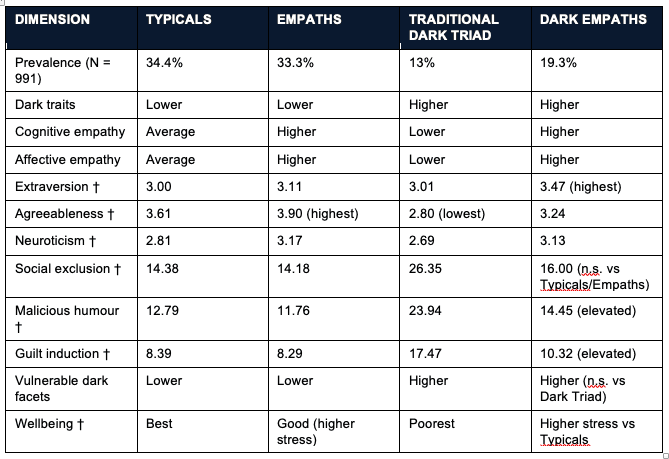
† Derived from sub-cohorts in which the Dark Empath cell comprised approximately 31 participants. Treat as preliminary. n.s. = not statistically significant.
5.2 Reading the Table
Three patterns are worth extracting.
First, on every dimension that concerns what the person is like internally — dark trait facets, vulnerable narcissism, primary and secondary psychopathy, Machiavellian orientation — the Dark Empath and the traditional Dark Triad are statistically the same group.
Second, on every dimension that concerns how the person appears and behaves socially — extraversion, agreeableness, aggression, wellbeing — they diverge, and the Dark Empath is consistently closer to the general population.
Third, the Dark Empath is the only profile in the table that is simultaneously socially rewarded and meaningfully antagonistic. Extraversion predicts leadership emergence, interview performance, network centrality and promotion across a large organisational literature. Agreeableness in the low-to-middling range does not much impede advancement and, in competitive environments, can assist it. This combination is not a disadvantage in an organisational hierarchy. It is close to an optimal one.
That observation should be labelled for what it is: an inference from the trait profile combined with the separate literature on extraversion and career outcomes. Heym et al. did not study occupational attainment, and there is no direct evidence that Dark Empaths are over-represented in senior roles. It is a plausible hypothesis, not a finding, and readers should treat any source that states it as established with scepticism.
PART III — THE WORKPLACE
Chapter 6: Manifestation and Consequence
6.1 Why the Organisational Case Is Distinct
Most writing about difficult personalities in intimate relationships transfers poorly to organisations, because organisations have three features that private life does not: formal processes, documentary records, and third-party observers with authority.
Those features are usually described as protections. For the specific behavioural profile identified in the Heym data, they function closer to the opposite.
Consider what a grievance process is built to handle. It requires an identifiable act, occurring at an identifiable time, that a reasonable person would recognise as a breach of a stated standard, and that can be corroborated. It is well designed for the behaviours the traditional Dark Triad scores highest on: overt exclusion from meetings and information, hostility that witnesses can describe, conduct that maps to a policy clause.
Now consider the two behaviours that actually distinguish Dark Empaths from ordinary colleagues. Malicious humour and guilt induction are, structurally, the two forms of interpersonal harm least susceptible to that process.
A joke has deniability built into its grammar. The response to an objection — that it was a joke, that no offence was intended, that the objector seems to be having a difficult week — is not an evasion bolted on afterwards. It is available in advance, which is part of what makes the form attractive. To sustain a complaint, the complainant must argue that a remark which others found funny was in fact targeted, and must do so while appearing not to lack a sense of humour. Most people decline that trade.
Guilt induction is harder still, because the mechanism operates through the target's own values. A person who has been made to feel indebted has not been subjected to an act; they have been placed in a state. There is no moment to point to. The most accurate description a complainant can usually give is that they felt obliged to agree, and felt bad about not agreeing — which reads, in a written statement, as a description of the complainant's psychology rather than the other party's conduct.
Add the extraversion finding and the picture becomes structurally difficult. The person against whom such a complaint is made is likely to be well regarded, socially connected, and articulate about others' emotional states. In an investigation that turns on credibility, those are considerable assets.
6.2 The Caring Manager
The most common organisational presentation is the leader whose emotional attentiveness is real, accurate, and directed towards their own interests rather than the interests of the person being read.
It is worth being precise about what is and is not being claimed. The attentiveness is not fake. On the self-report data, this group's empathy is genuinely elevated. The manager who notices that a team member is struggling is actually noticing. The difference lies in what happens to the information afterwards — whether it is used to support the person, or retained as an asset.
In practice, the pattern that colleagues describe tends to include some combination of the following. Support offered visibly, in settings where it is observed, alongside private commentary that qualifies or undermines it. Information disclosed in confidence resurfacing later, framed as concern, in contexts where it reduces the discloser's standing. Rapport that operates on a ledger, in which warmth is extended and a corresponding obligation is understood to exist. A marked preference for one-to-one interaction over group settings, which limits the opportunity for others to compare accounts. And a response to challenge that reframes the challenge as a symptom of the challenger's state rather than a substantive objection.
That list is a synthesis of the trait profile and general organisational-behaviour knowledge. It should not be presented as a validated instrument, because no such instrument exists for this construct. There is no published screening tool for Dark Empathy, no workplace validation study, and no occupational sample. Anyone offering a definitive workplace checklist is extrapolating, as this section is — the difference being that this section says so.
6.3 Death by a Thousand Small Things
The cumulative form is the one that causes most organisational damage, and it follows directly from the aggression data.
An individual instance of malicious humour is trivial. That is not a weakness of the mechanism; it is the mechanism. Each event is calibrated to sit below the threshold at which a reasonable person would escalate. The harm is produced by frequency and pattern, not by severity, and the organisation's detection apparatus is tuned almost entirely to severity.
This produces a characteristic sequence. The target notices a persistent discomfort they cannot articulate. Because they cannot articulate it, they doubt it — and doubt is reinforced by every colleague who reports finding the person delightful. The target either says nothing, or says something and is met with the observation that they seem to be taking things personally. Over time, the accumulated small events produce an effect indistinguishable in outcome from more overt hostility: withdrawal, disengagement, and eventually exit.
The exit interview then records a reason that has nothing to do with any of this, because there is no box for it and no vocabulary the departing employee trusts. The organisation loses a capable person and learns nothing.
The relevant organisational insight is that a system which requires a threshold event will never detect a pattern built specifically to avoid one. Detection has to come from a different source: aggregated, longitudinal, and non-incident-based — patterns in turnover by manager, in engagement scores that diverge from performance scores, in the distribution of who requests transfers. None of that identifies an individual as anything, and it should not be used to. It identifies where to look more carefully.
6.4 The Empathy Training Problem
This section makes an argument rather than reporting a finding, and it is labelled accordingly.
Empathy and emotional intelligence training is among the most widely deployed interventions in organisational development. Its logic is that improved capacity to recognise and interpret others' emotional states will produce better interpersonal conduct, because the mechanism assumed to prevent harm is understanding.
The Heym data complicate that logic. If the group most inclined towards indirect antagonism already has elevated empathy — if elevated empathy did not prevent the antagonism, and the specific channels through which the antagonism runs are ones that require accurate reading of others — then a general intervention which improves emotional reading has an ambiguous expected effect within that subgroup. It may improve conduct. It may improve targeting. The trait data alone do not tell us which.
There is a supporting strand in the wider literature. Björkqvist et al. (2000) found that social intelligence, once empathy is partialled out, is positively associated with indirect aggression. Davis and Nichols (2016) review evidence that emotional intelligence carries a dark side, conferring advantage in emotional manipulation. Nagler et al. (2014) report that dark personalities use emotional intelligence to manipulate others emotionally. None of these tested a training intervention, and none involved Dark Empaths as a defined group.
The inference is therefore this, stated with its limits: interventions that build emotional perception without simultaneously addressing prosocial motivation may be poorly targeted for the subgroup most likely to misuse the capability. The practical implication is not to stop empathy training. It is to be clear that the training's assumed causal pathway — understanding produces care — is an assumption rather than a demonstrated fact, and that programmes which include an explicit ethical and motivational component are on safer theoretical ground than those which teach perception alone.
No study has tested this. It is a hypothesis derived from trait data, and it is offered as one.
PART IV — CONTESTED GROUND
Chapter 7: More Dangerous, or Differently Detectable?
7.1 The Case That the Dark Empath Is Less Harmful
The strongest version of this position comes from the founding study itself, and it is well supported.
On every measured behavioural outcome, the Dark Empath performed better than the traditional Dark Triad. Indirect aggression was substantially lower across all three subscales, with the gap between the two groups considerably larger than the gap between Dark Empaths and the general population. Agreeableness was higher. Anxiety was lower, social anhedonia was lower, and capacity for pleasure in close relationships was greater.
The authors' summary is that the Dark Empath shows a more adaptive level of psychosocial functioning than the traditional Dark Triad, and that the presence of empathy did not increase vulnerability. If the question is which group is more likely to cause severe harm to any given person in any given interaction, the evidence points clearly at the low-empathy profile.
There is also a straightforward theoretical account. Empathy does appear to function as a partial brake. It is not a complete brake — the antagonistic core is intact and the elevated malicious humour and guilt induction demonstrate that — but the direction of the effect is protective. That is consistent with the traditional view of empathy's role, and it is a finding in favour of the mainstream position rather than against it.
7.2 The Case That the Dark Empath Is More Consequential
The counter-argument does not dispute any of the above. It disputes the question.
Severity per incident is not the only dimension on which harm can be measured. The second dimension is exposure: how many people encounter the behaviour, for how long, before anything is done. And on that dimension the traits run in the opposite direction.
The traditional Dark Triad profile is comparatively easy to identify. Low agreeableness, low extraversion, overt aggression across all channels, and poorer wellbeing produce a person whom colleagues tend to recognise as difficult relatively quickly, and whose behaviour is more likely to generate a documentable incident. The organisational immune response, imperfect as it is, has something to bind to.
The Dark Empath profile produces the inverse. High extraversion and functioning empathy generate access, trust and social capital. The behavioural channels that remain elevated are precisely the two that formal processes handle worst. And the observers who might otherwise corroborate a complaint are, in many cases, people who have experienced the same person as unusually kind — and who will say so, sincerely.
So the same trait profile that makes this group less harmful per incident makes it more likely to remain in place, in proximity to people it affects, for longer.
7.3 Resolving It Honestly
The resolution is to stop treating 'dangerous' as a single scale.
Two separate axes are in play. On severity of harm per incident, the evidence supports the traditional Dark Triad as higher, and the margin is not close. On probability of harm persisting undetected or unaddressed, the reasoning supports the Dark Empath as higher — though this second axis is an inference from the trait profile and the structure of organisational processes, not a directly measured finding.
Framing it this way avoids two failures. It avoids the sensationalist claim that the Dark Empath is the most dangerous personality profile, which the aggression data flatly contradict. And it avoids the dismissive conclusion that because they are less aggressive they are not a problem, which ignores the exposure dimension entirely.
One further caveat is required. Some secondary sources assert that follow-up research has found Dark Empath aggression approaching that of the traditional Dark Triad. This claim appears in commercial health-content and commentary sources without a named, retrievable study attached. It should not be treated as established. If such a study exists in peer-reviewed form, it would materially change the picture set out above — which is precisely why it should not be cited until it can be identified and read.
Chapter 8: The Other Dark Side of Empathy
8.1 A Different Phenomenon in the Same Conversation
Two distinct ideas circulate in the same online space under overlapping language, and conflating them causes real harm.
The first is the Dark Empath: elevated empathy alongside elevated antagonism, with the empathy doing nothing to prevent — and possibly shaping — indirect aggression.
The second is the risk that excessive empathy poses to the person who has it. Huang et al. (2025), reviewing human and animal evidence in Biological Psychiatry, examine empathy's negative implications for mental health. Their conclusion is that high levels of affective empathy in particular can produce overwhelming emotional states, heightening empathic distress and contributing to internalising disorders, depression, anxiety, emotional over-involvement, burnout, vicarious trauma and post-traumatic stress.
This has nothing to do with dark traits. It concerns people whose affective empathy is high and whose regulation of it is insufficient — a group heavily represented in caring professions, in healthcare, in social work, and in the population of managers who absorb their teams' distress as a matter of course.
8.2 Why the Distinction Matters Practically
The Heym data contain a quiet corroboration of this second phenomenon. Recall the neuroticism finding: both high-empathy groups scored above both lower-empathy groups, with ordinary Empaths highest of all. Recall the self-judgment finding: harsh self-judgment was shared by Empaths and Dark Empaths alike, leading the authors to characterise it as an epiphenomenon of empathy rather than a marker of darkness. And recall that ordinary Empaths scored significantly higher than Typicals on depression and stress.
In other words, within the study most often cited to show that empathy can be weaponised, the group carrying the clearest psychological cost of empathy is the ordinary, entirely benign, high-empathy group.
This matters for how the topic is communicated. A meaningful share of any audience reading about Dark Empaths is not worried about a colleague. They are recognising something in themselves — the exhaustion of absorbing other people's states, the difficulty of setting limits, the harsh internal commentary. For those readers the relevant literature is not the Dark Triad literature at all. It is the empathic distress literature, and the appropriate response is regulation and boundaries rather than vigilance.
Conflating the two produces a specific and predictable harm: highly empathic people concluding that their empathy is suspect. Nothing in the evidence supports that conclusion.
Chapter 9: Is the Construct Sound?
9.1 The Replication Question
No account of the Dark Empath is complete without addressing whether the construct has held up. It has held up partially, and the qualifications are substantial.
Fino et al. (2023), a team including Heym herself, conducted a latent profile analysis of Dark Tetrad traits and trait emotional intelligence, examining the resulting profiles against maladaptive personality trait domains. The study did not recover a clean Dark Empath profile of the kind identified in 2021. That is not a straightforward failure to replicate — the measures differ, trait emotional intelligence is not the QCAE, and the addition of sadism changes the trait space — but it is a caution against assuming the four-profile structure is stable across instruments.
Grabovac et al. (2025), publishing a network analysis of Dark Triad traits and domains of emotional functioning in the International Journal of Psychology, raise a more pointed challenge. Their results did not confirm the existence of Dark Empaths, on the grounds that relationships between ability-based cognitive empathy and dark traits were negative or non-significant.
9.2 The Self-Report Problem
That last point identifies the construct's central methodological vulnerability, and it deserves to be stated directly.
Every empathy measurement in the founding study was self-report. The QCAE asks people to rate how well statements about their own empathic tendencies describe them. It does not test whether they can accurately identify what another person is feeling.
Consider what that means for a group defined by elevated narcissism, elevated Machiavellianism and elevated psychopathy. These are traits associated with self-enhancement, impression management and strategic self-presentation. A high score on self-reported empathy from such a respondent admits at least two interpretations: that the person genuinely has elevated empathic capacity, or that the person is inclined to describe themselves favourably — including on a dimension that is socially prized.
The Dark Empath finding requires the first interpretation. The second cannot be excluded from the data as collected. And Grabovac et al.'s finding — that the profile weakens when empathy is measured as an ability rather than a self-description — is exactly the result the second interpretation predicts.
This does not dissolve the construct. Two things about the founding study are relatively robust to this critique. The prevalence finding stands on the largest sample and the primary analysis. And the aggression findings do not depend on empathy being genuine: a group exists which reports high empathy and also reports elevated malicious humour and guilt induction, and that behavioural pattern is real whatever the empathy scores mean.
But it does change the confident causal story. The claim 'they understand you perfectly and use it against you' rests on an interpretation of self-report data that a subsequent ability-based study did not support. The claim 'a meaningful minority of people combine antagonistic traits with a warm, socially fluent presentation, and their antagonism runs through channels that formal processes miss' rests on firmer ground.
The second claim is less dramatic. It is also the one that survives scrutiny, and it is sufficient for every practical purpose in this article.
PART V — APPLICATION
Chapter 10: A Defensible Framework
10.1 The Governing Principle
The framework below begins from a constraint rather than a technique: you cannot diagnose anyone, and you should not try.
The Dark Empath is a statistical profile derived from self-report questionnaires in non-clinical samples. It has no diagnostic criteria, no validated screening instrument, no occupational normative data, and a contested replication record. Applying it to a named individual — a manager, a colleague, a partner, a public figure — is not a use the evidence supports.
What the evidence does support is a shift in what you attend to. The practical value of this literature is not that it lets you identify a person. It is that it removes warmth from your list of exculpatory evidence.
10.2 Observation: What to Attend To
The following signals are derived from the behavioural findings in Heym et al. (2021) combined with standard organisational-behaviour reasoning. They describe patterns, not incidents, and none of them individually indicates anything.
- Consistency across audiences. Does the person's characterisation of a third party change materially depending on who is present? This is the single most informative observable, because it requires no interpretation of intent.
- The direction of the ledger. Over a period of months, does the relationship run reciprocally, or does one party consistently accumulate obligation? Guilt induction is the elevated channel; a persistent sense of owing is its trace.
- Humour that lands on the same person. Individual jokes are meaningless. A distribution in which the target is consistently the same person, and consistently that person's known sensitivity, is not.
- What happens to disclosed information. Confidences that resurface, framed as concern, in settings where they reduce the discloser's standing.
- The response to challenge. Whether an objection is engaged on its substance, or reframed as evidence about the objector's state of mind.
- Setting preference. A marked and sustained preference for one-to-one interaction, in circumstances where group settings would be normal, limits corroboration.
10.3 Response: What Actually Helps
Response strategies follow from the structural analysis in Chapter 6. The problem is evidential, so the response is evidential.
Document contemporaneously and factually. Record what was said and when, in plain descriptive language, close to the time it happened. Avoid interpretation, characterisation and diagnosis — a record that says 'in the 14 May team meeting, X said Y' is durable; a record that says 'X was being manipulative' is not. This is the single highest-value action available, because the specific harm pattern is one that accumulates below the threshold of memory.
Trust the persistent feeling enough to start a record, not enough to reach a conclusion. A diffuse and hard-to-name discomfort is not proof of anything. It is, however, a legitimate reason to begin writing things down. The record will subsequently show either a pattern or the absence of one, and both outcomes are useful.
Seek outside perspective early. The described dynamic operates partly by making the target doubt their own reading. Self-assessment is therefore the least reliable available instrument. A mentor, a trusted peer outside the reporting line, or an HR professional can assess whether the documented pattern reads as significant to someone with no stake in it.
Limit disclosure, proportionately. Information about vulnerabilities is the raw material for both elevated channels. This is not an argument for guardedness as a general professional posture, which carries its own costs. It is an argument for calibrating disclosure to demonstrated reciprocity rather than to demonstrated warmth.
Hold explicit boundaries in writing. Guilt induction operates on ambiguity about what is owed. Confirming agreements in writing — what was asked, what was agreed, what the deadline is — removes the ambiguity the mechanism requires.
Escalate on patterns, not incidents. A single instance will not survive a formal process, and an unsuccessful early escalation makes a later one harder. Escalate when the record shows repetition, and present it as a documented pattern rather than a characterisation of the person.
10.4 For Organisations
Three implications follow at the system level.
First, incident-triggered detection will not find this pattern, by construction. Organisations serious about it need aggregated indicators that do not depend on anyone making a complaint: turnover and transfer requests disaggregated by manager, engagement scores that diverge from performance outcomes, and exit interview themes analysed longitudinally rather than case by case. None of these identify an individual. They identify where to look.
Second, investigations should be designed on the assumption that credibility contests favour the socially fluent party. That is not a reason to lower evidential standards. It is a reason to weight contemporaneous documentation appropriately, and to be alert to the difference between 'no corroborating witnesses' and 'no witnesses who experienced the behaviour themselves'.
Third — and returning to Chapter 6.4 — organisations should be clear-eyed that emotional intelligence training rests on an assumed causal pathway. Programmes that develop perception alongside explicit ethical and prosocial framing are on better theoretical footing than those that treat emotional reading as self-evidently virtuous.
Chapter 11: Conclusion
11.1 What the Construct Actually Reframes
The Dark Empath does not tell us that there is a new and more frightening kind of person in the world. The behavioural data say something almost opposite: this group is markedly less aggressive than the profile we already knew about.
What it reframes is the reliability of a heuristic that nearly all popular guidance depends upon.
That heuristic — watch for coldness, and treat warmth as reassurance — is not merely incomplete. It is inverted with respect to the larger of the two dark groups in the founding sample. Nineteen per cent of that sample combined elevated antagonistic traits with elevated empathy and the highest extraversion of any profile. Thirteen per cent matched the description the heuristic was built for. If the sample is anywhere near representative, most people trying to protect themselves by watching for emotional coldness are calibrated against the minority case.
The correction is not to become suspicious of warmth, which would be both miserable and wrong — a third of that sample were ordinary Empaths, and the largest cost of empathy in the entire study was borne by them. The correction is narrower. Warmth is evidence about someone's manner. It is not evidence about their conduct. The two are usually related, and this literature describes the substantial minority in whom they are not.
11.2 What Remains Unknown
It is worth ending on the size of the gap between what is claimed about this construct and what has been shown.
One study established the profile. Its behavioural findings rest on approximately thirty participants. Its empathy measurement was entirely self-report, in a group whose defining traits include self-enhancement. A subsequent network analysis using ability-based measures did not confirm it. There is no occupational research, no longitudinal research, no clinical validation and no intervention evidence. Almost everything written about how Dark Empaths behave at work — including sections of this article, which say so — is extrapolation.
That is not a reason to dismiss the construct. Early findings are how fields advance, and this one identified something the prevailing theory said should be rare and found it to be common. It is a reason to hold the practical conclusions loosely and to be suspicious of anyone who does not.
11.3 The Accurate Version of the Hook
The framing that circulates most widely is that the most dangerous manipulator is the one who reads you perfectly and feels nothing.
Both halves of that require correction. The evidence does not establish that they read you perfectly — self-reported empathy is not demonstrated accuracy, and the one study that tested accuracy directly did not confirm the profile. And they do not feel nothing; that is precisely what makes the group distinctive, and precisely what the founding study set out to test.
The accurate version is less quotable and considerably more uncomfortable. A meaningful minority of people carry the full antagonistic trait structure — the callousness, the exploitative orientation, the entitlement — alongside a genuine, self-reported capacity to understand and share what others feel. In that group, empathy does not remove the antagonism. It appears to change its shape, into forms that require knowing someone well: the joke that finds the soft place, and the obligation that was never quite agreed to.
They feel enough to know where it lands. That is not an absence of feeling. It is something harder to think about.