
PART I — FOUNDATIONS: WHAT IS PERSONALITY AND CAN IT REALLY CHANGE?
Chapter 1: The Architecture of Personality
1.1 An Unexpected Metamorphosis
James had built a successful career in management consulting on the back of a personality profile that his colleagues would have described, diplomatically, as 'analytically intense.' He was meticulous, methodical, and spectacularly uncomfortable in rooms full of people who wanted to talk before the spreadsheets were finished. He avoided presentations. He deflected social events. He found small talk — his word — 'a form of psychological torture.'
By his mid-forties, James had concluded, with the certainty of a man who had read too many fixed-mindset articles, that this was simply who he was. Introverted. Reserved. Wired that way. So when his firm asked him to lead a high-visibility client engagement that would require sustained public presence — keynotes, panel appearances, client dinners — he sat across from an executive coach and told her, without drama, that he did not think he could do it.
Three years later, the same James presents to rooms of three hundred people with a confidence that, by his own account, 'feels genuine, not performed.' He still values solitude. He still reaches for data before narrative. But he has expanded, as he puts it, 'the range of things I can do without it costing me.' He is not a different person. He is, in some meaningful sense, a fuller version of the same person.
Is James exceptional? Or is what happened to him — deliberate, sustained, structured personality change — something that the science now says all of us can do?
That is the question at the heart of this article, and of the multi-episode series it underpins. The answer, as you will discover, is both more optimistic and more complicated than the popular psychology headlines would have you believe.
But before we can understand how personality changes, we need to understand what personality actually is.
1.2 What We Mean by 'Personality'
The word 'personality' is one of psychology's most promiscuously used terms. In everyday language, it describes everything from social charm ('she has great personality') to the unique configuration of a person's inner life ('his personality is complex'). In clinical contexts it takes on a more technical flavour — personality disorder, personality assessment, personality type. In management training it is routinely conflated with communication style, working preferences, or whatever the latest leadership framework happens to measure.
For the purposes of this article, and of the scientific literature it draws upon, personality is defined with considerably more precision. Personality traits are the relatively enduring patterns of thoughts, feelings, and behaviours that distinguish individuals from one another and remain consistent across situations and over time (Roberts, 2009). The word 'relatively' is doing important work in that definition, as we will see. Traits are not perfectly fixed. But they are not infinitely flexible either. They occupy the middle ground — stable enough to be recognisable and predictively useful, malleable enough to shift meaningfully under the right conditions.
It is equally important to understand what personality traits are not. Traits are not moods — the transient emotional states that fluctuate across hours and days. Nor are they habits, which are automatic behavioural responses to specific triggers. They are not values, which are motivational goals and principles. And they are emphatically not types — the categorical boxes that popular models like the Myers–Briggs Type Indicator attempt to sort people into. Personality traits are dimensions: continuous spectra along which individuals are distributed, with most people occupying the middle rather than the extremes.
1.3 The Brief History: From Allport to the Big Five
The systematic scientific study of personality has a history stretching back nearly a century. Gordon Allport, writing in the 1930s, first attempted to identify personality traits by cataloguing every adjective in the English language that described a stable individual difference — an exercise that produced a list of nearly 18,000 terms (Allport & Odbert, 1936). The obvious question was whether these thousands of descriptors could be reduced to a smaller, more tractable number of underlying dimensions.
Raymond Cattell used factor analysis to whittle Allport's list to 16 source traits. Hans Eysenck proposed a parsimonious model of just three dimensions. But it was the convergence of multiple independent research programmes across the 1980s and early 1990s — Paul Costa and Robert McCrae working with the NEO inventory, Warren Norman and his lexical analyses, Lewis Goldberg with his natural language studies — that produced what is now the dominant framework in personality science: the Five-Factor Model, also known as the Big Five (John, Naumann, & Soto, 2008).
The Big Five emerged not from a single theorist's insight but from repeated discoveries, using independent methods in multiple countries and over multiple decades, that human personality could be reliably described by five broad dimensions. This convergent validity — the fact that radically different approaches consistently identified the same five factors — is the primary source of the model's scientific credibility (McCrae & John, 1992). It is not a perfect model. No model is. But it is the best-validated, most widely researched taxonomy of personality that psychology has produced, and it is the framework upon which virtually the entire VPC literature is built.
1.4 The Big Five: A Working Map
Each of the Big Five dimensions represents a spectrum — a continuum along which individuals vary — rather than a dichotomy. High and low scores are not intrinsically good or bad; they represent different adaptive strategies, each with distinct strengths and limitations in different contexts. This is what we mean on keca.co.uk when we say that personality is 'a dial, not a box.'
Openness to Experience
Openness to Experience (or simply Openness) encompasses intellectual curiosity, aesthetic sensitivity, imaginative thinking, and receptivity to novel ideas and experiences. High scorers are creative, original, and drawn to complexity and ambiguity. Low scorers tend to be practical, conventional, and prefer the familiar and concrete. The facets of Openness include Fantasy, Aesthetics, Feelings, Actions, Ideas, and Values (Costa & McCrae, 1992). In the VPC literature, Openness is notably resistant to deliberate change — it is the trait for which we have the weakest evidence of intervention, possibly because its roots lie deeper in intellectual temperament and perceptual processing than in readily modifiable social behaviours.
Conscientiousness
Conscientiousness covers organisation, self-discipline, dutifulness, achievement striving, and goal-directed behaviour. High scorers are reliable, hardworking, and structured; low scorers tend toward spontaneity, flexibility, and a more relaxed attitude toward obligations. The facets include Competence, Order, Dutifulness, Achievement Striving, Self-Discipline, and Deliberation. Conscientiousness has the strongest relationship with life outcomes of any Big Five trait — it predicts career success, academic achievement, health behaviour, and longevity — and it is one of the most commonly targeted traits in VPC interventions (Roberts et al., 2007). The existing keca.co.uk article 'Conscientiousness: The Trait That Runs Your Life' provides a comprehensive treatment of this dimension; readers familiar with that piece will find this chapter enriches and extends it.
Extraversion
Extraversion describes sociability, assertiveness, positive emotionality, and the tendency to seek and enjoy social stimulation. High scorers are energised by social interaction, talkative, and experience frequent positive affect. Low scorers (introverts) find social engagement more taxing, prefer smaller groups and deeper conversations, and draw their energy from solitude rather than company. The facets include Warmth, Gregariousness, Assertiveness, Activity, Excitement Seeking, and Positive Emotions. Extraversion is particularly relevant to VPC because it is among the traits most commonly targeted for change — most people who want to change Extraversion want to increase it — and it is one of the better-evidenced targets for deliberate intervention (Haehner et al., 2024).
Agreeableness
Agreeableness reflects cooperation, trust, empathy, and prosocial orientation. High scorers are warm, altruistic, and accommodating; low scorers tend toward competitiveness, scepticism, and a harder-edged approach to interpersonal conflict. The facets include Trust, Straightforwardness, Altruism, Compliance, Modesty, and Tendermindedness. Agreeableness occupies an interesting position in the VPC literature: people who score low on it are not the most common seekers of personality change (because subclinical antagonism tends to accompany limited self-awareness of its costs to others), yet Agreeableness is the trait for which current intervention approaches have produced the weakest evidence. Hudson (2024) describes it as the 'hard case' for VPC research.
Neuroticism
Neuroticism (sometimes framed positively as Emotional Stability at the low end) describes the tendency to experience negative emotions — anxiety, sadness, anger, self-consciousness, irritability — readily and intensely. High scorers are emotionally reactive and more vulnerable to stress and psychological distress. Low scorers (high Emotional Stability) tend toward equanimity, calm, and resilience in the face of adversity. The facets include Anxiety, Angry Hostility, Depression, Self-Consciousness, Impulsiveness, and Vulnerability. For the VPC literature, Neuroticism is the most important trait: it is the most commonly targeted for deliberate change, the trait that responds most strongly to both clinical interventions and structured VPC programmes, and the one for which the evidence of genuine, durable change is most robust (Roberts et al., 2017; Haehner et al., 2024). The keca.co.uk article 'Neuroticism: The Smoke Alarm in Your Head' notes that Neuroticism may be 'the most changeable Big Five trait' — a claim that the VPC literature substantially supports.
◼ EXPLAINER: What is a trait?
A personality trait is a statistical abstraction: a description of the average tendency of a person's behaviour, thoughts, and feelings across situations and over time. It is not a prediction of any single act. A highly conscientious person still sometimes leaves things until the last minute; a highly neurotic person still experiences joy and calm. Traits tell us about tendencies and distributions, not certainties. This is why the whole-trait framework (Fleeson & Jayawickreme, 2015) — which describes traits as density distributions of states — is so theoretically important for understanding personality change: if a trait is a distribution of states, then shifting that distribution is the mechanism of change.
1.5 Beyond the Big Five: Broader Frameworks
The Big Five is not the only model of personality worth knowing about, though it is the one that underpins virtually the entire VPC literature. Several extensions and alternatives deserve brief acknowledgement.
The HEXACO model (Ashton & Lee, 2007) adds a sixth factor, Honesty-Humility, capturing individual differences in sincerity, fairness, greed avoidance, and modesty. Honesty-Humility has proven particularly valuable in organisational psychology and in the study of dark personality traits, complementing the Big Five's coverage without displacing it.
The Dark Triad and its expanded cousin the Dark Tetrad (narcissism, psychopathy, Machiavellianism, and sadism) describe a cluster of socially aversive personality characteristics that sit at the low end of Agreeableness and (partially) low Conscientiousness but are not fully captured by the Big Five. The keca.co.uk article 'Shadows in the Machine' addresses the Dark Tetrad in depth.
An emerging and potentially important distinction is between personality traits and social-emotional-behavioural (SEB) skills. Thielmann, Spadaro, and Rauthmann (2025), in a preprint from Utrecht University and the University of Padua, argue that individuals perceive it as both more desirable and more feasible to change specific skills — such as emotional regulation, assertive communication, or empathic responding — than to change abstract traits such as 'Extraversion' or 'Neuroticism.' This reframing has significant implications for intervention design: trait change may be a downstream consequence of skill acquisition, making skills-focused approaches more engaging and motivationally accessible to people who balk at the abstraction of trait-level goals.
Throughout this article, however, the Big Five / Five-Factor Model remains the primary framework, because it is the one upon which the scientific VPC literature is built and the one whose measurement tools are most rigorously validated.
1.6 The Operating System Metaphor — and Its Limits
In the foundational keca.co.uk article 'The Hidden Operating System of Behaviour,' personality is described as the operating system of human behaviour: the underlying architecture that runs in the background, shaping how we process information, generate responses, and relate to the world, largely without our conscious awareness.
It is a useful metaphor, and this article extends it deliberately: if personality is an operating system, can it be updated? Can old routines be overwritten? Can new modules be installed? The VPC literature's answer, we will see, is a qualified yes — but the update process is nothing like the frictionless software patch we might imagine. It requires months of sustained effort, structured practice, and careful design. It can fail. It can, in some circumstances, produce unintended consequences. And the question of whether the update is genuinely installing new capacity or merely creating a convincing interface over the same underlying code, is one that personality science has not yet fully resolved.
But it can be done. And that, for many people, is a profound and important discovery.
Chapter 2: The Stability–Change Paradox
2.1 The Case for Stability
The scientific case for personality stability is not a straw man. It rests on a century of measurement and a literature of extraordinary depth. When personality researchers track individuals across years and decades — administering the same personality questionnaires at multiple time points — they find something remarkably consistent: people's relative standing on personality traits tends to persist.
The landmark meta-analysis by Roberts and DelVecchio (2000), synthesising data from 152 longitudinal studies involving more than 50,000 participants, established that rank-order stability — the degree to which individuals maintain their relative position compared to peers — typically produces correlations between r = .50 and r = .70 over five-to-ten-year intervals. That is to say, if you were in the top quarter of your peer group on Conscientiousness today, the probability is considerably better than chance that you will still be in the top quarter a decade from now. Roberts and DelVecchio also found that stability increases with age, peaking in the 50s and 60s — though this 'plaster sets at 30' conclusion has since been substantially revised.
The genetic architecture of personality provides another source of evidence for stability. Twin studies consistently estimate the heritability of Big Five traits at between 40% and 60% (Bouchard & Loehlin, 2001), meaning that roughly half the variance in personality traits is attributable to genetic factors. Gene–environment correlations further entrench this stability: people tend, through their own choices and behaviours, to select and create environments that reinforce their existing personality tendencies — a phenomenon known as niche-picking.
These findings — substantial heritability, moderate-to-high rank-order stability, and the systematic selection of trait-congruent environments — formed the empirical basis for what McCrae and Costa (1994) called the 'plaster hypothesis': the idea that personality hardens like plaster after early adulthood and is thereafter essentially fixed.
2.2 The Case for Change
And yet. Alongside this evidence for stability runs an equally robust body of evidence for change — and the two sets of findings are not actually contradictory. They answer different questions using different analytic lenses.
The most replicated finding in adult personality development is the 'maturity principle' (Roberts, Walton, & Viechtbauer, 2006). Synthesising longitudinal data across 92 studies and a combined sample of more than 50,000 adults, Roberts and colleagues found systematic, mean-level increases across adulthood in the traits associated with mature, social functioning: Conscientiousness, Agreeableness, and Emotional Stability (the inverse of Neuroticism) all tend to increase from young adulthood to midlife, while Social Dominance (a facet of Extraversion) increases in young adulthood before declining slightly in later life, and Social Vitality (a facet of warmth and sociability) declines modestly across the lifespan. These changes are not trivial: they are large enough to have meaningful effects on life outcomes and are replicated across cultures and measurement instruments.
The most recent and comprehensive treatment of lifespan personality development comes from Bleidorn and colleagues' 2024 Annual Review of Psychology chapter, which integrates data from cohort studies of unprecedented scale. This work confirms the maturity principal findings while adding important nuance: change is not uniform across the lifespan, not uniform across traits, and emphatically not uniform across individuals. The population-level trend toward greater Conscientiousness, Agreeableness, and Emotional Stability with age describes the average; individual trajectories deviate from this average in ways that are meaningful, systematic, and — crucially — predictable to a significant degree by early life circumstances and experiences.
At the facet level, the picture is still more complex (Bleidorn et al., 2024). Not all facets of a trait mature in the same direction. Within Extraversion, for example, Assertiveness (a dominance-related facet) shows a different developmental trajectory than Warmth (an affiliative facet). This facet-level heterogeneity is important for VPC: when people set goals to become 'more extraverted,' they may not be targeting a single coherent dimension but rather a cluster of distinct facets with different neural substrates, different developmental trajectories, and different responsiveness to deliberate intervention.
2.3 Resolving the Paradox: Different Questions, Different Answers
The apparent contradiction between stability and change dissolves once we recognise that the two bodies of evidence are answering fundamentally different questions.
Rank-order stability studies ask: do people maintain their relative position compared to their peers over time? The answer is largely yes, with correlations in the moderate-to-high range. But this tells us nothing about whether people's absolute trait levels change.
Mean-level change studies ask: do average trait levels shift across the population over time? The answer is also yes — and quite substantially across the lifespan. But this tells us nothing about whether any particular individual changes.
Individual-differences-in-change studies ask: do people differ from each other in how much and in which direction their personality changes? Here too the answer is yes — and this is the most directly relevant question for VPC research.
The key insight is that these three questions can all produce affirmative answers simultaneously without contradiction. A coastline metaphor captures the logic: the coastline is recognisably the same from year to year (rank-order stability), but its absolute position shifts continuously through erosion, deposition, and tidal action (mean-level change), and some sections change far more than others (individual variation in change). The question for VPC research is whether human agency — deliberate effort, structured intervention, sustained behavioural change — can function like the sea-wall engineer, shaping the coastline more deliberately than natural processes alone would permit.
◼ EXPLAINER: Three types of personality change
Mean-level change: The average level of a trait across a population shifts over time. Example: adults as a group become more conscientious between their 20s and 40s. | Rank-order change: Individuals move relative to their peers. Example: someone who was in the 60th percentile for Neuroticism at 25 drops to the 40th by 45. | Individual-level change: A specific person changes in their absolute trait level, regardless of what happens to the population average. VPC interventions target this third type of change — they aim to shift a specific person's trait level, not to alter population norms.
2.4 The TESSERA Framework: How Change Happens Over Time
Before we arrive at the deliberate interventions that constitute the heart of the VPC literature, it is worth establishing the theoretical framework that best explains how personality change occurs at all. The TESSERA model, developed by Wrzus and Roberts (2017), provides the most rigorous available account of the micro-level processes through which macro-level trait change accumulates.
TESSERA is an acronym: Triggering situations → Expectancies → States and State Expressions → ReActions. The model proposes that personality change — whether volitional or naturally occurring — unfolds through recursive cycles of these four components. A triggering situation (a performance review, a social gathering, a conflict with a colleague) activates trait-relevant expectancies ('I expect this to go badly' / 'I can handle this'). Those expectancies shape the emotional, cognitive, and behavioural states the person enters. Those states are expressed in observable behaviour, which generates reactions from the social environment and from the person themselves. Those reactions, repeated over many cycles, gradually shift the person's trait-level distribution.
What makes TESSERA particularly valuable for the VPC enterprise is that it identifies the specific leverage points where deliberate intervention can influence the chain. Structured VPC programmes can modify expectancies through psychoeducation and cognitive reframing. They can facilitate different state expressions through behavioural challenges and implementation intentions. They can create supportive environmental reactions through social accountability and coaching relationships. Sustained over months of repeated cycles, these interventions culminate in genuine trait-level change.
2.5 Life Events and Personality Change
One of the most compelling sources of evidence for personality malleability comes not from deliberate intervention but from the spontaneous changes associated with major life events. Roberts, Wood, and Smith (2005) proposed Social Investment Theory to explain this phenomenon: investing in adult social roles — becoming a partner, entering the workforce, becoming a parent, assuming leadership responsibilities — creates new expectations, new behavioural repertoires, and new identity commitments that gradually shift personality in the direction of the role's demands.
The empirical signature of this process is well-established. Entering a first serious romantic relationship is associated with decreases in Neuroticism and increases in Agreeableness. Entering stable employment is associated with increases in Conscientiousness. Becoming a parent produces complex, mixed effects that vary substantially across individuals and contexts. Beginning a leadership role is associated with increases in Social Dominance (an Extraversion facet). Retirement is associated with a modest softening of Conscientiousness, as the external structures that scaffolded organised behaviour recede.
These life-event-driven changes are directly relevant to VPC for two reasons. First, they confirm that adult personality is genuinely malleable — it changes in response to environmental demands, role investments, and social expectations. Second, they suggest that situational design — deliberately placing oneself in environments that make new trait expressions necessary and rewarding — may be a powerful mechanism for volitional change. This is the insight that Trait Activation Theory (Tett & Guterman, 2000) contributes to the VPC framework: traits are activated by trait-relevant situational demands; deliberately selecting or designing situations that activate the trait states you want to develop is itself a VPC strategy.
Bleidorn, Hopwood, and Lucas (2018) distil the life-event literature into a four-factor framework of personality change mechanisms: Preconditions (the baseline personality characteristics and circumstances that make change more or less likely); Triggers (the events, decisions, or role transitions that initiate change); Reinforcers (the ongoing environmental and social feedback that sustains change); and Integrators (the processes — particularly narrative identity integration — through which change becomes durable and self-consistent). This framework maps naturally onto the six-phase practitioner protocol developed in Chapter 12.
PART II — THE SCIENCE OF VOLITIONAL PERSONALITY CHANGE
Chapter 3: Who Wants to Change, and Why?
3.1 The Prevalence of Change Goals
Before asking whether personality can be deliberately changed, it is worth asking who wants to change it, and why. The answer turns out to be — nearly everyone.
Researchers Nathan Hudson and Chris Fraley (2015) were among the first to systematically document what they called 'volitional personality trait change': the explicit, self-conscious goal of modifying one's own personality. Their initial studies, conducted with US undergraduate samples, found that the vast majority of participants reported wanting to change at least one Big Five trait. The most commonly desired changes were increases in Emotional Stability (i.e., reductions in Neuroticism), increases in Conscientiousness, and increases in Extraversion.
Baranski and colleagues (2017) extended this inquiry to include lay theories of personality change — what ordinary people believe about the possibility and process of personality modification. They found that, while people generally regard personality as moderately stable, they do not regard it as immutable: most participants believed that personality change was possible and that personal effort could contribute to it. This 'implicit incrementalism' — the folk psychology of personality as malleable — is itself psychologically significant, because the belief that change is possible is a prerequisite for attempting it.
The most comprehensive assessment of the prevalence of personality change goals comes from Baranski and colleagues' (2021) landmark 56-country study, published in the Journal of Personality and Social Psychology. Across a sample of more than 13,000 participants from 56 nations, an extraordinary degree of cross-cultural consistency emerged: goals of personality change were near-universal. However, the prevalence varied dramatically: from 82% of participants in Thailand reporting a desire to change at least one trait, to 21% in Kenya. This variation — nearly a four-fold difference — provides a powerful reminder that the desire for self-transformation is not a universal human constant but a culturally situated aspiration, shaped by local norms around self-improvement, individual agency, and the malleability of character. Any VPC intervention or framework that is developed primarily for Western, educated, industrialised populations (the notorious 'WEIRD' sample problem) must acknowledge this cultural specificity.
Within the most commonly targeted traits, an important inverse relationship emerges: people who score low on a trait are the most likely to want to increase it (Baranski et al., 2020). The chronically disorganised want more Conscientiousness. The socially anxious want less Neuroticism. The reluctant loner wants more Extraversion. This is intuitive — people want more of what they perceive themselves to lack — but it has a less intuitive implication: the people most motivated to change may be those for whom change is most difficult, precisely because a low score on a trait often reflects the combined influence of temperament, habit, and years of trait-consistent environmental selection.
3.2 Motivations Behind Change Goals
Why do people want to change their personality? The motivations are diverse, and the source of motivation — whether genuine self-determination or external pressure — turns out to matter enormously for outcomes.
Self-Determination Theory (Ryan & Deci, 2017) distinguishes between autonomous motivation — wanting to change because you genuinely value the outcome, because it aligns with your identity and your sense of who you want to become — and controlled motivation — wanting to change because others expect it of you, because your job seems to demand it, or because you feel you 'should' even if you are not personally invested. This distinction may seem philosophical, but its practical implications are substantial. As we will see in Chapter 5, the research evidence suggests that Conscientiousness can change through repeated behavioural practice even without deep autonomous motivation. But Emotional Stability is different: Hudson (2021a) demonstrated that changes in Neuroticism require autonomous motivation to succeed. Feeling that you genuinely want to become calmer and more emotionally resilient, for your own reasons and on your own terms, appears to be a psychological prerequisite for the trait-level change that deliberate intervention aims to produce.
Self-Discrepancy Theory (Higgins, 1987) provides a complementary perspective. Higgins identified three self-representations: the actual self (how I currently am), the ideal self (how I aspire to be), and the ought self (how I believe I should be). Change goals emerge primarily from the gap between the actual and ideal self — an awareness of the meaningful distance between who you are and who you want to become. The magnitude of this discrepancy and the emotional valence associated with it (moving toward the ideal generates positive affect; failing to close the gap generates anxiety or dejection) shape both the intensity of the motivation to change and the emotional cost of failing to do so.
One of the more intriguing findings in the change-goals literature concerns how people narrate past changes in personality. Research by Hudson and colleagues found that approximately 18–20% of adults, when reflecting on personality changes, they had undergone, attributed those changes to their own deliberate efforts. The majority attributed change to life events, maturation, circumstances, or other people — external factors. This 'volitional attribution undercount' suggests that deliberate personality change is more common than people recognise in retrospect, and that the role of personal agency in their own development is systematically underestimated. For the VPC practitioner, this finding has a practical implication: helping people recognise the degree of personal agency they have already exercised in shaping their personality may itself be an important intervention.
3.3 Who Is Most Likely to Succeed?
The desire to change is near-universal. The ability to sustain the effort required is not. What predicts success in VPC attempts?
Baseline Conscientiousness is one of the most reliably identified predictors. The irony is stark but well-established: the trait most closely associated with self-discipline, goal persistence, and organised effort is also the trait most likely to determine whether someone can sustain a personality change programme over the weeks and months required for genuine trait-level shift. This poses a meaningful challenge for VPC interventions targeting Conscientiousness itself: the people most in need of the intervention may be least equipped to sustain it without substantial external scaffolding.
Thielmann and de Vries (2021) identified additional moderators of change goal formation and pursuit. Their research found that individuals with higher Openness scores were more likely to hold multiple change goals simultaneously (consistent with their broader curiosity and tolerance for complexity), whereas individuals higher in Conscientiousness were more likely to actively pursue their goals once formed. Agreeableness, interestingly, was associated with a higher likelihood of abandoning change goals when they conflicted with social relationships — a finding that sits in interesting tension with the Agreeableness VPC literature, where low scorers (who may be more internally focused and less concerned with social approval) might actually be better positioned to persist with socially disruptive change programmes.
The specificity and strength of motivation also matter. Baranski and colleagues (2020) found that participants who were more dissatisfied with their current personality showed stronger change goals — but also that the relationship between goal strength and actual change was moderated by perceived feasibility. Wanting to change is necessary but not sufficient; believing that change is possible and knowing how to pursue it are equally essential preconditions. This is precisely why the effective VPC interventions reviewed in Chapter 4 spend considerable effort on both psychoeducation (establishing that change is scientifically credible) and implementation planning (translating abstract goals into concrete, situation-specific action plans).
3.4 The Trait-Specificity of Change Goals
Not all personality change goals are equally accessible. Thielmann and de Vries (2021) demonstrated in a Journal of Personality and Social Psychology study that the desire to change and the perceived feasibility of change vary systematically by trait. People find it easier to imagine increasing their Openness than decreasing their Neuroticism, even though the evidence suggests the reverse is closer to the truth — Neuroticism is the most responsive to intervention, while Openness is among the least. This mismatch between lay beliefs about tractability and the actual scientific evidence is an important source of potential frustration and misaligned expectation in VPC programmes.
It also points to a potential advantage of the skills-versus-traits reframing proposed by Thielmann, Spadaro, and Rauthmann (2025). When change is framed at the level of specific, concrete skills — 'I want to get better at emotional regulation' or 'I want to practise assertive communication' — rather than at the level of broad personality dimensions, people tend to rate the goal as both more desirable and more feasible. This lower level of abstraction may reduce the psychological distance between current self and aspired self, making the change goal feel more achievable and the path toward it more visible.
Chapter 4: From Desire to Action — What the Evidence Says
4.1 The Central Question
Can people actually change their personality through deliberate effort? This is the question the VPC literature has spent the better part of fifteen years attempting to answer, and the honest summary of where the evidence stands is this: yes, with important qualifications, and with genuine uncertainties that the field has not yet fully resolved.
Three distinct phenomena must be carefully distinguished. Wanting to change is widespread. Trying to change is considerably rarer. Actually changing — producing a reliable, meaningful, durable shift in a personality trait — is rarer still and demonstrating that the change resulted from deliberate effort rather than natural development, life events, or measurement artefacts presents methodological challenges that the field continues to wrestle with.
With that caveat established, let us look at what the evidence actually shows.
4.2 Goals Alone Are Not Enough — and Can Make Things Worse
Hudson and Fraley's foundational experiments, published in 2015 in the Journal of Personality and Social Psychology, established several findings that have shaped the entire subsequent VPC literature. The most important of these concerns the relationship between change goals and actual change.
In their initial experiments, Hudson and Fraley found that simply forming the intention to change a personality trait — setting the goal, without any additional structure or support — did not reliably produce trait change over a sixteen-week intervention period. This was a significant and initially counterintuitive finding: strong, explicit motivation to change was not sufficient to produce the change.
What did predict change was behavioural follow-through: participants who not only set change goals but also formed specific implementation intentions — detailed 'if–then' plans specifying exactly what they would do, in which situations, to pursue their trait-change goal — showed measurably greater trait change over the intervention period. The gap between 'I want to be more conscientious' and 'if it is Sunday evening and I have unfinished work, then I will spend 30 minutes reviewing and planning the coming week' is, the evidence suggests, the gap between failure and success.
But the most alarming finding came later, and it demands prominent attention in any honest treatment of the VPC literature. Hudson and colleagues (2019) demonstrated what they called a 'boomerang effect': participants who set VPC goals but failed to follow through with the required behavioural challenges did not merely fail to change — they showed trait movement in the undesired direction. They became, in measurable terms, slightly less conscientious, slightly more neurotic, slightly more closed than they had been before setting the goal.
The mechanism is not fully established, but the most plausible explanation points to Self-Discrepancy Theory: the gap between intention and action increases the experienced discrepancy between actual and ideal self, generating dejection, demoralisation, and a negative self-evaluation cycle that actually worsens the trait pattern the person was trying to improve. The practical implication is stark and must be communicated with emphasis: any VPC framework that emphasises goal setting without providing robust behavioural support to ensure follow-through risks causing measurable psychological harm. The self-help industry's fetishisation of intention without equally rigorous attention to implementation is not merely ineffective — it may be counterproductive.
◼⚠CRITICAL WARNING: The Boomerang Effect
Setting a volitional personality change goal without the behavioural follow-through to support it does not merely fail — it can move your personality in the WRONG direction. This is one of the most important findings in the VPC literature (Hudson et al., 2019) and one of the most commonly ignored by self-help approaches. If you are designing a VPC programme for yourself or others, the first and most important design principle is this: never set a change goal without building a robust, specific, and scaffolded plan for behavioural execution. Goal-setting without action architecture is not harmless — it is actively counterproductive.
4.3 Structured Interventions: The Meta-Analytic Evidence
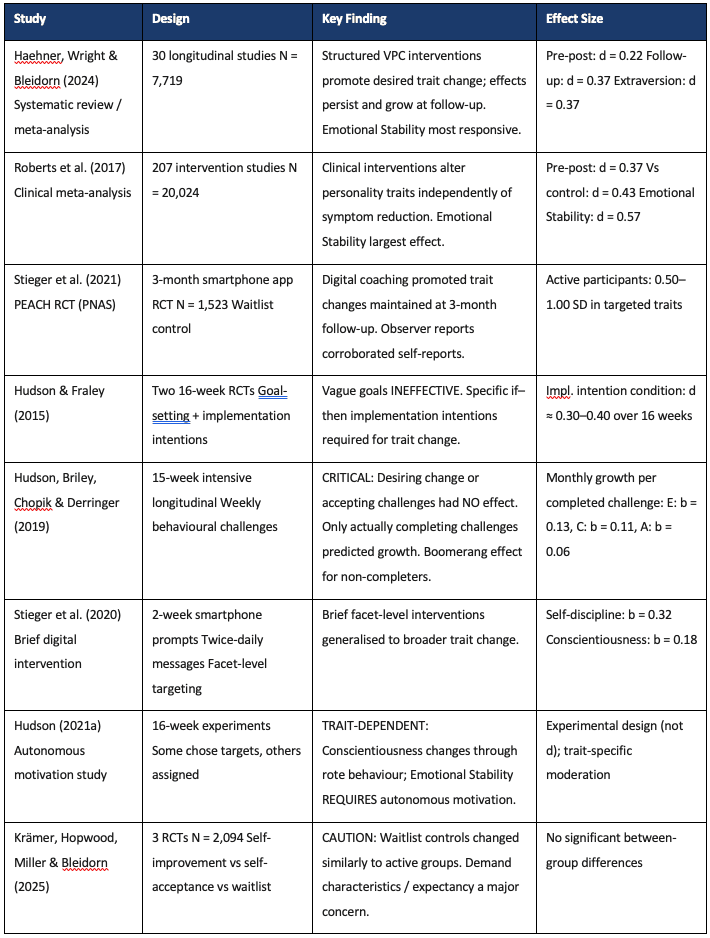
The most comprehensive synthesis of the VPC intervention literature to date is the systematic review and meta-analysis by Haehner, Wright, and Bleidorn (2024), published in Psychological Bulletin. Integrating findings from 30 longitudinal studies with a total of 7,719 participants, Haehner and colleagues found that structured VPC interventions — programmes involving goal articulation, implementation intentions, behavioural activation, self-monitoring, and feedback loops — produced reliable, statistically significant change in targeted personality traits.
The pooled pre-to-post effect size across all studies was d = 0.22 — a 'small' effect by conventional benchmarks, but one that is psychologically meaningful when sustained over time and across multiple life domains. More encouraging still, the effect size at follow-up assessments (conducted after the active intervention had ended) was d = 0.37 — larger than the immediate post-intervention effect, suggesting that change consolidated rather than decayed once the intervention concluded. For Extraversion specifically, the follow-up effect size reached d = 0.37, indicating moderate and durable change.
Roberts and colleagues' (2017) clinical meta-analysis provides complementary evidence from a different angle. Synthesising 207 intervention studies with a combined N of more than 20,000 participants, Roberts et al. found that therapeutic interventions (psychotherapy of various modalities) produced personality trait change with a pre-to-post effect size of d = 0.37, and an effect size of d = 0.43 when comparing treatment groups to controls. For Emotional Stability — the inverse of Neuroticism — the clinical intervention effect reached d = 0.57: a moderate-to-large effect that substantially exceeds what is typically observed in non-clinical VPC programmes. Crucially, the Roberts meta-analysis established that these personality changes emerged independently of symptom reduction — they were not merely a relabelling of 'felt better' as 'became more emotionally stable.' Genuine trait-level change, by this evidence, is achievable through structured therapeutic contact.
◼ EXPLAINER: Effect sizes
Effect sizes (expressed as Cohen's d) quantify the magnitude of a difference or change. A d of 0.20 is conventionally described as 'small,' 0.50 as 'medium,' and 0.80 as 'large.' In the context of personality change, where traits are stable by design and measurement, a pre-to-post effect size of d = 0.20–0.37 represents meaningful change — comparable in magnitude to the spontaneous maturation effects observed across decades of normal adult development but achieved in months through structured intervention. For reference, the effect of conscientiousness on life expectancy is approximately d = 0.20 (Roberts et al., 2007) — a substantively significant effect that most psychologists consider practically important.
4.3.1 A Critical Caution: The Demand Characteristics Problem
The optimistic picture painted by the meta-analytic evidence requires a significant and honest qualification, one that has only recently been placed at the centre of the VPC literature and that any serious treatment of the field is obligated to confront directly.
Krämer, Hopwood, Miller, and Bleidorn (2025) published findings in the Journal of Personality and Social Psychology that challenge the attribution of VPC intervention effects to the interventions themselves. Across three randomised controlled trials with a combined N of 2,094, they compared the effects of two active interventions — a self-improvement programme and a self-acceptance programme — against a waitlist control condition. The finding: participants in the waitlist control group — who received no active intervention — showed self-reported personality changes at rates statistically indistinguishable from participants in the active intervention conditions. There were no significant between-group differences.
This is a sobering result. It does not prove that VPC interventions have no specific efficacy — the waitlist control design has well-known limitations, including the expectancy effects associated with being enrolled in a study about personality change. But it raises serious questions about whether the effects reported in VPC intervention studies reflect genuine, intervention-specific trait change, or whether they largely reflect demand characteristics (participants inferring the expected outcome and adjusting their self-reports accordingly), expectancy effects (the placebo-like benefit of believing change is coming), regression to the mean, or natural developmental processes that would have occurred anyway.
Haehner, Asselmann, and colleagues (2025), in a preprint titled 'Ten Concerns About Personality Change Interventions,' enumerate these methodological challenges with considerable rigour. Their analysis identifies demand characteristics as a primary concern and calls for the field to move beyond waitlist control designs toward active-control RCTs — studies in which the control condition provides something meaningful (e.g., a well-being intervention, or a neutral educational programme) that controls for the non-specific effects of attention, expectancy, and participation without providing the specific change-mechanism hypothesised to drive trait change.
This evidence means that the article — and any practitioner framework derived from it — must be honest about the limits of current knowledge. We can say with reasonable confidence that motivated individuals in structured VPC programmes show self-reported trait changes that persist at follow-up. We cannot yet say with confidence how much of this change reflects genuine neurological or dispositional reorganisation, versus the psychological effects of expecting to change. Both may be real and valuable. But they are not the same thing, and the distinction matters for how we communicate VPC science to an educated audience.
4.4 Comprehensive Intervention Evidence Table
The table below synthesises the key VPC intervention studies, their methodologies, and their reported findings:
4.5 Trait-Specific Findings
The evidence for VPC is not uniform across traits. Understanding which traits are most and least responsive to deliberate intervention is essential for setting realistic expectations and designing effective programmes.
Emotional Stability (the inverse of Neuroticism) is consistently the most responsive trait to both clinical and non-clinical intervention. The Roberts et al. (2017) clinical meta-analysis found an effect size of d = 0.57 for Emotional Stability in therapy — a clinically significant magnitude. This responsiveness may reflect the fact that Neuroticism is closely tied to anxiety-regulation systems that are directly targeted by evidence-based therapies (particularly CBT), and that the neural substrates underlying emotional reactivity retain significant plasticity into adulthood.
Extraversion shows moderate responsiveness to deliberate intervention, particularly through behavioural activation approaches. The 'act extraverted' research stream, discussed in Chapter 5, demonstrates that introverts who consistently engage in extraverted behaviour over extended periods show genuine increases in trait Extraversion that are corroborated by observer reports.
Conscientiousness presents a theoretically interesting case. Hudson (2021a) found that it is uniquely modifiable through rote behavioural repetition, even without the autonomous motivation required for change in Emotional Stability. Building habits of organised, disciplined behaviour — through scheduling systems, environmental design, and accountability structures — can produce trait-level increases in Conscientiousness even in people who are not deeply invested in becoming more conscientious, as long as they consistently execute the behaviours. The keca.co.uk Conscientiousness article's core practical insight — 'systems beat willpower' — is directly validated by this finding.
Agreeableness is the 'hard case' in the VPC literature (Hudson, 2024). Current interventions have produced only modest evidence for increasing Agreeableness, possibly because the trait has deeper roots in attachment systems, empathic responding, and early relational history than in the more immediately modifiable social and behavioural patterns targeted by standard VPC approaches. However, Hudson (2023) found an encouraging secondary effect: VPC programmes designed to increase Agreeableness also produced reductions in Dark Triad scores — subclinical narcissism, Machiavellianism, and psychopathy. This 'agreeableness-antagonism axis' effect suggests that even modest Agreeableness interventions may have meaningful downstream effects on the personality characteristics most disruptive to professional and relational functioning.
Openness is the trait least commonly targeted in VPC research, and the evidence for deliberate change in Openness is thin. There is suggestive evidence from aesthetic and intellectual engagement programmes, but no large-scale RCT evidence comparable to what exists for Neuroticism or Extraversion. The keca.co.uk article 'Genius, Madness and the Open Mind' treats Openness as relatively fixed in its expression, and the VPC evidence does not strongly contradict this position.
4.6 Informant Reports and Behavioural Measures
One of the most significant methodological vulnerabilities in the VPC literature is its near-total reliance on self-report measures. When we ask participants whether their personality has changed, they may report change because it has actually occurred — but also because the intervention has shifted their self-perception, because they know what they signed up for and are telling the researcher what they expect the researcher to want to hear, or because re-reading the questionnaire item a second time with fresh eyes produces a subtly different response than the first reading.
The PEACH study (Stieger et al., 2021) is notable for including observer-report measures — personality ratings provided by close others who knew the participants but were not enrolled in the study — alongside self-reports. The convergence of self-reported and observer-reported change in the PEACH study is among the strongest pieces of evidence that at least some of the observed personality changes in digital VPC interventions are real and socially perceptible, not merely a shift in self-perception. Observer-reported changes are typically smaller than self-reported changes — this is a consistent finding across the personality change literature — but their presence substantially strengthens the evidential case.
The field's call for the next generation of VPC research to include ecological momentary assessment (EMA), wearable sensor data, and, where possible, behavioural observation alongside self-report is well-founded. These methods are expensive and logistically complex, but they are the only way to move beyond the reasonable suspicion that what VPC programmes primarily change is how people describe themselves, rather than what they fundamentally are.
Chapter 5: Mechanisms of Change — How It Actually Works
5.1 The States-to-Traits Pathway
The most fundamental theoretical question in the VPC literature is not 'can personality change?' but 'how does personality change?' Understanding the mechanism is essential both for scientific credibility and for designing effective interventions.
The foundational insight comes from William Fleeson's work on personality states. Fleeson (2001) demonstrated, through intensive daily diary studies, that personality traits are best understood not as fixed characteristics that a person either has or does not have, but as density distributions of states: the distribution of all the personality-state scores a person exhibits across situations and over time. A 'highly extraverted' person is not someone who is always extraverted — they are someone whose distribution of social behaviour is shifted toward the extraverted end of the spectrum, with high average levels and considerable situational variability.
Fleeson and Jayawickreme (2015) formalised this insight into Whole Trait Theory, which characterises traits as simultaneously descriptive (they describe the density distribution of a person's states) and explanatory (they describe the causal mechanisms that generate those distributions). The critical implication for VPC: if traits are distributions of states, then shifting the distribution — by consistently enacting different personality states over an extended period — is the mechanism of trait change. You do not change your personality by willing it to be different; you change it by repeatedly acting differently until the new pattern of behaviour becomes the dominant distribution.
This is not a trivial theoretical point. It means that the path to becoming more conscientious runs through behaving more conscientiously — consistently, repeatedly, situationally specifically — for long enough that the distribution of your behavioural states shifts at the population level. 'Fake it till you make it' is not, by this account, a glib platitude; it is a theoretically grounded description of the mechanism of personality change. The discomfort of acting against type is the cost of purchasing genuine trait-level change.
5.2 The TESSERA Process Model
Wrzus and Roberts (2017) provide the most detailed mechanistic account of how this states-to-traits pathway operates across time in the real world. Their TESSERA framework identifies four recursive elements that drive personality development: Triggering situations, Expectancies, States and State expressions, and ReActions.
A triggering situation is any environmental or social stimulus that activates personality-relevant processing. For someone high in Neuroticism, a vague, critical email from a senior colleague is a triggering situation; for someone high in Extraversion, an unexpected social gathering triggers the approach system. Triggering situations do not determine how personality is expressed — they merely activate the system.
Expectancies are the individual's beliefs, predictions, and interpretive schemas activated by the triggering situation. A person high in Neuroticism may enter a vague critical email situation expecting criticism, threat, or social rejection — and this expectation shapes how they process it, even before they have consciously deliberated about it. Expectancies are particularly important for VPC because cognitive reframing interventions (from CBT and from coaching) target expectancies directly: by changing what a person expects from trait-relevant situations, interventions can alter the trajectory of the TESSERA chain from its second link onward.
States and State expressions are the actual thoughts, feelings, and behaviours that the person enacts in response to the situation. These are the immediate, observable expressions of personality — the raised voice, the avoidance behaviour, the spontaneous generosity, the careful planning. States are the raw material of trait-level change: their repeated distribution across situations is what constitutes the trait.
ReActions are the consequences — internal and external — that follow from state expressions. Internal reactions include emotions, self-evaluations, and attributional conclusions ('that went well'; 'I handled that badly'). External reactions include responses from the social environment: praise, criticism, reciprocity, withdrawal. These reactions feed back into subsequent expectancies, creating a recursive loop that either reinforces or gradually modifies the existing pattern.
Crucially, the TESSERA model is designed to explain both the stability of personality (self-reinforcing loops maintain existing patterns) and its malleability (loop-breaking interventions can shift the pattern over time). VPC interventions work precisely by intervening in the TESSERA loop: by providing new expectancies ('you can respond differently'), new behavioural scripts (implementation intentions), and new environmental feedback (coaching accountability, social support, app-based progress tracking).
5.3 Top-Down Identity Change: The Neo-Socioanalytic Model
Alongside the bottom-up TESSERA pathway — in which repeated behavioural states gradually reshape trait-level distributions — there is a complementary, top-down pathway in which changes at the level of identity and self-concept drive changes in behaviour and, ultimately, in trait expression.
Roberts' Neo-Socioanalytic Model (Roberts & Wood, 2006) integrates motives, values, and narrative identity alongside traits into a comprehensive account of personality development. The model proposes that when people commit to new social roles, adopt new identities, or substantially revise their life narrative, these identity-level changes create new internal standards and expectations that restructure the person's day-to-day behavioural patterns. The new parent who commits to being a more patient, emotionally present person does not become more emotionally stable one morning when the baby arrives; they become more emotionally stable through the sustained effort of parenting, through the revised self-concept that parenthood generates, and through the gradual consolidation of emotion-regulation behaviours that the parenting role demands and rewards.
The corresponsive loop — a concept introduced by Roberts and colleagues — captures how bottom-up and top-down processes interact and reinforce each other. When someone commits to a new identity (top-down), they enact supporting behaviours (bottom-up), and the experience of enacting those behaviours strengthens the identity commitment (top-down again). This bidirectional reinforcement is what makes stable identity change self-sustaining: once the loop is established, it generates its own momentum.
For VPC practitioners, the implication is that interventions that operate only at the behavioural level ('do this specific thing in this specific situation') will be less durable than interventions that also engage with identity and narrative ('who is the version of you who acts this way, and how does their story go?').The six-phase framework in Chapter 12 explicitly incorporates identity integration as a final, consolidating phase for precisely this reason.
5.4 The Three-Part Framework: Desire → Feasibility → Habit
Hennecke, Bleidorn, Denissen, and Wood (2014) proposed a practical theoretical framework for understanding why VPC attempts succeed or fail. Their three-part framework identifies three sequential conditions that must all be satisfied for self-regulated personality change to occur:
First, Desire: the person must want to change the trait, with sufficient strength and specificity to motivate sustained effort. As established in Chapter 3, this condition is usually met — most people have goals for personality change. The desire is typically present.
Second, Feasibility: the person must believe that change is possible and must have access to a plausible 'how' — a concrete pathway from current self to desired self. This is where many unaided attempts at change fail. Without an understanding of the mechanisms of personality change, and without a structured approach that converts the abstract goal into specific, situation-linked actions, the person has no navigable route between desire and outcome. Psychoeducation (explaining what personality is and how it changes), and implementation intention training (helping the person construct specific if–then plans), directly address the feasibility condition.
Third, Habit Formation: new behaviours must be repeated consistently enough, and with sufficient contextual consistency, that they become automatic — executed without requiring deliberate effort or significant willpower. This is the long game of VPC. The aspiring extrovert who forces herself into social situations with gritted determination is in a different, less durable position than the person who, after months of practice, finds that social engagement has become the path of least resistance in certain contexts. Automatisation is the difference between a strenuous performance and a genuine trait.
This framework makes clear why goals alone fail (they satisfy condition 1 but not 2 or 3), why psychoeducation alone fails (it addresses 2 but not 3), and why digital coaching programmes that combine information with daily behavioural challenges and progress tracking are more effective: they systematically address all three conditions in sequence.
5.5 Implementation Intentions and Behavioural Activation
The single most empirically supported technique for translating personality change goals into personality change outcomes is the 'if–then' implementation intention, developed by Gollwitzer (1999) and subsequently applied to the VPC context by Hudson and Fraley (2015) and their successors.
An implementation intention specifies, in advance, the triggering situation ('if situation X arises…') and the desired response ('…then I will do Y'). Examples in the VPC context might include: 'If I am in a meeting and I have an opinion on the topic under discussion, then I will speak up before the meeting ends' (an Extraversion/Assertiveness goal); 'If I feel the urge to respond to criticism with anger, then I will take three slow breaths before speaking' (an Emotional Stability goal); or 'If it is Sunday evening, then I will spend twenty minutes planning the coming week in my diary' (a Conscientiousness goal).
The psychological mechanism underlying implementation intentions is prospective memory: by specifying the triggering situation in advance, the person effectively delegates the initiation of the desired behaviour to the environment. When the situation arises, the 'if' condition is automatically detected and the 'then' response is facilitated without requiring conscious deliberation in the moment. This is particularly important in high-arousal or socially complex situations — precisely the contexts in which deliberately enacting trait-incongruent behaviour is most difficult — because it reduces the cognitive and motivational demands of acting contrary to one's traits.
For VPC practitioners, the practical implication is clear: always translate abstract trait-change goals into specific, situation-linked if–then plans before beginning a behavioural change programme. The specificity is not a stylistic preference; it is a mechanistic requirement. The more precisely the implementation intention specifies the triggering situation, the more effectively the environmental detection mechanism will work.
5.6 The Comfort Zone Expansion Model
An emerging framework from Dupré and Wille (2024), developed at Ghent University, offers a complementary and practically valuable reconceptualisation of what VPC interventions actually aim to achieve. Rather than framing the goal as 'changing a trait,' the Comfort Zone Expansion model proposes that VPC is better understood as expanding the range of personality states that a person can comfortably access and sustain.
By this account, an introvert who completes a successful VPC programme targeting Extraversion has not 'become an extravert' in the sense of shifting their fundamental dispositional preference. Rather, they have expanded their comfort zone: they can now access and sustain extraverted behaviours — leading presentations, initiating social contact, holding the floor in group settings — without the prohibitive discomfort that previously prevented these behaviours. The new behaviours remain somewhat more effortful than they would be for a natural high-Extraversion individual, but they are no longer inaccessible.
This framing has several practical advantages. It is more honest about what VPC can realistically achieve: it does not promise to fundamentally transform someone's dispositional preferences, but it does promise to significantly expand their behavioural repertoire. It is also arguably more congruent with the authenticity concerns discussed in Chapter 10: the person has not abandoned who they are, they have expanded what they can do. And it aligns with the whole-trait framework: trait change, by this model, is a shift in the density distribution of states — more of the new states becoming accessible and comfortable, even if the original disposition remains the modal point of the distribution.
In organisational coaching contexts, this reframing is particularly useful. The executive who needs to 'be more decisive' or 'show more empathy' or 'demonstrate more strategic patience' is not being asked to become a different kind of person. They are being helped to expand their behavioural range — to access states already latent in their personality profile but that situational habits, comfort-zone constraints, or developmental blind spots have historically blocked.
5.7 What Works — and What Doesn't
Drawing together the mechanism research and the intervention evidence, a clear pattern emerges regarding the approaches that produce genuine personality change versus those that do not.
The evidence-supported approaches share several common characteristics: they are behaviourally specific (targeting concrete actions in concrete situations, not abstract aspirations); they are high-frequency (daily or near-daily contact with the intervention, not weekly or monthly); they include self-monitoring with structured feedback; they provide scaffolding through implementation intentions; and they extend over sufficient time (at least eight to twelve weeks, with follow-up support thereafter). The PEACH digital coaching programme (Stieger et al., 2021) is the best-evidenced example of a comprehensive intervention that incorporates all of these elements.
The approaches that consistently fail to produce trait-level change are those that rely on psychoeducation alone (reading about personality change without practising changed behaviour), brief or low-frequency interventions (single sessions, email newsletters, occasional reminders), and vague goal setting without behavioural specificity. Baranski, Hudson, and colleagues (2024) found that a newsletter-based VPC programme — one that provided regular information about personality change without structured behavioural support — produced no significant trait change, even among participants who found the material interesting and credible.
The most dangerous approach is goal-setting without behavioural follow-through support — the boomerang-effect territory. Any VPC programme, self-directed or professionally supported, must treat the risk of non-completion as a design priority, not an afterthought.
PART III — METHODS, TOOLS, AND INTERVENTIONS
Chapter 6: Structured VPC Interventions and Digital Tools
6.1 The PEACH Study: A Landmark Trial
Of all the VPC intervention studies published to date, the PEACH trial (Stieger et al., 2021) stands as the most methodologically rigorous and practically instructive. PEACH — the PErsonality coACH — was a three-month randomised controlled trial conducted with a sample of 1,523 participants recruited from the general population through the University of Zurich and ETH Zurich. Participants were randomly assigned either to use the PEACH smartphone application for three months or to a waitlist control condition. At the end of the three months, and again at a three-month follow-up, all participants completed validated personality assessments. Crucially, participants also nominated a close other — a friend, partner, or family member — to complete observer reports of their personality, providing an independent check on the self-report findings.
The PEACH application itself was a conversational coaching tool — an early AI-adjacent chatbot, though not based on large language models — that delivered personalised micro-coaching interventions through daily digital interactions. Participants specified which trait they wanted to change at the outset, and the app then delivered daily behavioural challenges tailored to that trait, self-reflection prompts, progress feedback, and goal-tracking features. The interaction was brief — typically five to fifteen minutes per day — but highly consistent, occurring daily across the three-month period.
The findings were striking. Participants in the active PEACH condition showed self-reported personality changes in the direction of their target trait that were substantially larger than those in the control condition and were, at smaller effect sizes, confirmed by observer-report data from their nominated close others. Effect sizes in the active condition reached 0.50 to 1.00 standard deviations in targeted traits — a range that, if replicated and validated, represents some of the largest deliberate personality change effects reported in a randomised design.
Stieger, Flückiger, and Allemand (2023) published a one-year follow-up of the PEACH participants, finding that the trait changes observed at the end of the active intervention period had been largely maintained at twelve months — the strongest available evidence for the durability of digitally mediated VPC effects. This maintenance finding is theoretically important: it suggests that the changes produced by the programme were not merely temporary performance shifts or expectancy-driven response biases but rather represented a durable reorganisation of personality expression.
Measurement quality concerns — specifically, whether the observed changes reflected genuine trait change or response-shift artefacts — were addressed by Olaru, Stieger, and colleagues (2024), who subjected the PEACH data to measurement invariance testing. Their analysis confirmed that the personality instruments performed consistently across time and groups, supporting the interpretation that the observed changes reflected genuine trait movement rather than participants using the questionnaire items differently pre- and post-intervention.
The PEACH study also extended to life outcomes. Olaru, van Scheppingen, and colleagues (2023) demonstrated that participants who had undergone personality change through the PEACH programme showed improvements in subjective satisfaction across 10 life domains — work, relationships, health, finances, and others —attributable to their trait changes. This is the closest the VPC literature has come to establishing a link between deliberate personality change and improved real-world outcomes, and it represents an important counterpoint to what Haehner and colleagues (2024) call the 'outcomes gap' in the VPC literature: the absence, in most studies, of any evidence linking trait change to objective life improvements.
6.2 Why the PEACH Findings Require Careful Interpretation
Before concluding that the PEACH study has definitively proved the efficacy of digital VPC coaching, several important limitations and contextual factors must be noted — and the demand characteristics critique discussed in Chapter 4 is relevant here.
The PEACH sample was self-selected: participants enrolled in a study specifically about personality change and had already expressed a desire to change. This means the sample is likely unrepresentative of the general population in ways that inflate observed effects. People who volunteer for personality change research are, by definition, highly motivated, relatively open to psychological intervention, and likely to hold positive expectations about its success. The effect sizes observed in PEACH may not generalise to populations that include people with lower motivation, more scepticism, or greater initial resistance to change.
The control condition was a waitlist — a design that Krämer et al. (2025) have specifically identified as inadequate for ruling out demand characteristics and expectancy effects. The three-month improvement observed in the waitlist group was smaller than in the active condition, but the comparison does not rule out the possibility that a substantial proportion of the active condition's apparent efficacy reflects non-specific factors: the experience of being paid attention to, of having a personalised tool designed around one's goals, of expecting to change.
Finally, the PEACH app is no longer commercially available, limiting its practical accessibility. The specific combination of features, dosage, and relational elements that made PEACH work cannot simply be replicated by recommending any available commercial coaching app.
These qualifications do not negate the PEACH findings — they contextualise them. The study remains the best evidence available for the efficacy of digital VPC interventions, and the one-year follow-up and observer-report data substantially reduce (though do not eliminate) concerns about artefact. But honest communication about VPC requires that these nuances be communicated rather than buried.
6.3 Other Digital and App-Based Interventions
PEACH is the largest and most rigorously evaluated digital VPC programme, but it is not the only one. A range of other digital and technology-mediated approaches have been investigated with varying degrees of methodological rigour.
Stieger, Allemand, Roberts, and Davis (2020) demonstrated that even a brief two-week smartphone intervention — twice-daily text message prompts targeting specific personality facets — could produce measurable changes in those facets that generalised to broader trait-level change. Targeting the 'Self-Discipline' facet of Conscientiousness, for example, produced not only facet-level change (b = 0.32) but a broader increase in the Conscientiousness domain score (b = 0.18). This 'facet-to-trait generalisation' effect suggests that interventions do not need to target a full personality trait directly — change at the more specific facet level can radiate upward to the broader dimension.
Haehner, Wright, and colleagues (2025) have published the protocol for the CHILL study — a next-generation smartphone-based VPC programme specifically designed to target Neuroticism reduction. The CHILL study is methodologically informed by the demand-characteristics critique: it uses active rather than waitlist controls, includes ecological momentary assessment of personality states, and employs pre-registered analysis plans. If the CHILL study produces significant between-group differences despite these methodological improvements, it will substantially strengthen the case for genuine intervention-specific effects in VPC programmes.
Looking forward, the emergence of large language model (LLM) based coaching tools — AI systems capable of personalised, empathic, situation-specific coaching at scale — represents a potentially transformative development for VPC intervention delivery. The key theoretical requirements for effective VPC (high frequency, personalisation, implementation intention support, self-monitoring, and feedback) are precisely the capabilities that well-designed AI coaching tools provide. Whether LLM-based coaching will prove effective for personality change — and how it can be delivered safely and ethically — are among the most important empirical questions for the field in the coming years.
6.4 Non-Digital Structured Interventions
Not all structured VPC interventions rely on digital tools, and the non-digital approaches in the literature are important both historically and practically.
Allemand and Flückiger (2022) describe a structured, group-based VPC programme model that combines psychoeducation about personality (explaining the Big Five, the evidence for change, and the mechanisms of change), individual goal-setting workshops, daily behavioural experiments, structured journaling, and social accountability structures between group members. This model is closer in spirit to a personalised group coaching programme than to a clinical intervention, and it is designed for non-clinical populations — people who want to develop their personality, not to treat a disorder.
Allan, Leeson, De Fruyt, and Martin (2018) investigated a ten-week individual coaching programme specifically designed to facilitate VPC, published in the International Journal of Evidence-Based Coaching and Mentoring. The programme combined regular one-to-one coaching sessions with between-session behavioural tasks and weekly self-monitoring. Results showed significant changes in targeted traits, with effect sizes broadly comparable to those of other structured VPC interventions.
Martin, Oades, and Caputi (2014a, 2014b) published a stepwise model of intentional personality change coaching, including a randomised controlled trial. Their model progressed through sequential stages: establishing clarity about desired change, building intrinsic motivation, identifying behavioural levers, and consolidating through habit formation and narrative integration. This sequential model anticipates the six-phase protocol developed in Chapter 12 of this article.
6.5 Design Principles for Effective VPC Interventions
Drawing together the evidence from digital and non-digital VPC programmes, a set of design principles emerges that distinguish effective interventions from ineffective ones. These principles are not merely practical recommendations; they are empirically grounded requirements derived from the mechanism research reviewed in Chapter 5.
•Specific, measurable trait-change goals: not 'I want to be less anxious' but 'I want to move from responding to uncertainty with worry to responding with problem-focused inquiry.'
•Implementation intentions: specific if–then plans linking identifiable situational cues to desired behaviours, developed before the intervention begins.
•Daily or near-daily behavioural activation: small, consistent, situation-specific actions that create the repeated state expressions required for trait-level change. The evidence consistently favours high frequency over high intensity.
•Structured self-monitoring: journaling, app-based tracking, or coaching check-ins that maintain metacognitive awareness of progress and setbacks.
•Social support or accountability: a coaching relationship, peer support group, or accountability partner who provides external reinforcement for the desired change direction.
•Duration of at least eight to twelve weeks: meaningful trait-level change does not occur over days or weeks; it requires sustained effort over months.
•Follow-up support: post-intervention contacts to support maintenance, address relapse, and facilitate identity integration of the new patterns.
•Active attention to the boomerang effect risk: explicit communication to participants that incomplete follow-through is worse than not starting, and robust support systems to maximise completion rates.
6.6 The Next Generation: Tailored and Precision VPC
Haehner and colleagues (2025), in a preprint published on PsyArXiv, describe the emerging vision of 'tailored personality interventions' — VPC programmes that are customised not only to the individual's trait-change target but to their specific personality profile, their motivational stage, the timing and context of intervention delivery, and the specific mechanisms most likely to be effective for their particular change goal.
This precision VPC vision draws directly on the mechanism research reviewed in Chapter 5: if Conscientiousness can be changed through rote behavioural repetition but Emotional Stability requires autonomous motivation, then the design of an effective Emotional Stability programme must invest substantially in motivation assessment and autonomy support before deploying behavioural challenges. If facet-to-trait generalisation is a reliable mechanism, then targeting the most accessible and behaviourally specific facet of the desired trait change — rather than the broad trait itself — may be the most efficient intervention strategy.
The integration of real-time personality monitoring via ecological momentary assessment and wearable sensors, combined with adaptive AI coaching systems that detect daily fluctuations in personality states and deliver just-in-time micro-interventions, represents the frontier of this precision approach. Whether these technical capabilities will translate into reliably better outcomes than current best-practice approaches remain to be demonstrated.
Chapter 7: The Role of Psychotherapy in Personality Change
7.1 The Roberts et al. (2017) Meta-Analysis
When people think about changing their personality, they rarely think first of psychotherapy. Yet the most consistent and largest-effect-size evidence for trait-level personality change comes not from digital coaching apps or self-directed behavioural programmes, but from the clinical psychology literature.
Roberts, Luo, Briley, Chow, Su, and Hill (2017) published a systematic review and meta-analysis in Psychological Bulletin that synthesised evidence from 207 intervention studies with a combined sample of more than 20,000 participants. Their inclusion criteria were specifically designed to capture personality trait change, not merely symptom reduction: they required that studies measure Big Five personality traits at baseline and at follow-up using validated instruments, and they carefully distinguished between trait change and symptom change.
The headline finding — a pre-to-post effect size of d = 0.37 across all interventions, and d = 0.43 when comparing treatment groups to control groups — masks an important refinement. For Emotional Stability (the inverse of Neuroticism), the treatment-versus-control effect size reached d = 0.57: a clinically meaningful and practically significant magnitude of change. Agreeableness and Conscientiousness also showed reliable changes in the therapeutic context. Extraversion and Openness were less consistently affected.
Critically, the Roberts meta-analysis addressed the 'symptom reduction relabelling' concern head-on. By statistically controlling for symptom change, the authors demonstrated that personality trait change in therapeutic contexts was not merely a consequence of feeling better — of experiencing fewer depressive symptoms, less anxiety, or reduced distress — but reflected genuine reorganisation of trait-level functioning that was partially independent of symptom improvement. The person who completed a course of CBT for generalised anxiety disorder did not merely report feeling less anxious; they genuinely became, by independent measurement, more emotionally stable.
The timing of change was also informative: personality change began to emerge within the first four weeks of therapy and continued throughout treatment, rather than accumulating only after a therapeutic threshold was crossed. This temporal pattern is consistent with the TESSERA and states-to-traits mechanisms described in Chapter 5: change accumulates gradually through repeated cycles of new emotional and behavioural expression, from the very first sessions.
7.2 Therapy Modalities and Their Trait-Change Profiles
Not all therapeutic approaches produce the same pattern of personality change, and understanding the mechanisms through which different modalities operate can help explain why.
Cognitive Behavioural Therapy (CBT) has the strongest evidence for reducing Neuroticism, operating through two primary mechanisms that map directly onto the TESSERA and states-to-traits frameworks: cognitive restructuring (modifying the expectancies that amplify emotional reactivity) and behavioural activation (increasing approach behaviour in situations previously avoided, thereby generating new state distributions). The specificity of CBT's techniques for identifying, challenging, and replacing maladaptive cognitions makes it particularly well-suited to interrupting the self-reinforcing cycles that maintain high Neuroticism.
Psychodynamic and psychoanalytic therapies operate through different mechanisms — specifically, through the exploration of unconscious relational patterns, the development of insight into how early relational experiences shape current personality expression, and the 'corrective emotional experience' of a therapeutic relationship that offers relational responses different from those the persons’ formative environment provided. The evidence for personality changes in psychodynamic therapy is less extensive than for CBT but broadly consistent with the overall meta-analytic picture.
Acceptance and Commitment Therapy (ACT) and mindfulness-based approaches show emerging evidence for increasing psychological flexibility — the capacity to respond to situations with less automaticity and more deliberate choice — which maps onto Openness and Emotional Stability. The mechanism is partly attentional (reducing experiential avoidance, cultivating present-moment awareness) and partly narrative (defusing from unhelpful cognitive frameworks rather than restructuring them, as CBT does).
Schema therapy, designed specifically for personality disorders and deeply maladaptive personality patterns, takes a more intensive approach to the identity and relational patterns that maintain personality pathology. Its evidence base, particularly for borderline personality organisation, demonstrates that even the most entrenched personality patterns can be substantially modified through sustained, specialised therapeutic contact.
7.3 Clinical and Volitional Change: Where the Boundary Blurs
One of the most practically significant developments in the VPC literature is the progressive blurring of the boundary between 'therapy' and 'volitional personality change.' The distinction, which once seemed sharp, is becoming increasingly difficult to maintain.
Traditional clinical psychology held that personality change was a therapeutic outcome — something that happened to people with disorders, in clinical settings, through the treatment of psychopathology. VPC research, by contrast, treats personality change as a developmental goal that ordinary people can pursue outside clinical contexts, for reasons of personal growth rather than symptom relief.
The evidence from Roberts et al. (2017) complicates this picture by demonstrating that the personality changes produced by therapy are partially independent of symptom change — suggesting that even in clinical settings, trait-level reorganisation occurs through mechanisms that are at least partially analogous to those operating in non-clinical VPC programmes. Both involve repeated new behavioural expression in relevant situational contexts; both involve modified expectancies and revision of self-concept; both involve the social scaffolding of a coaching or therapeutic relationship.
Rufino, Hudson, and Briskin (2025) extend the VPC framework explicitly into clinical territory, examining whether people with pathological personality traits can volitionally change those traits. Their findings — published in Personality and Social Psychology Bulletin — suggest that the same principles that apply to normative personality change also, with appropriate modification, apply to pathological personality patterns. This represents a potential bridge between the VPC and personality disorder literatures, with significant implications for clinical practice.
The practical implication for practitioners is that the question 'does this person need therapy or coaching?' may be less important than the question 'what combination of structured support, behavioural activation, cognitive reframing, and identity work does this person need, at what dosage, delivered through what relational and environmental architecture?' The modality is secondary to the mechanism.
Chapter 8: Coaching, Organisations, and Leadership Development
8.1 The Organisational Psychology Perspective
The conversation about personality change in the organisational psychology literature has historically been conducted in a different register from that of clinical or developmental psychology. Where clinical researchers ask whether personality disorders can be treated and developmental psychologists ask how personality matures naturally across the lifespan, organisational psychologists have tended to ask a more immediately practical question: can organisations deliberately develop the personality-relevant characteristics of their people in ways that improve individual and collective performance?
For much of the twentieth century, the dominant organisational psychology answer was: no, and the attempt is probably misguided. The personality-and-performance literature focused heavily on person–job fit — the idea that the right solution to a personality–performance mismatch was to select people whose personalities were already well-suited to the role, rather than attempting to develop personality characteristics that were not already present. This logic drove decades of psychometric selection practice and built an industry around personality assessment at the point of hire.
The VPC literature does not negate the value of personality-informed selection — matching people to environments that allow their natural traits to flourish remains a sound developmental principle. But it substantially expands the toolkit available to organisational psychologists and leadership development practitioners. The evidence that personality can change meaningfully in response to structured, sustained intervention creates a legitimate basis for development programmes that go beyond skills training to engage with the personality-level characteristics that shape how people lead, collaborate, and perform under pressure.
This shift — from 'trait-based selection' to 'trait-informed development' — is one of the most significant practical implications of the VPC literature for the field. You cannot hire only people with perfect personality profiles for every role. But you can, within meaningful limits, develop people whose personality-relevant characteristics are currently misaligned with their role demands.
8.2 Executive Coaching and Behavioural Flexibility
The most mature application of VPC principles in organisational settings is executive coaching, and the most sophisticated executive coaching practitioners have been operating with an implicit VPC framework for decades before the academic literature caught up.
Modern executive coaching philosophy — at least in its evidence-based forms — does not promise to change who a leader fundamentally is. It promises something more nuanced and arguably more valuable: to expand what a leader can do across a broader range of situational demands. Dupré and Wille's (2024) Comfort Zone Expansion model, discussed in Chapter 5, is the most explicit theoretical articulation of this practice.
In leadership contexts, the most common coaching targets map directly onto the Big Five dimensions. Highly agreeable leaders often struggle with decisive confrontation — they find it psychologically costly to deliver challenging feedback, hold people accountable, or maintain positions under social pressure. Coaching these leaders is not about making them less warm or less caring; it is about helping them access assertive behaviour in specific situational contexts without the prohibitive discomfort that currently prevents it.
Highly conscientious leaders often struggle with strategic ambiguity — the capacity to hold multiple uncertain possibilities without premature closure. Coaching these leaders is not about reducing their organisational capacity; it is about expanding their comfort with incomplete information and unresolved complexity. Highly introverted leaders in externally facing roles need to develop the capacity for sustained social engagement and visible public presence — not to become extraverted, but to access extraverted behaviour when their role demands it without finding the demand unsustainable.
These coaching goals are consistent with the Trait Activation Theory framework (Tett & Guterman, 2000): in weak situational contexts, where strong situational cues do not constrain behaviour, individual personality differences exert maximal influence on performance. In strong situational contexts, where role demands are clear and compliance is rewarded, personality differences are attenuated. Effective coaching creates the strong situational architecture — clear role expectations, consistent environmental feedback, accountability structures — that activates the desired personality states and rewards their expression until they are sufficiently automatised to operate in weaker situational contexts as well.
8.3 Team-Level Applications
VPC principles extend beyond the individual to the team level through at least two distinct pathways: the personality composition of teams, and the emotional contagion dynamics through which individual personality change can ripple through a team system.
Team personality composition research has established that the aggregate personality profile of a team — not merely individual members' profiles — predicts team outcomes including communication effectiveness, conflict style, creative problem-solving capacity, and resilience under pressure. Teams high in mean Conscientiousness tend to execute reliably; teams high in mean Extraversion tend to communicate actively; teams high in mean Agreeableness tend to maintain cohesion but may struggle with constructive conflict.
For the VPC practitioner working in organisational contexts, this means that team-level personality assessment — using Big Five profiles for developmental feedback, not selection gatekeeping — can reveal collective blind spots and developmental priorities that individual coaching might miss. A leadership team that is collectively high in Conscientiousness and low in Openness may be executing its current strategy with admirable discipline while being systematically under-attentive to emerging strategic threats or opportunities. A team coaching intervention targeting Openness-relevant behaviours (horizon scanning, challenging assumptions, engaging with disconfirming information) is a VPC-informed approach to collective development.
The emotional contagion dimension of team personality dynamics is addressed in the keca.co.uk Neuroticism article ('The Smoke Alarm in Your Head'), which discusses how high-Neuroticism individuals in a team can amplify collective anxiety and reactivity through emotional contagion mechanisms. The VPC implication is significant: if one team member successfully reduces their Neuroticism through sustained intervention — becoming calmer, more emotionally regulated, more predictable under pressure — the surrounding team may benefit through reduced exposure to anxious emotional contagion. Individual personality change, in this light, is not merely a personal development project; it can be a team intervention.
8.4 The Ethics of Organisational VPC
Before leaving the organisational applications of VPC, a direct confrontation with the ethical dimensions of personality change in workplace contexts is necessary — and this will be treated more fully in Chapter 11.
The power dynamics of employment relationships make 'voluntary' personality change programmes in organisational settings ethically complex. Even when participation is formally optional, the signal that a senior leader or organisation values a particular personality development trajectory can create effective pressure to participate that employees experience as anything but optional. The conscientious employee who declines the 'emotional resilience programme' may correctly perceive that their refusal signals something about their fit with the organisation's culture — a perception that may be accurate, and that creates a form of coercive pressure invisible to an ethics review.
The ethical principle that should govern organisational VPC is clear: personality change programmes in workplace contexts are appropriate only when (a) participation is genuinely voluntary, with no discernible career penalty for non-participation; (b) the change goals are designed in collaboration with the individual, not imposed by the organisation; (c) the individual has access to independent psychological support outside the organisational relationship; and (d) the organisation has explicitly committed to its side of the development bargain — providing the environmental conditions, role structures, and supportive feedback that are necessary for the change to be sustainable.
Organisations that want their people to become more emotionally stable, more conscientious, or more collaborative must be willing to examine whether their own cultures, structures, and leadership behaviours are creating the conditions for those traits to flourish — or whether they are asking individuals to change while maintaining the systemic conditions that maintain the existing patterns.
PART IV — THE DEEPER QUESTIONS
Chapter 9: Neuroscience and Neuroplasticity
9.1 The Neurobiological Architecture of Personality
Personality traits do not exist in a vacuum. They are the emergent properties of biological systems — neural networks, neurochemical signals, hormonal influences, and the genetic programmes that shape them. Any account of personality change that takes seriously the question of 'what actually changes?' must engage with the neuroscience.
The mapping of Big Five personality traits onto neural systems is an active and productive research area. Allen and DeYoung (2017), in their comprehensive review of personality neuroscience, synthesise evidence linking Neuroticism to the amygdala and related threat-processing systems in the limbic network; Extraversion to the dopaminergic reward system, including the ventral striatum and prefrontal dopamine; Conscientiousness to the executive control functions of the prefrontal cortex; Agreeableness to systems involved in mentalising, empathic responding, and affiliation; and Openness to the salience and default mode networks associated with creative cognition, mental simulation, and intellectual engagement.
These neural mappings are not deterministic — the brain is not a simple trait-to-region lookup table — but they provide important context for understanding both the stability of personality traits (these are deep, widely distributed neural systems) and their malleability (these systems retain neuroplastic capacity throughout the adult lifespan).
9.2 Neurochemical Metatrait Systems
DeYoung (2015), in the framework he calls Cybernetic Big Five Theory, proposed that the Big Five traits can be partially organised into two higher-order metaTraits, each associated with a distinct neurochemical system.
The Stability metatraits — encompassing Conscientiousness, Agreeableness, and Emotional Stability — is associated primarily with the serotonergic system. Lower serotonergic functioning is associated with higher Neuroticism, lower Conscientiousness, and lower Agreeableness; higher serotonergic tone promotes the calm, regulated, prosocial functioning characteristic of the high-Stability profile. This neurochemical association is one reason why SSRI antidepressants — which increase serotonergic availability — produce changes in Neuroticism and related traits independently of their antidepressant effects (discussed below).
The Plasticity metatrait — encompassing Extraversion and Openness — is associated primarily with the dopaminergic system. Dopamine drives approach motivation, reward sensitivity, cognitive flexibility, and exploration of novelty — the functional profile that characterises both high Extraversion (social approach, positive affect) and high Openness (intellectual exploration, aesthetic engagement). Interventions that increase dopaminergic activation — including physical exercise, novel environmental exposure, and certain pharmacological agents — would be expected, by this theory, to produce shifts in the Plasticity metatrait.
The practical implication of the metatrait framework for VPC is subtle but significant: because of neurochemical covariation among traits within each metatrait cluster, interventions targeting one trait may produce secondary effects on adjacent traits. An intervention successfully targeting Neuroticism reduction may also produce modest improvements in Conscientiousness and Agreeableness, through the shared serotonergic pathway. Hudson's (2023) finding that Agreeableness interventions also reduce Dark Triad scores may reflect a similar within-metatrait generalisation effect.
9.3 Neuroplasticity: The Engine of Biological Change
Neuroplasticity — the brain's capacity to reorganise its structure, function, and connectivity in response to experience — is the biological mechanism that makes personality change possible at all. Without neuroplasticity, the TESSERA loops of repeated new behavioural expression would have no biological substrate through which to accumulate into trait-level change.
The classic description of neuroplasticity is Hebbian learning: neurons that fire together wire together. Repeated co-activation of neural pathways — through consistent behavioural practice, emotional experience, or environmental exposure — strengthens them via synaptic remodelling, dendritic arborisation, and changes in synaptic receptor density. The acquisition of any new skill, habit, or behavioural repertoire involves use-dependent synaptic strengthening.
In the context of VPC, the implication is that sustained behavioural change — the repeated practice of new personality states specified by implementation intentions and reinforced by coaching accountability — is not merely a psychological exercise but a programme of neural remodelling. Each repetition of the new behaviour slightly strengthens the neural pathway underlying that behaviour. Accumulated over months of daily practice, this microscopic strengthening produces the macroscopic shift in the density distribution of personality states that constitutes trait-level change.
Recent advances in neuroscience (summarised in 2025 reviews of synaptic transmission research) suggest that the brain maintains distinct mechanisms for spontaneous activity — maintaining baseline personality expression — and for learning-driven plasticity — incorporating new patterns. This distinction may explain why personality change is both possible and effortful: the learning plasticity mechanisms are available and responsive, but they must overcome the gravitational pull of spontaneous baseline activity that maintains the existing personality pattern.
The molecular machinery of neuroplasticity includes brain-derived neurotrophic factor (BDNF), which supports synaptic remodelling; microRNA regulation of gene expression patterns relevant to personality-related neural systems; and NMDA receptor-mediated extinction pathways that allow maladaptive conditioned responses — including the threat-reactive patterns underlying high Neuroticism — to be unlearned through repeated exposure without the feared consequence.
9.4 Epigenetic Mechanisms
Beyond synaptic remodelling, epigenetic mechanisms — changes in gene expression patterns that are heritable across cell divisions but do not involve changes in DNA sequence — provide another biological substrate for personality change.
Epigenetic modifications can be divided into relatively reversible ('pliable') and relatively resistant ('elastic') systems. This distinction may be significant for understanding the durability of personality change: some personality changes may persist because they are supported by pliable epigenetic modifications maintained by ongoing environmental inputs, while others may fade as the environmental support for those modifications is withdrawn. The possibility that sustained VPC-induced personality changes involve durable epigenetic modifications is theoretically intriguing, but the direct empirical evidence linking VPC interventions to epigenetic change in humans remains sparse.
More established is the concept of allostatic load: the cumulative physiological wear associated with sustained stressors, including the physiological cost of sustained behavioural change. This concept connects directly to the Boyce et al. (2015) finding, discussed in detail in Chapter 11, that positive personality change is associated with physiological costs over a ten-year horizon. The effort of consistently enacting trait-incongruent behaviour — the discomfort of acting extraverted when your resting state is introverted, the sustained regulation required to suppress neurotic responses, the effortful maintenance of conscientiousness structures that are not yet automatic — is physiologically real. Change has a biological cost.
9.5 SSRIs as Direct Personality Modulators
One of the most philosophically provocative findings in the personality neuroscience literature is the evidence that selective serotonin reuptake inhibitor (SSRI) antidepressants produce changes in personality traits — specifically in Neuroticism and Extraversion — that are statistically independent of their effects on depression symptoms.
This finding, replicated across multiple clinical studies, suggests that pharmacological intervention on the serotonergic system can directly modulate the neurochemical substrate of the Stability metatrait, producing personality changes in individuals who would not ordinarily seek VPC, and without the sustained behavioural effort that non-pharmacological VPC approaches require. The person who takes an SSRI for depression and becomes 'calmer, more able to cope, more like myself,' as patients frequently report, may be experiencing genuine trait-level change in Neuroticism — a pharmacological VPC effect.
This finding raises profound questions for the VPC enterprise. If a pill can change personality, what does this mean for the 'volitional' in volitional personality change? Does pharmacological modulation of trait-relevant neurochemistry constitute genuine personality change, or merely a chemically induced performance of different personality states that would revert on discontinuation? The evidence suggests that SSRI-associated personality changes can persist after discontinuation in some cases, suggesting that they may involve genuine neuroplastic reorganisation rather than merely pharmacological performance.
This article treats the SSRI evidence as important confirmation of the neurobiological malleability of personality — a substantive demonstration that the neurochemical systems underlying Big Five traits are modifiable by targeted intervention. It does not endorse pharmacological personality engineering as a goal or advocate for SSRI use as a VPC tool outside appropriate clinical contexts. The ethical dimensions of pharmacological personality modification are complex and deserve separate treatment beyond the scope of this article.
9.6 Age and Neuroplasticity: Is Change Harder in Later Life?
A common assumption in both popular and scientific accounts of personality change is that neuroplastic capacity declines with age, making personality change increasingly difficult as people move through adulthood and into later life. This assumption has some empirical basis: certain forms of synaptic plasticity do show age-related decline, and the increasing rank-order stability of personality in later adulthood is consistent with a reduction in dispositional plasticity.
However, Küchler and colleagues (2025), publishing in Communications Psychology, directly challenged this assumption in the VPC context. Their study compared the effectiveness of structured personality interventions in younger and older adult samples, finding that interventions targeting Emotional Stability and Extraversion produced comparable effect sizes in both age groups. Older adults showed no significant disadvantage in their capacity to achieve deliberate personality change through structured intervention, relative to younger adults.
This finding is both practically important and theoretically significant. Practically, it means that VPC programmes should not be positioned as a young person's game — the organisational applications reviewed in Chapter 8 often involve senior leaders in mid-to-late career, and this evidence supports the appropriateness of personality-level development work at any career stage. Theoretically, it suggests that the age-related increase in rank-order stability reflects the accrual of established habits, social roles, and environmental niches rather than a fundamental reduction in neuroplastic capacity. The code can still be updated; it simply requires more deliberate effort to override the established pattern.
Chapter 10: Identity, Narrative Self, and Authenticity
10.1 McAdams' Three Levels of Personality
Among the deepest questions raised by the VPC enterprise is one that lies not in the realm of neuroscience or intervention design, but in the philosophy of personal identity: if you change your personality, in what sense is the person who emerges still you? This is not merely a philosophical puzzle — it is a psychological question with direct practical relevance for how VPC is experienced, whether its benefits feel genuine, and how durable its effects prove to be.
Dan McAdams' three-level framework of personality (McAdams, 1995) provides the most theoretically sophisticated scaffolding for this question available in the personality psychology literature. McAdams distinguishes three levels at which personality can be described and understood.
Level 1 — Dispositional Traits (the self as actor): The Big Five traits that describe consistent patterns of behaviour, affect, and cognition. This is the level at which conventional VPC research operates: it measures whether Neuroticism scores have declined, whether Conscientiousness scores have increased. The self, as an actor, performs the same role in different situations, with a recognisable characteristic style.
Level 2 — Personal Goals and Characteristic Adaptations (the self as agent): The motivated strivings, coping mechanisms, personal projects, and identity commitments that give individual lives their direction and purpose. This level is where the 'why' of personality operates: not merely 'what does this person typically do?' but 'what are they trying to achieve, and how do they navigate the challenges of doing so?' VPC interventions engage with Level 2 when they involve goal clarification, motivation assessment, and implementation planning.
Level 3 — Narrative Identity (the self as author): The internalised, evolving life story that each person constructs to provide unity, purpose, and meaning to their experience across time. This is the level at which we understand ourselves as characters in an unfolding story — the story we tell ourselves, and eventually others, about who we are, how we got here, and where we are going. VPC interventions must ultimately engage with Level 3 if they are to produce durable change: new personality patterns need to be woven into the person's life narrative, reinterpreted as aspects of who they are becoming rather than foreign impositions on who they fundamentally are.
10.2 Narrative Identity and the Psychology of Change
The concept of narrative identity, developed most extensively by McAdams (1995; 2013) and his colleagues, draws on the insight that human beings are not merely trait-possessed organisms but 'interpreting animals' (Taylor, 1985) who experience their lives as stories with themes, turning points, protagonists, and developmental arcs.
McAdams' (2013) research on redemptive narratives is particularly relevant to VPC. He found that individuals who construe their life stories in terms of redemption — in which suffering, difficulty, or limitation is ultimately transformed into strength, growth, or opportunity — show higher levels of well-being, generativity, and psychological maturation than those whose narratives are more contaminating (in which good things are followed by bad). The relevance to VPC is direct: when people undergoing deliberate personality change tell that narrative as a redemptive story — 'I was trapped by my anxiety/disorganisation/social avoidance, and I chose to transform it' — they are not merely using a metaphor. They are engaging the identity-integration mechanisms that make trait-level change durable.
The keca.co.uk article 'Two Maps of the Self' explores how attachment style and Big Five personality intersect to create the multi-layered architecture of personal identity. That framework — which demonstrates that identity is not a single, unified structure but an overlapping set of representations operating at different levels of abstraction and temporal scale — enriches the McAdams framework by showing how VPC at the trait level must be coherent with, and eventually integrated into, the attachment and relational representations that operate at a deeper stratum of the self.
One finding in the narrative identity literature that practitioners need to attend to carefully is the 'volitional attribution undercount' noted in Chapter 3: most people do not narrate their past personality changes as volitional. When looking back at developmental shifts — becoming more patient, more organised, less reactive — they attribute them to circumstances, to other people, or to time rather than to their own deliberate effort. This attribution bias has a practical implication: explicitly supporting people to recognise and narrate the agency they have exercised in their own personality development — through structured reflection, journaling, or coaching conversation — may be an important intervention in its own right, strengthening the identity integration of change and increasing the perceived sense of self-authorship that Self-Determination Theory identifies as a key need for autonomous functioning.
10.3 Self-Determination Theory and Autonomous Change
Self-Determination Theory (Ryan & Deci, 2017) is one of the most extensively validated macro-theories of human motivation in the psychological literature. Its core proposition — that human beings have three basic psychological needs (autonomy, competence, and relatedness) whose satisfaction is essential for well-being and optimal functioning — has been confirmed across cultures, ages, and developmental contexts.
For the VPC practitioner, SDT provides a motivational architecture that is both theoretically grounded and practically actionable. The autonomy need — the experience of acting from genuine self-determination rather than external pressure — maps directly onto the distinction between autonomous and controlled VPC motivation. VPC interventions that provide choice, rationale, and genuine respect for the person's own goals (rather than imposing normative trait standards) support autonomy need satisfaction and, by extension, more durable change outcomes.
The competence need — the experience of effective action, mastery, and progressive skill development — maps onto the design principles for effective VPC programmes: graded behavioural challenges that provide the experience of genuine accomplishment, structured feedback that makes progress visible, and explicit framing of personality change as a learnable skill rather than an innate characteristic. Fostering the subjective sense of growing competence in managing one's personality-relevant behaviours is not a cosmetic addition to VPC programme design; it is a substantive mechanism for sustaining motivation across the weeks and months required for genuine trait-level change.
The relatedness need — the sense of genuine connection to and care from others — underlines why social accountability and coaching relationships are effective VPC supports. Being genuinely known by a coach or accountability partner who cares about one's development, and who will notice and acknowledge genuine progress, is not merely motivationally pleasant: it satisfies a fundamental psychological need in a way that activates the person's full developmental resources.
10.4 The Authenticity Paradox
Perhaps the most philosophically rich challenge in the VPC enterprise is the authenticity paradox: if VPC involves deliberately acting against one's natural personality tendencies — being extraverted when you feel introverted, being organised when chaos feels natural, being calm when anxiety feels instinctive — is the resulting behaviour authentic? Or is it a kind of performance, a mask worn so persistently that it eventually becomes the face?
This question is not academic. Many people who contemplate personality change express this concern precisely: that becoming 'more extraverted' or 'less neurotic' would mean abandoning something essential about who they are, performing a persona that feels foreign rather than developing a capacity that feels genuinely theirs. The self-help industry's enthusiasm for 'fake it till you make it' does not resolve this concern — it sidesteps it.
The resolution offered by the VPC literature is empirical rather than philosophical, and it is striking. Hudson and Fraley (2015) found that people who successfully changed their personality through deliberate effort reported feeling 'more like themselves,' not less. The initial period of contra-trait behaviour — acting extraverted despite feeling introverted, maintaining calm despite feeling anxious — was experienced as effortful and somewhat dissonant. But as the new behaviours became more practised and more automatic, the reported dissonance faded. The new patterns were no longer experienced as performance; they were experienced as genuine expression.
This empirical finding resonates with the existentialist philosophical tradition's account of authentic selfhood. In the existentialist reading (drawing on Sartre, Heidegger, and Rogers), authenticity is not rigid adherence to a fixed self-concept that was determined before you had any say in the matter. It is the dynamic, ongoing process of becoming who you choose to be — of taking responsibility for your own existence and exercising genuine agency in shaping it. On this account, deliberate personality change is not the antithesis of authenticity; it is, potentially, its highest expression.
The keca.co.uk article 'Authenticity, Empathy and Organisational Culture' explores the emotional dissonance associated with professional personas — the gap between felt identity and displayed identity in organisational contexts. The VPC lens enriches this analysis: emotional dissonance is highest when the person is in the early stages of contra-trait behaviour, before automatisation reduces the effortful quality of the new pattern. The goal of VPC is not to live permanently in dissonance, but to move through dissonance to a new authentic state — a genuine expansion of who you are, not a permanent performance of who you are not.
Chapter 11: Ethics, Culture, and the Limits of Change
11.1 Ethical Dimensions of Volitional Personality Change
The enthusiasm that greets evidence of the possibility of personality change—and the popular psychology industry that rapidly capitalises on such evidence—can obscure a set of genuinely difficult ethical questions. Who decides what personality characteristics are 'desirable'? Who bears the cost of change programmes that fail? What obligations do organisations have when they encourage employees to change? And does the very framing of personality change as a goal smuggle in normative assumptions about which kinds of people are more valuable and deserve scrutiny?
The normative question is the most fundamental. VPC research and practice privilege certain trait directions: more Conscientiousness, more Emotional Stability, more Extraversion, and more Agreeableness, consistently. These preferences are not arbitrary — they are grounded in empirical evidence that higher scores on these traits are, on average, associated with better outcomes across multiple life domains (Roberts et al., 2007). But 'on average' conceals enormous situational, contextual, and individual variability. The organisational psychologist who counsels a creative director to become 'more conscientious' may be impairing the very cognitive flexibility and comfort with ambiguity that makes the director's work valuable. The coach who helps a highly conscientious surgeon become 'less detail-focused' is doing something that requires very careful examination.
The curvilinear relationships between personality traits and outcomes — the inverted-U relationships discussed in various keca.co.uk articles — mean that increases in traits are not always beneficial. Optimally functional personalities may involve trait levels that are neither at the floor nor the ceiling of the distribution, but at the level best suited to the individual's particular configuration of roles, relationships, and objectives. Any VPC framework must acknowledge this complexity and resist the temptation to treat personality change goals as simply 'more is better.'
The ethics of VPC in therapeutic contexts are somewhat cleaner: clinical interventions that reduce Neuroticism in people suffering from anxiety disorders or increase Conscientiousness in people whose disorganisation is causing significant functional impairment are operating within a clear clinical rationale. The ethics of VPC in organisational contexts are considerably murkier, and the ethics of VPC as commercial self-help — sold to individuals who may or may not have carefully considered their goals, their baseline, and the risks — are murkier still.
11.2 The Boomerang Effect: Risk in Self-Help Contexts
The boomerang effect (Hudson et al., 2019), introduced in Chapter 4, represents the most practically dangerous risk in the VPC landscape, and one that the popular self-help industry has largely failed to communicate.
Self-help books that celebrate personality change as an achievable goal, and provide motivational frameworks for pursuing it, are operating in precisely the high-risk space identified by the boomerang effect research: they successfully generate change goals in motivated readers without providing the sustained, high-frequency, behaviourally specific, accountability-supported structure that the evidence requires for those goals to result in change rather than worsening.
The ethical obligation of any VPC practitioner, programme designer, or content creator is therefore to be explicit and prominent about this risk, and to design their offerings accordingly. A coaching programme that launches with a personality assessment and goal-setting workshop, then relies on monthly check-ins to maintain momentum, is — by the evidence — more likely to produce boomerang effects than genuine change in participants who do not independently maintain daily behavioural practice. The responsibility for ensuring adequate implementation support rests with the programme designer, not only with the participant.
11.3 Personality Change as Physiological Stressor
One of the most sobering findings in the entire VPC literature, and one of the least widely discussed in the popular treatment of personality change, comes from Boyce, Wood, and Linley (2015). Their longitudinal study, tracking a large community sample over 10 years, found that positive personality change — becoming more conscientious, more emotionally stable, more agreeable — was associated with increased cognitive decline and elevated risk of metabolic syndrome over the follow-up period.
This is a finding that inverts the ordinary expectations of personality research, which typically frames positive trait changes as unconditionally beneficial. Boyce and colleagues' interpretation implicate allostatic load: the sustained physiological effort of behaving in trait-incongruent ways, of overriding established response patterns, of maintaining the executive control required for consistent contrary-to-trait behaviour, accumulates as a physiological stressor over time. Change, even positive change, is not biologically free.
This finding should not be interpreted as an argument against VPC — the benefits of reduced Neuroticism, for example, are well-evidenced and substantial. It is, rather, an argument for approaching VPC with appropriate respect for the cost involved, designing change programmes that include adequate physiological recovery, and avoiding the presentation of personality change as a costless or trivially easy project. It also suggests that the optimal VPC strategy may be one that makes new behaviours automatic as quickly as possible — shifting them from effortful executive-control-mediated performance to habitual, low-cost execution — rather than one that maintains high conscious effort indefinitely.
11.4 Cultural Variation: The WEIRD Problem
The VPC literature, like so much of academic psychology, has been built overwhelmingly on WEIRD samples: Western, Educated, Industrialised, Rich, and Democratic populations (Henrich, Heine, & Norenzayan, 2010). The methodological implications of this sampling bias are well-established in general psychology; for VPC, they are particularly acute.
The very concept of volitional personality change — the deliberate, self-directed effort to modify one's own psychological characteristics — is deeply embedded in a specifically Western, individualistic, and Protestant-influenced cultural framework that values self-improvement, individual agency, and the malleability of the self. In cultural contexts where the self is understood as more relational, more contextually embedded, and less amenable to individual-level modification — much of East Asian, South Asian, and African philosophical and psychological tradition — the VPC enterprise may be conceptualised, practised, and pursued in fundamentally different ways.
Baranski and colleagues' (2021) 56-country data on personality change goals are revealing in this respect. The fact that 82% of Thai participants reported wanting to change a personality trait, compared to 21% in Kenya, does not simply reflect cultural variation in personality change aspiration: it reflects profound differences in cultural frameworks for understanding the self, its relationship to others, and the legitimacy and desirability of deliberate self-modification. VPC researchers and practitioners who are developing universal models and interventions based on WEIRD samples should treat these cross-cultural variations as a serious challenge to the generalisability of their findings, rather than as an interesting footnote.
11.5 Limitations and Boundary Conditions of VPC
Honest communication about VPC requires a direct statement of the current limits of what we know and what the evidence supports.
Methodologically, the VPC literature has several important limitations. The over-reliance on self-report measurement, with insufficient investment in behavioural, observer-report, and objective outcome measures, leaves open the concern that much of what VPC interventions primarily change is how people describe themselves, not what they fundamentally are. The prevalence of waitlist control designs, now identified by Krämer et al. (2025) as inadequate for ruling out demand characteristics, means that many positive intervention effects in the literature may significantly overestimate the specific efficacy of the interventions themselves. Self-selection bias — the fact that VPC study participants are already unusually motivated and open to change — limits the generalisability of findings to the broader population.
Trait-specifically, the evidence for VPC is highly uneven. Neuroticism/Emotional Stability has robust, multi-study evidence from both clinical and non-clinical interventions. Extraversion and Conscientiousness have moderate evidence. Agreeableness is the consistent 'hard case,' with limited and contested evidence. Openness has the weakest evidence for intervention among the five traits.
The outcomes gap deserves particular emphasis. Despite the evidence that VPC interventions can produce self-reported trait changes, there is currently very little evidence that these trait changes translate into improved objective life outcomes — better career performance, stronger relationships, better physical health. The Olaru et al. (2023) finding of improved self-reported life satisfaction following the PEACH intervention is the closest available evidence, but it relies on subjective satisfaction ratings rather than objective outcome measures. Until VPC-induced trait changes are convincingly linked to improved objective life outcomes, the enterprise — however scientifically credible — must be positioned as providing developmental and psychological benefits rather than guaranteed performance improvements.
The question of permanence also remains unresolved. Follow-up periods in VPC research rarely exceed twelve months (Stieger et al., 2023 being the notable exception). Whether VPC-induced trait changes persist over five, ten, or twenty years — or whether they gradually revert to baseline in the absence of sustained environmental support — is not known.
Individual differences in 'changeability' represent a final important boundary condition. The research consistently finds that some people change more than others in response to identical interventions. The factors determining individual plasticity — genetic, neurobiological, temperamental, motivational — are beginning to be identified but are not yet well understood enough to permit confident prediction of who will benefit most from VPC programmes.
PART V — SYNTHESIS AND APPLICATION
Chapter 12: A Practitioner's Framework for Volitional Change
12.1 The Governing Design Principle: Systems Beat Willpower
Before laying out the six-phase framework, the governing principle must be stated explicitly, because it shapes every element of the design. The single most important lesson from the VPC research literature — one that the keca.co.uk Conscientiousness article articulates for that trait specifically — is that systems beat willpower.
Volitional personality change is not achieved by summoning greater reserves of motivation, sheer force of will, or inspirational commitment to a better self. It is achieved by designing and inhabiting systems — environmental structures, implementation intentions, accountability relationships, self-monitoring routines, and scheduled behavioural practices — that make the desired behaviours the path of least resistance, rather than the heroic exception. Raw motivation is a depletable resource that tends to peak at the moment of commitment and decline thereafter. Systems are structures that compensate for motivational variability with architectural consistency.
This principle has a direct implication for programme design: the most important phase of any VPC programme is not the goal-setting session but the systems-design session — the point at which abstract change goals are translated into specific, concrete, environmentally embedded behavioural routines that will operate even on days when motivation is low.
12.2 Phase 1: Discrepancy Awareness
The first phase of the VPC framework involves establishing a clear, evidence-based picture of the individual's current personality profile and identifying the specific dimension(s) they want to change. This is not merely a psychological formality — it is a substantive intervention in itself.
Many people who want to change their personality have a vague, affect-laden sense of their current state ('I'm too anxious,' 'I'm not organised enough,' 'I'm too much of a pushover') without a structured, calibrated understanding of where they actually sit on the relevant trait dimension, or of the specific facets within that dimension that contribute most to their dissatisfaction. Validated Big Five assessment — using an instrument such as the BFI-2 (Soto & John, 2017) or the NEO-PI-3 (Costa & McCrae, 2010) — provides this calibration.
Critically, the assessment should be used to establish specific, realistic expectations for change. The evidence suggests that meaningful trait-level change over a structured eight-to-twelve-week programme is in the range of 0.20 to 0.50 standard deviations — equivalent to moving from the 50th to roughly the 60th to 70th percentile on the target trait, for a starting point near the mean. This is meaningful and consequential. It is not a transformation from one personality profile to another. Setting expectations at the realistic end of the evidence-supported range is an ethical obligation for practitioners and an important protection against the demoralisation that follows from expecting dramatic change and achieving meaningful-but-modest change.
The discrepancy awareness phase should also attend to the type of motivation (SDT's autonomous versus controlled motivation) and specifically assess whether the change goal is genuinely self-determined or reflects external pressure, social comparison, or ought-self conformity. As Hudson (2021a) demonstrated, changes in Emotional Stability require autonomous motivation to succeed — a finding with direct implications for assessment-to-intervention sequencing.
12.3 Phase 2: Strengths Identification and Foundation Assessment
Effective VPC does not begin from a deficit model — 'here is what is wrong with you and how to fix it.' It begins with a strengths model: identifying the existing personality characteristics, skills, and behavioural capacities that can serve as the foundation for the desired change.
An aspiring introvert who wants to develop greater Extraversion-relevant behaviours is not starting from nothing: they likely have existing strengths in careful preparation, deep relationship capacity, focused listening, and written communication that can be leveraged as entry points for expanded social engagement. An aspiring person who wants to reduce Neuroticism is not without resources: their existing ability to recognise and name their emotional states may be precisely what makes emotion regulation training effective.
This phase also involves assessing the environmental supports and constraints relevant to the desired change. What social relationships, role demands, or situational structures will facilitate or impede the change? What existing habits or environmental defaults will need to be modified? What social accountability resources are available? The answers shape the implementation design in Phase 3.
12.4 Phase 3: Implementation Intention Training
Phase 3 translates the abstract change goal into the specific, situationally embedded if–then plans that the evidence identifies as the primary psychological mechanism of effective VPC.
For each change goal, the practitioner and individual collaboratively develop a set of implementation intentions that: (a) identify the most frequent and important triggering situations in the person's daily life that are relevant to the target trait; (b) specify the desired behavioural response in each situation; (c) anticipate and plan for the obstacles most likely to interfere with execution; and (d) establish the self-monitoring mechanism that will track completion.
Examples for common VPC goals: For Extraversion — 'If I am in a meeting and someone invites input from the group, then I will contribute one specific observation or question before the meeting ends.' For Emotional Stability — 'If I receive unexpected criticism, then I will wait twenty-four hours before responding and use the interval to write down what the criticism might be getting right.' For Conscientiousness — 'If it is 8pm on a weekday, then I will review my task list for tomorrow and identify my three most important actions before closing my computer.'
The specificity of these plans is not pedantry. It is the mechanism. The research evidence is clear that vague, aspirational formulations ('I will be more organised') are substantially less effective than concrete, situation-specific if–then specifications. The time invested in constructing precise implementation intentions at the outset of a VPC programme pays dividends in execution reliability throughout the programme.
12.5 Phase 4: Behavioural Challenges with Graded Difficulty
Phase 4 is the engine room of the VPC programme: the sustained period of daily behavioural activation during which the new personality states are repeatedly enacted, building the density-distribution shift that constitutes trait-level change.
The design of the behavioural challenge programme must attend to two critical features identified by the research evidence: frequency and graded difficulty. High frequency — daily or near-daily practice — is more important than intensity per se. It is better to do a small, consistent practice daily than a demanding practice weekly. The PEACH programme's daily micro-interactions (five to fifteen minutes per day) produced substantially better results than approaches with lower-frequency contact.
Graded difficulty is the second design principle: behavioural challenges should begin at a level that is sufficiently easy to complete reliably (building the completion habit and the associated sense of competence) and progressively increase in difficulty as the new behaviours become more automatic. Starting a Neuroticism reduction programme with high-difficulty challenges — confronting the most anxiety-provoking situations in the person's life immediately — risks demoralisation and non-completion. Building from smaller challenges to larger ones mirrors the principle of progressive overload in physical training: adaptation requires challenge, but the challenge must be calibrated to the current capacity.
THE NON-NEGOTIABLE REQUIREMENT: Every participant in a VPC programme — whether self-directed or professionally supported — must understand, before beginning, that incomplete follow-through is not a neutral outcome. The boomerang effect means that setting challenges without completing them is, by the evidence, worse than not setting them at all. This must be communicated clearly, prominently, and early — and the design of the support system must reflect it, with adequate scaffolding, accountability, and recovery planning for periods of low compliance.
12.6 Phase 5: Self-Monitoring and Structured Reflection
Phase 5 provides the metacognitive layer that transforms behavioural practice from a mechanical exercise into a developmental process. Structured self-monitoring and reflection serve three functions.
First, they make progress visible. Personality change is gradual and often imperceptible in the moment — people typically cannot feel themselves becoming more conscientious on any given Tuesday. The accumulation of consistent behavioural records, combined with periodic formal re-assessment using validated personality instruments, provides the evidence of progress that sustains motivation across the long intermediate period when change is occurring but not yet experientially vivid.
Second, they enable strategy adjustment. Not all implementation intentions will work as planned; some triggering situations will prove more challenging than anticipated; some behavioural challenges will prove less relevant than expected. Structured weekly review creates the opportunity to examine what is working, modify what is not, and maintain the flexibility and responsiveness required for sustained progress over months.
Third — and most importantly for durability — structured reflection supports the identity-integration process identified in McAdams' Level 3 narrative identity framework. Journaling that asks not only 'what did I do this week?' but 'what does this tell me about who I am becoming?' engages the narrative self-understanding processes that weave new personality patterns into the life story, making them experienced as genuinely one's own rather than externally imposed performances. This narrative work is the difference between temporary behavioural modification and durable personality change.
12.7 Phase 6: Identity Integration and Habit Consolidation
The final phase of the VPC framework concerns the transition from active, effortful change to consolidated, sustainable new personality expression. This phase has two inter-related goals: to support the automatisation of new behavioural patterns (reducing the ongoing effortful cost of the change and therefore its allostatic burden), and to consolidate the identity narrative integration begun in Phase 5.
Habit consolidation — the transition from deliberate, consciously initiated behaviour to automatic, cue-triggered execution — is the neuroplastic equivalent of the 'infrastructure build,' the point at which the new behaviour is represented in the brain not as an effortful override of an established pattern but as a parallel pathway that has become the default in relevant situational contexts. The conditions for habit consolidation include environmental consistency (the same triggering cues reliably present), motivational consistency (the behaviour is intrinsically rewarding or immediately beneficial), and temporal consistency (sufficient time for the neural pathway to be strengthened to the level of automaticity).
Identity integration involves the explicit narrative work of incorporating the changed personality pattern into the person's self-concept and life story. By the end of a successful VPC programme, the person should be able to articulate — genuinely, not as a coached response — that the new patterns of thought, feeling, and behaviour feel like expressions of who they are, not performances of who they are trying to be. Coaching conversations, life review exercises, and narrative journaling all support this integration.
The transition out of active programme support — gradual tapering rather than abrupt termination — is important for maintaining gains. The research evidence suggests that an abrupt return to the pre-intervention environment, without the scaffolding provided by the programme's support structures, increases the risk of reverting to baseline personality expression. Establishing environmental supports that will maintain the new patterns independently of coaching contact — new social norms, changed environmental defaults, maintained accountability relationships — is the final design task of the VPC programme.
12.8 For Self-Directed Individuals
Not everyone who wants to pursue personality change has access to a coach, therapist, or structured programme. The evidence suggests that self-directed VPC is possible — but requires considerably more self-scaffolding than professionally supported approaches.
The most important self-directed VPC resources are: a validated, free or low-cost personality assessment instrument (the BFI-2 is available through academic sources; numerous free online Big Five measures provide adequate approximations for personal use, though with lower precision); a clear, specific implementation intention plan developed through careful self-reflection; a self-monitoring system (a simple daily journal or habit-tracking app); an accountability partner (a trusted friend, partner, or peer who agrees to check in regularly on progress); and realistic expectations about the timeline (months, not weeks, for meaningful change; years for maximum consolidation).
The most important self-directed VPC risk management is internalising the boomerang-effect warning: if you cannot commit to daily practice for at least eight to twelve weeks, it may be better — by the evidence — to wait until you can, rather than setting goals you will not follow through on. Personal development that fails is not neutral; it leaves a psychological cost in its wake.
Chapter 13: The Future of Personality Science
13.1 Emerging Frontiers
Personality science is not a mature, settled field. The VPC literature in particular is young enough that some of its most important findings are preprints rather than published papers, and some of its most consequential questions remain empirically open. Several frontiers deserve attention for their potential to transform both the science and the practice of VPC over the coming decade.
AI-powered personalised coaching is perhaps the most immediately scalable development. Large language model-based coaching tools — systems that can engage in extended, empathic, personalised coaching conversations; track implementation intention completion; provide real-time if–then plan support; and adapt their approach based on individual personality profiles and progress data — are already being developed and trialled. If these systems can deliver the key therapeutic ingredients of effective VPC (frequency, personalisation, implementation intention support, feedback, and the sense of being genuinely known and cared for) at scale and at a fraction of the cost of human coaching, the accessibility of evidence-based personality change support could be transformed.
Psychedelic-assisted personality change represents a frontier that this article addresses only briefly, given the early state of the evidence and the substantial ethical and regulatory complexity involved. Maclean, Johnson, and Griffiths (2011) reported that a single high-dose psilocybin session produced significant increases in Openness — a trait notoriously resistant to other forms of intervention — that were maintained at fourteen-month follow-up. More recent research has explored psilocybin, MDMA, and ketamine-assisted approaches to Neuroticism reduction and personality integration. The mechanisms proposed (default mode network disruption, increased cognitive flexibility, enhanced narrative integration) are theoretically consistent with the VPC framework, but the evidence base is not yet sufficient for clinical application outside research contexts.
Precision personality interventions — the matching of VPC approaches to individual personality profiles, motivational styles, neurobiological characteristics, and life circumstances — represent the logical culmination of the research directions described in this article. If Conscientiousness can be changed through rote behavioural repetition but Emotional Stability requires autonomous motivation; if some individuals are neurobiologically more plastic than others; if the most effective intervention timing, context, and strategy vary across individuals and trait targets — then the future of VPC is a field of personalised, adaptive, evidence-based approaches that look nothing like the generic self-help frameworks currently dominating the market.
The extension of VPC to pathological personality traits is addressed directly by Rufino, Hudson, and Briskin (2025), who present evidence that the VPC framework applies — with appropriate modifications — to people whose personality trait expression falls within the pathological range. This development has potentially significant implications for personality disorder treatment, suggesting that the line between clinical personality disorder intervention and evidence-based VPC may be less categorical than it has historically appeared.
Finally, Küchler and colleagues' (2025) finding that personality interventions produce comparable effects in older and younger adults challenges the assumption that personality is increasingly rigid with age. The VPC enterprise, this evidence suggests, is relevant across the entire adult lifespan — a particularly important message for organisational contexts where the people who most need personality-informed development are often senior leaders in mid-to-late career.
13.2 Unresolved Questions
The VPC field's most important unresolved questions deserve explicit acknowledgement, both as an exercise in scientific honesty and as a guide to the research agenda that will determine what the field looks like in a decade.
Is there a ceiling to VPC? Can someone move from the 10th to the 90th percentile on Conscientiousness? The evidence suggests that modest-to-moderate trait change (in the range of 0.30–0.60 standard deviations) is achievable. Large-magnitude trait change — the fundamental reorientation of a personality from one extreme to another — has not been demonstrated in the current evidence base and should be regarded with considerable scepticism in popular accounts.
How do we definitively distinguish genuine trait change from artefact? The Krämer et al. (2025) demand characteristics critique has not been definitively answered. The next generation of VPC research needs active-control designs, objective behavioural measures, neuroimaging data, and longer follow-up periods to provide the kind of evidence that would settle this question.
What role do unconscious processes play in personality change? The current VPC literature is heavily focused on deliberate, consciously mediated change processes. The psychodynamic tradition's emphasis on unconscious relational patterns, implicit self-representations, and non-volitional personality dynamics is largely absent from the current research landscape.
Can VPC be designed to work equally well across cultures? The 56-country data (Baranski et al., 2021) demonstrate substantial cultural variation in personality change desires and assumptions. Whether the intervention approaches developed primarily in Western contexts are equally effective in non-Western populations — or whether fundamentally different approaches are needed — is an open and important question.
Does VPC-induced trait change improve objective life outcomes? The 'outcomes gap' — the absence of evidence linking VPC-induced trait changes to objectively measured improvements in career performance, relationship quality, or physical health — remains one of the field's most significant limitations. Until this gap is addressed, VPC must be positioned as providing subjective well-being and developmental benefits rather than proven performance improvements.
13.3 Closing Reflection
We began this article with James — the analytically intense consultant who, over three years, expanded his behavioural range to include a confidence in public presence that he had previously regarded as constitutionally unavailable to him. His story is not extraordinary. It is, the evidence now suggests, a species of the possible.
Personality is not destiny. This is the most important sentence in this very long article. The traits you were born with, the patterns reinforced by decades of consistent experience, the neural pathways strengthened through a lifetime of use — none of these are immutable. They are influences, not determinations. The science of volitional personality change has established, beyond reasonable doubt, that people can deliberately shift the distribution of their personality states, that these shifts can persist over time, and that they can make a meaningful difference to how people experience themselves and how others experience them.
But the science also demands honesty about the limits of this optimistic picture. Change is slow. It requires sustained, structured, daily effort across months. It carries physiological costs. It can go backwards if goal setting is not matched with consistent behavioural follow-through. The demand characteristics critique means that we cannot be entirely confident about how much of the self-reported change in VPC studies reflects genuine dispositional reorganisation. And the outcomes gap means we cannot yet tell participants with confidence that changing their personality will improve their careers, relationships, or health — only that they will feel more like who they want to be.
The honest message — the one that respects both the evidence and the audience's intelligence — is this: you are not a finished product. The most reliable map of personality science currently available says that you can steer your own development, within meaningful limits, if you are prepared to invest in the structured effort required. Whether you do so is, ultimately, the most truly volitional decision in the entire VPC enterprise — and no research programme can make it for you.