1. Two men, one trait
Two men. The first lies awake at three in the morning, running the same worry on a loop, certain that something is about to go wrong. The second snaps at his children over nothing, swears at the car in front, feels his chest tighten in a meeting that did not go his way. Most people would look at those two and say that one is anxious and the other is angry. Here is what almost nobody realises: very often, they are running the exact same trait — simply pointed in two different directions.
That trait is neuroticism, the most misunderstood of the Big Five. We use the word as an insult; we treat it as a weakness, a thing to be ashamed of. It is none of those things. It is a threat-detection system — a smoke alarm wired into your nervous system — and some of us simply have a more sensitive one than others.
This is also the trait that runs underneath everything else: the one that decides whether your own inner world is an ally or a trap. It is the single best personality predictor of general unhappiness and, by a clear margin, the strongest predictor of the most common mental-health difficulties (Lahey, 2009; Kotov et al., 2010). For the senior leaders, managers and people professionals in this channel’s audience, it is also a hard performance issue, because — as we shall see — negative emotion is contagious and spreads through teams. And for the reflective individual, understanding it properly is often the difference between a lifetime of self-blame and a workable plan.
This article gives a careful, evidence-based account: where the idea came from, what it actually is beneath the worry, what it predicts, where it helps and where it harms, how to manage it, and the genuinely hopeful part — that of all five traits, this is the one the evidence says you can most change. It draws on a century of research and on the most recent meta-analytic evidence available at the time of writing.
Please read this first. This article touches on mental health. Everything here describes normal-range personality — the ordinary spread of human temperaments — and is intended to educate, not diagnose. There is an important line between a personality trait you can manage and a clinical condition that needs care, and section 11 sets it out plainly. If worry or low mood is genuinely interfering with your sleep, work or relationships, that is a reason to speak to your GP or a qualified mental-health professional — not a weakness, and not something to face alone.
2. Where the idea came from
2.1 The lexical tradition and the Big Five
Neuroticism arrived in the Five-Factor Model by the same route as the other four traits: the lexical hypothesis, the idea that the differences between people which matter most become encoded as words in a language. Francis Galton floated the notion of mining the dictionary for character terms as early as 1884 (Galton, 1884); Gordon Allport and Henry Odbert extracted some 18,000 person-descriptive words from it (Allport & Odbert, 1936); Raymond Cattell compressed the list with early factor analysis (Cattell, 1943); Donald Fiske found five recurring factors (Fiske, 1949); and Ernest Tupes and Raymond Christal repeatedly recovered the same five (Tupes & Christal, 1961/1992). Warren Norman confirmed the structure (Norman, 1963), and Lewis Goldberg revived it and named it the Big Five (Goldberg, 1990). One of those five was always a dimension of negative emotion, worry and emotional reactivity — the axis along which people differ in how readily, and how intensely, they feel distress.
2.2 Eysenck, the NEO facets and the two aspects
The term ‘neuroticism’ itself predates the Big Five. Hans Eysenck made it one of the central dimensions of his model of personality, conceiving it as the stability versus instability of the emotional nervous system. Paul Costa and Robert McCrae then developed the most influential modern measure, the Revised NEO Personality Inventory, which divides each domain into six facets (Costa & McCrae, 1992). For neuroticism, these are anxiety, angry hostility, depression, self-consciousness, impulsiveness and vulnerability — the architecture this article works through. More recently, Colin DeYoung and colleagues showed that each Big Five trait splits into two correlated but distinct aspects; for neuroticism, these are withdrawal (the inward, anxious, low-mood side) and volatility (the outward, irritable, angry side) (DeYoung et al., 2007). That distinction, as section 4 shows, reframes the whole trait — especially for men.
2.3 What lies beneath: the logic of negative emotion
Why would evolution build a trait whose whole job is to make us feel bad? Because for most of human history, missing a threat was far costlier than missing an opportunity. The predator, the bad food, the hostile stranger could kill you; a missed chance just meant a worse afternoon. So the brains that survived were the ones that weighted losses more heavily than equivalent gains — a robust asymmetry psychologists summarise as ‘bad is stronger than good’ (Baumeister et al., 2001). Neuroticism is simply how strong that setting is in a given person: how easily the negative-emotion system fires, and how loudly. A sensitive alarm catches real dangers early but also goes off at shadows; a flat one keeps you calm but can sleep straight through a warning that mattered. Neither is broken — and, as ever in this series, it is a dial, not a box.
3. What neuroticism actually is
Each Big Five trait describes how you relate to one big thing. Extraversion is how you relate to reward and people; conscientiousness is how you relate to goals. Neuroticism is how you relate to threat. It is the sensitivity of your negative-emotion system — your built-in threat detector — and how readily it fires in the face of difficulty, frustration or loss.
The high scorer’s alarm is sensitive: it catches real dangers early, but it also goes off at shadows, and living inside it can be exhausting. The low scorer — high in what we call emotional stability — stays cool under fire, but the very same flatness can tip into complacency, missing warnings that a more anxious person would have caught. Most people sit somewhere in the broad middle, with an alarm that is mostly useful and occasionally tiring.
There is no ‘right’ setting for everyone. The level of vigilance that would make a fighter pilot reckless might leave a poet numb. The useful question this series keeps asking is not ‘is my setting high or low?’ but ‘is my setting matched to the life I am actually trying to live?’ A sensitive alarm is a serious asset in a role where missing a threat is catastrophic, and a serious liability in one that demands calm improvisation under fire.
One more clarification matters from the outset. Neuroticism is a personality trait, not a diagnosis. It is the strongest personality predictor of anxiety and depression, but it is not itself a disorder — a point section 11 develops carefully, because confusing the two causes real harm in both directions.
3.1 How neuroticism is measured
Neuroticism is assessed mainly through self-report questionnaires — the NEO-PI-R, which yields the domain and its six facets (Costa & McCrae, 1992), and freely available equivalents such as the International Personality Item Pool. This matters more for neuroticism than for some other traits, because the trait is largely internal: a person’s worry, low mood or self-doubt is far less visible to an outside observer than, say, their talkativeness. Where extraversion can be read fairly accurately from brief behaviour, neuroticism often cannot — the calm-seeming colleague may be churning underneath — so honest self-report, and a trusted relationship in which someone feels able to disclose, carry real weight. The known limitation is that, in high-stakes settings such as selection, people may understate distress; this is one reason the corrected validities of section 8.1 are modest and why personality should never be the sole basis of a consequential decision.
3.2 The threat system beneath it
Underneath the questionnaire scores sits a real neurobiology of threat. The brain’s threat circuitry — centred on structures such as the amygdala — evaluates incoming signals for danger and mobilises the body to respond, and individual differences in the reactivity of this system track closely with the trait. The psychologist Jeffrey Gray influentially described a behavioural inhibition system: a neural ‘stop and check’ mechanism that scans for threat and, when it fires, produces the freezing, vigilance and anxious arousal characteristic of high neuroticism. On this view, the high scorer is not weak or irrational; their threat system is simply set to fire earlier and harder. The picture is necessarily simplified — the neuroscience is complex and still developing — but it reinforces the central reframe that neuroticism is the calibration of an ancient protective system, not a character defect.
4. The two faces: the worrier and the short fuse
Beneath the trait lie two aspects that, from the outside, appear to be completely different problems (DeYoung et al., 2007).
Withdrawal is the inward face: anxiety, worry, self-doubt and low mood. This is the person who freezes, who ruminates, who shrinks back from the threat — the three-in-the-morning man from the opening.
Volatility is the outward face: the same sensitive alarm, but instead of retreating, this person pushes back. Irritability, a short fuse, the snap at a small thing, the flash of temper when the day goes wrong. And here is what many people — men especially — never join up: that is not a separate ‘anger problem’. It is neuroticism, turned outward. Cultures that train men out of ever saying the words ‘I am anxious’ leave the same threatened nervous system to come out sideways, as frustration, as a temper, as a tightness in the chest that turns into a bark.
Why this matters for the men reading. If you would never in a hundred years call yourself anxious, but you would quietly admit to a short fuse, this trait is very likely about you, too. Same smoke alarm. One person it makes go quiet; another, it makes go loud. Recognising a temper as threat-sensitivity rather than a character flaw is often the first step to doing something useful about it.
4.3 Gender and the masking of the trait
On average, women tend to report somewhat higher neuroticism than men on standard questionnaires, particularly on the anxiety and depression facets. The gap is modest, its origins are debated — biology, socialisation and reporting style all plausibly contribute — and it says nothing about any individual. But there is a cultural twist that matters enormously for how the trait is recognised. Many men are raised in a world that makes the word ‘anxious’ almost unsayable, while quietly tolerating — even rewarding — anger. The result is systematic masking: the same threatened nervous system that a woman might more readily name as worry, a man may express, and have reflected back to him, only as irritability, a short fuse or a tight jaw. He scores lower on the inward facets not necessarily because he feels less, but because the feeling has been routed outward and relabelled. This is why a great deal of what presents as a ‘man’s anger problem’ is better understood as unrecognised, unspoken neuroticism — and why naming it accurately, rather than moralising about the temper, is so often the first step to addressing it.
5. The six NEO facets in detail
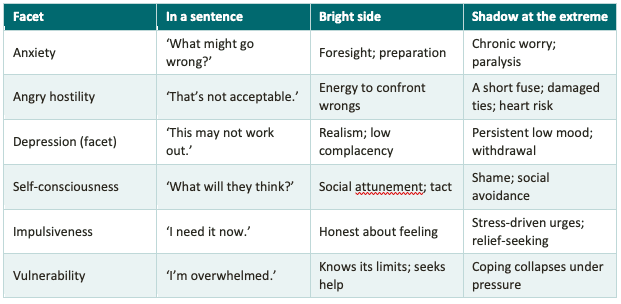
Beneath the two aspects sit the six NEO facets — six dials inside the one big dial (Costa & McCrae, 1992). The first three are the raw core of negative emotion; the second three are subtler but every bit as important.
5.1 The core of negative emotion
Anxiety
Anxiety is a proneness to worry, tension and fear — a forward-tilted sensitivity to what might go wrong. Turned up, it is the mind that is always three steps ahead, rehearsing disasters that mostly never arrive; turned down, it is the calm that can shade into not seeing the cliff edge.
Angry hostility
Angry hostility is the readiness to feel frustration and anger when thwarted. It is the facet most likely to spill out and damage the people around you, at work and at home, and it carries a real physical cost: a meta-analysis of prospective studies found that anger and hostility predict the later development of coronary heart disease in healthy people and a worse prognosis in those who already have it (Chida & Steptoe, 2009). It is the facet that quietly costs people friendships and marriages — often without their ever connecting it to the word ‘neuroticism’.
Depression
Depression — and precision matters here — is a temperamental disposition toward sadness, discouragement and low mood. It is not the same thing as clinical depression, the medical condition. One is a dimmer-switch setting on everyday mood; the other is an illness that needs proper care. They are related but not identical, and confusing them — in either direction — is how people either dismiss something serious as ‘just me being me’ or beat themselves up over an ordinary temperament. Section 11 returns to this line, because it is the single most important distinction in the whole article.
5.2 The subtler three
Self-consciousness
Self-consciousness is sensitivity to judgment — proneness to shame, embarrassment and worry about what others think. It is the engine of social anxiety: the person replaying the one slightly awkward thing they said three days ago.
Impulsiveness
Impulsiveness, in the NEO sense, is easily misread. It does not mean general disorganisation — that is a matter of conscientiousness. It means difficulty resisting urges and cravings under emotional pressure: the stress-eating, the one drink too many, the thing reached for when a feeling gets too big to sit with. It lives here, with neuroticism, because it is about emotion driving the hand.
Vulnerability
Vulnerability is how well you actually cope when stress hits — whether you hold together or come apart under genuine pressure. It is the facet that matters most for high-stakes roles, because it is not about how much you feel; it is about whether your functioning survives the feeling.
Why the carve-up matters in practice. The lever is different for each facet. Worry, anger, shame and stress-cravings respond to completely different approaches, so treating ‘neuroticism’ as one undifferentiated lump is exactly how a person pours effort into the wrong thing and wonders why nothing shifts. The man white-knuckling his temper when the real driver is social shame or trying to ‘think positive’ when his actual problem is stress-cravings under pressure, is working hard on the wrong facet. Name the specific one, and you have already done half the work.
5.3 How to spot — and work with — each facet
Each facet leaves visible fingerprints. Anxiety shows up as forward-tilted worry and is eased less by reassurance than by concrete planning (section 9). Angry hostility shows up in how you behave when thwarted and in how you respond, like resilience generally, is built by graded exposure, recovery, to managing the triggers — sleep, hunger, and ambush — that shorten the fuse. Depression (the facet) shows up as low everyday mood and responds to behavioural activation and routine, but if it is more than a setting, it needs professional help. Self-consciousness shows up in post-event replaying and is eased by attention trained outward rather than inward. Impulsiveness shows up under emotional pressure and is best managed by reducing the pressure and the cue, not by sheer willpower. Vulnerability shows up under genuine stress and is built, like resilience generally, by graded exposure, recovery and support. The general principle: target the specific facet, change the situation that activates it, and do not mistake a clinical problem for one a routine can fix.
6. The bright side and the dark side
Neuroticism has had a terrible press. The honest picture is that a sensitive alarm is genuinely protective up to a point, and genuinely costly past it.
6.1 The bright side: a sensitive alarm is a feature
That sensitive alarm is not just noise; it is protection. The threat-detector catches the flaw in the plan that the confident optimist sailed straight past. Anxious diligence — the checking, the preparing, the quiet playing-out of what could go wrong — is exactly what you want in your surgeon, your pilot, your finance director, the engineer signing off on the bridge. There is a real phenomenon of productive worry: the person whose low hum of dread makes them over-prepare and therefore quietly deliver more than anyone expected.
And there is an elegant finding that ties straight back to extraversion. Where extraverts grab status fast and can lose it, the more anxious often do the opposite: they start low — the group reads visible anxiety as weakness and writes them off early — and then climb, because that same anxiety drives the preparation that lets them outperform the people who doubted them (Bendersky & Shah, 2013). The quiet, worried one is frequently the slow-burn winner. And the bottom of the scale is no free ride: extreme emotional stability brings its own price in complacency — the person who never worries also never checks.
There is also a constructive strategy available to the anxious that the confident often lack. Some high scorers harness their worry deliberately through what has been called defensive pessimism — setting low expectations and mentally rehearsing everything that could go wrong, not as self-sabotage but as preparation, so that by the time the event arrives, every contingency has been planned for. Used this way, anxiety becomes fuel for rigour rather than a brake on performance. The same trait that floods one person with useless dread can, channelled, make another the most thoroughly prepared person in the room — which is precisely why a moderate, well-managed setting so often outperforms both the careless optimist and the paralysed worrier.
6.2 The dark side: when the alarm will not switch off
When the alarm is jammed on, firing constantly at nothing, the trait does real damage. It is exhausting to live inside, and it drains the very attention you need to think clearly, so decisions get worse exactly when pressure is highest. Useful worry curdles into rumination — the same hopeless loop, all night, solving nothing. The volatile, outward version corrodes relationships: the short fuse that everyone around you slowly tiptoes around.
Rumination deserves singling out because it is the specific mechanism that converts a useful trait into a harmful one. Useful worry is forward-looking and finishes in a plan; rumination is backwards-looking and circular — the same unsolved problem turned over and over, late into the night, generating distress without ever producing action. It is rumination, far more than worry as such, that links neuroticism to depression and to impaired decision-making, because it consumes cognitive resources while resolving nothing. The practical antidote is the through-line of this whole article: convert the loop into a concrete next step. A worry written down as a single, specific action it can be discharged into loses much of its power; a worry left to circle in the dark gains it.
6.3 The dark side at scale: emotional contagion
It gets worse in groups, because of something the research is blunt about: emotion is contagious, and negative emotion spreads particularly readily. In a classic study, one person’s mood measurably shifted the mood, cooperation and perceived performance of an entire group — a ‘ripple effect’ (Barsade, 2002). This is the mechanism behind what has been called the bad-apple effect, by which a single highly neurotic or highly disagreeable member can degrade the functioning of a whole team (Felps et al., 2006). The brand’s own doctoral research found that as a knowledge-work team’s average neuroticism rises, its performance falls away, with contagion as the plausible mechanism: a tense atmosphere quietly makes even steady people start scanning for threats (Keca, 2019).
The leadership flip side. Contagion runs both ways. A genuinely calm, steady presence is just as compelling as an anxious one: a composed person can lower the temperature in a tense room for everyone. That is one of the quietest and most underrated forms of leadership there is — and it is why, for anyone who leads people, neuroticism is a hard performance issue, not a soft one.
6.4 The curve
Putting the two sides together gives the familiar inverted-U. A little of the trait sharpens attention and preparation; too much floods the system and degrades the very performance it was trying to protect. As with conscientiousness, the goal is rarely the minimum or the maximum, but a setting matched to the demands of the role and the life.
7. What the trait predicts: behaviours and life outcomes
7.1 Mental health
This is the trait’s most consequential association. Across a large meta-analysis, every common mental disorder group — anxiety, depressive and substance-use disorders — scored markedly high on neuroticism, with a mean effect size around d = 1.65, an unusually large and consistent link (Kotov et al., 2010). Neuroticism has accordingly been described as a trait of profound public-health significance, predicting a wide range of mental and physical disorders and the use of health services (Lahey, 2009). The trait is best understood as a broad, transdiagnostic vulnerability — a shared risk factor underlying many specific conditions — rather than a marker of any single one.
7.2 Well-being and relationships
Neuroticism is the single best personality predictor of general unhappiness, because the same sensitivity that catches real threats also catches slights that were never meant and reads rejection where there is none. It is a major predictor of relationship dissatisfaction and of divorce, and of a range of poorer life outcomes (Roberts et al., 2007). The mechanism is rarely a lack of love and often an excess of threat-reading: the partner who hears criticism in a neutral remark, or rejection in a late reply, and reacts to the threat their alarm reported rather than the one that was actually there.
7.3 Health, longevity and the economic cost
The health stakes are real. The most comprehensive recent evidence — a 2025 meta-analysis pooling almost six million person-years — found neuroticism to be one of three Big Five traits that independently predict mortality: each one-point increase was associated with roughly a 3% higher risk of death at any given time, an effect that was stronger in younger populations and that attenuated after adjusting for health-related factors (McGeehan et al., 2025). At the population level, the economic costs are striking in a large Dutch study, the excess costs attributable to the highest-scoring quarter of the population exceeded those of common mental disorders by roughly two and a half times (Cuijpers et al., 2010). These are population-level associations, not personal verdicts, and the routes run substantially through behaviour, and through the conditions neuroticism predicts.
7.4 The nuance: ‘healthy neuroticism’
One intriguing and genuinely unsettled line of research asks whether neuroticism’s costs can be buffered by high conscientiousness — the so-called healthy neuroticism hypothesis, in which the worried-but-disciplined person channels their vigilance into protective action rather than rumination. Some studies find that, at high conscientiousness, high neuroticism is associated with better health behaviours, such as reduced smoking; however, large, pre-registered, coordinated analyses have produced mixed and often null results for chronic conditions and longevity (Graham et al., 2020). The honest summary is that the conscientious worrier may indeed fare better than the careless one, but the evidence is far from settled — a caution worth keeping in mind whenever the idea is presented as an established fact.
7.5 Work performance, burnout and counterproductive behaviour
At work, the trait’s effects are nuanced. High neuroticism is generally a modest negative predictor of job performance, chiefly because chronic worry consumes the attention and working memory that complex tasks demand, and because it raises vulnerability to stress and burnout. It is also associated with more counterproductive and withdrawal behaviours — absenteeism, conflict, and the strain that emotional volatility places on colleagues. Yet the relationship is neither simple nor uniformly negative: in roles where vigilance and error detection are the core of the job, a degree of the trait is protective, and the productive-worry and defensive-pessimism routes can turn anxiety into conscientious overpreparation. The decisive moderators are the facet involved (vulnerability and angry hostility tend to be the most costly), the interaction with conscientiousness (section 10), and the situation (section 9). Treating neuroticism as a blanket disqualifier is therefore both unfair and inaccurate; the better question is always which facet, in which role, under which conditions.
8. Putting the model to work
8.1 In organisations
Used well, an understanding of neuroticism improves selection, team design and day-to-day management — provided it is handled lawfully, ethically and without stigma.
- Select for the role, not against the trait. A degree of vigilance is an asset in roles where missing a threat is costly — audit, safety, compliance, quality, risk. As with any single predictor, treat personality as one structured input among several, remembering that corrected validities are more modest than once taught (Sackett et al., 2022), and never use it to screen people out in ways that stigmatise or discriminate.
- Read the team, not just the individual. Because negative emotion is contagious (Barsade, 2002; Felps et al., 2006), the aggregate emotional climate of a team matters more than any one member’s score. A single jammed-on alarm can raise everyone’s; a single calm presence can lower it.
- Lead with steadiness. For managers, visible composure is a performance tool: it quiets the collective alarm and frees attention for the work. This is contagion used deliberately and well.
- Reduce ambient uncertainty. Clear goals, predictable processes and honest communication lower the situational activation of the trait across the whole team (section 9) — often the highest-leverage and cheapest intervention available.
8.2 For individuals
For the individual, the model turns a vague sense of being ‘too much’ or ‘too sensitive’ into something workable.
- Name the facet. Decide whether your alarm points inward (worry, low mood, shame) or outward (irritability, a short fuse), and which specific facet is driving the trouble. The right lever depends entirely on the answer.
- Use structure, not willpower. Uncertainty switches the alarm on; structure switches it down. A clear next step, a routine that gives the day a spine, a plan that turns ‘everything might go wrong’ into ‘here is the one thing I will do first’ — this is design, not grit, and it works (section 9).
- Protect the basics. Most short-fuse explosions happen when someone is tired, hungry, underslept, and ambushed by the unexpected. Guarding sleep, food and predictability lengthens the fuse far more reliably than resolving to be calmer.
- Know the line. Everyday self-management is for a normal-range temperament. If worry or low mood is genuinely interfering with your life, that is a signal to seek professional help — covered in section 11.
One application deserves its own mention, because it is where the trait does much of its quiet damage: close relationships. Neuroticism is among the strongest personality predictors of relationship dissatisfaction and divorce (Roberts et al., 2007), and the mechanism is usually threat-reading rather than absent love — the partner who hears criticism in a neutral remark, or rejection in a slow reply, and responds to the danger their alarm reported rather than the one that was actually there. The practical antidotes are specific: learn to recognise the physical signature of your own alarm firing and to name it (‘I think I am reading a threat that may not be there’) before reacting; agree, with a partner, a shared language for when the smoke alarm is sounding; and protect the basics — sleep, food, predictability — that keep the fuse long. Understanding that a sharp reaction is often an alarm, not a verdict, can defuse a great many otherwise avoidable conflicts.
8.3 Psychological safety: managing the climate, not the person
Because neuroticism is activated by threat and spread by contagion, the most powerful organisational lever is rarely aimed at any individual — it is the psychological safety of the team as a whole. When people believe they can speak up, admit a mistake or flag a risk without humiliation or punishment, the ambient threat level falls, and with it the situational activation of everyone’s alarm. When the climate is punitive, the opposite happens: even steady people begin scanning for danger, airtime narrows to the confident, and the anxious-but-able go quiet precisely when their vigilance is most needed. For leaders, the practical moves are concrete: respond to bad news without shooting the messenger; separate the problem from the person; make uncertainty explicit and bounded rather than leaving it to fester as rumour; and model visible composure under pressure. None of this is ‘being soft’. It is lowering the collective threat signal so that attention returns to the work — a hard-edged performance intervention dressed in humane clothing.
9. Strong and weak situations: the lever
Like every trait, neuroticism is a latent tendency that expresses itself only when the situation supplies relevant cues — the core insight of Trait Activation Theory (Tett & Burnett, 2003; Tett & Guterman, 2000). For this trait, the activating cue is uncertainty.
Ambiguity, unpredictability and a vague threat with no clear shape are what make the alarm scream. Clear goals, a concrete plan and a predictable routine are what switch it down. The very same person can be calm and capable in a well-defined role and a churning wreck in a chaotic, everything-changes-weekly one — not because they changed, but because the situation did. That hands you a genuine lever: you do not have to wrestle the feeling head-on in the moment, because you can turn the volume down in advance by building structure wherever you can.
Anxiety hates a plan. It thrives in fog and shrinks in the daylight of a concrete next action. The practical implication for leaders is that reducing ambient uncertainty — clear priorities, stable processes, honest and timely communication — is one of the most effective and least expensive ways to lower the emotional temperature of a whole team. For individuals, the equivalent is replacing vague dread with a written, specific first step.
10. How neuroticism interacts with other traits
Traits act in combination, and neuroticism’s expression shifts sharply depending on what sits alongside it.
- Neuroticism × conscientiousness. This is the most consequential pairing. High neuroticism with high conscientiousness can produce the productive worrier — vigilance channelled into preparation and protective action — and is the basis of the ‘healthy neuroticism’ idea (section 7.4). High neuroticism with low conscientiousness is the more damaging combination: the same dread, but discharged into rumination, avoidance and stress-driven urges rather than useful action.
- Neuroticism × extraversion. Low neuroticism with high extraversion is the ‘happy warrior’ — socially confident and emotionally steady, a robust predictor of well-being and resilient performance (Judge & Erez, 2007). High neuroticism with high extraversion is more volatile: outgoing and reward-seeking but easily knocked. High neuroticism with low extraversion (high negative affect, low positive affect) is the temperamental profile most associated with depressive presentation.
- Neuroticism × agreeableness. Volatility combined with low agreeableness is the hostile, abrasive profile — the short fuse aimed outward at others. The same volatility paired with high agreeableness is more often turned inward as guilt and self-criticism.
- Neuroticism × openness. High neuroticism with high openness can intensify rumination and existential worry but also fuels the sensitivity that drives a good deal of creative and artistic work.
At the team level, the brand’s doctoral research underlines that composition matters: rising average neuroticism, amplified by contagion, predicts falling team performance (Keca, 2019). Reading profiles in combination — pairing a steady presence with an anxious-but-able specialist and protecting the climate from a single jammed alarm — matters more than any individual score.
Two patterns are worth naming for anyone reading profiles in practice. Some combinations are compensatory: high conscientiousness can offset much of high neuroticism’s cost by converting worry into preparation, and a steady, agreeable colleague can absorb some of a volatile teammate’s friction. Others are corrosive: high neuroticism with low conscientiousness (dread without follow-through) or high volatility with low agreeableness (a short fuse aimed outward) tend to amplify each other. The practical move is to read traits in combination rather than isolation — pairing the anxious specialist with a calming lead, protecting the climate from a single jammed alarm, and remembering that the same neuroticism score can describe a productive worrier or a struggling one depending entirely on what sits beside it.
11. Dark traits, mental health and the clinical picture
Neuroticism’s clinical relevance is greater than any other trait’s — but it is widely misunderstood, and the distinctions here matter enormously.
11.1 The transdiagnostic core
Neuroticism is the closest thing personality science has to a general vulnerability factor for emotional disorder. It sits beneath the internalising spectrum — the anxiety and depressive disorders — and is elevated across almost every common condition (Kotov et al., 2010; Lahey, 2009). This is why it is described as transdiagnostic: it is not the signature of one illness but a shared sensitivity underlying many, which is part of why treatments that reduce it tend to help across several diagnoses at once.
This breadth also explains the high comorbidity among emotional disorders — why anxiety and depression so often travel together. If a single underlying sensitivity raises the risk of several conditions at once, then a person who develops one is, by the same token, at raised risk of another. It is a powerful argument for thinking about the shared root rather than only the surface labels, and it is part of why some modern treatments aim at the underlying reactivity itself rather than at one diagnosis in isolation.
11.2 The DSM-5 and ICD-11 picture
The maladaptive extreme is named directly in the DSM-5 Alternative Model of Personality Disorders, where the domain Negative Affectivity is defined as the opposite pole of emotional stability — frequent and intense negative emotions such as anxiety, depression, guilt, worry and anger, with associated behavioural and interpersonal disturbance (American Psychiatric Association, 2013). It is central to the borderline and avoidant presentations, and the ICD-11 trait model includes a closely corresponding negative affectivity domain (World Health Organization, 2019). Unlike extraversion or conscientiousness, neuroticism is only weakly tied to the ‘dark triad’ of socially aversive traits; its clinical footprint is overwhelmingly in internalising distress — the suffering people turn inward — rather than in callous exploitation of others, with the partial exception of the emotional instability seen in borderline and vulnerable-narcissistic patterns.
11.3 The line that matters most
Here is the single most important distinction in this article. The depression facet of neuroticism — a temperamental tendency toward low mood — is not the same as clinical depression, the medical condition. A trait is a setting you can often manage with structure, routine and self-knowledge; an illness is something you treat, with help. The two are related, and high neuroticism raises the risk of the illness, but they are not the same thing, and they call for different responses.
Boundaries, care and where to turn. Everything in this article describes normal-range personality and is educational, not diagnostic. There is a clear line: when worry or low mood stops being a setting you can manage and starts genuinely interfering with your sleep, work, relationships or ability to enjoy anything, that is no longer a matter for a better routine — it is a reason to talk to someone qualified, such as your GP or a mental-health professional. That is not weakness, and it is categorically not something anyone should face alone. If you are struggling right now, please reach out to a qualified professional or, in a crisis, to the urgent help lines available in your country; in the UK, your GP, NHS 111, or the Samaritans on 116 123 are good starting points.
11.4 Two balancing cautions
First, a high score is a risk marker, not a diagnosis or a destiny: most people high in neuroticism have no disorder, and the trait’s vigilance is genuinely useful in the right setting. Second, very low neuroticism is not a clean win — the imperturbable person who never worries can be the one who misses the warning everyone else felt. Naming both ends honestly, without pathologising sensitivity or romanticising detachment, is part of using this knowledge responsibly.
12. Across the lifespan — and the genuine hope
12.1 The maturity principle
Neuroticism is not fixed for life. In a meta-analysis of 92 longitudinal samples, emotional stability increased from early to middle adulthood — that is, average neuroticism fell — as part of the broader maturity principle, whereby most people drift toward more effective functioning as they take on adult roles (Roberts, Walton, & Viechtbauer, 2006). The anxious twenty-five-year-old is, on average, a steadier forty-five-year-old, not because they willed it but because time and responsibility quietly recalibrated the alarm.
12.2 The most changeable trait
And here is the genuinely hopeful part this whole series has been building toward. Of the Big Five, neuroticism is the one the evidence most clearly shows can come down through deliberate effort. A systematic review of intervention studies found that therapeutic and structured interventions can produce real, lasting change in personality traits, with neuroticism among the most responsive (Roberts et al., 2017). Effective treatment for anxiety and depression so reliably reduces neuroticism that, when people recover, you can often measure the trait falling with them. You are not welded to the volume it is set at today.
The practical reading. Natural maturation, deliberate structure, and — where needed — professional treatment all point the same way: this is the trait you can most change. That is not a promise that it will be easy, and it is not a substitute for care when care is needed. But it is a genuine, evidence-based reason for hope, and it is the bridge to the wider question of how personality changes at all.
13. A contemporary twist: neuroticism in an age of uncertainty
The trait was mapped long before smartphones, rolling news and remote work. Each interacts with it in ways worth naming.
13.1 The uncertainty economy
If uncertainty is the fuel of neuroticism, the modern information environment is a tinderbox. Rolling news, social feeds and algorithmic outrage deliver a near-continuous stream of vague, unresolved threats — exactly the diet a threat-detector is least able to switch off. Doomscrolling is, in effect, feeding the alarm with smoke. The practical defence is the same lever as ever: convert formless dread into a concrete, bounded next action, and ration exposure to the channels that manufacture it.
13.2 Remote work and social comparison
Remote and hybrid work removes some activating cues — the difficult corridor encounter — but adds others: ambiguity about how one is perceived, fewer reassuring social signals, and the isolation that lets rumination run unchecked. Social media compounds this through relentless upward comparison, a reliable trigger for the self-consciousness facet. None of these changes the underlying trait; it changes how often and how easily the situation pulls it out.
13.3 AI and the shape of worry
Generative AI introduces a new source of diffuse, hard-to-bound uncertainty — about work, skills and the future — of precisely the kind that activates the trait. It also offers, more speculatively, a counterweight: tools that impose structure, draft the plan and break a vague dread into concrete steps may help the anxious convert worry into action. The evidence here is nascent and should be treated as a hypothesis rather than a finding, but the direction is consistent with everything else in this article: structure quiets the alarm.
14. Why this matters — and how it helps
Understanding neuroticism converts a source of shame into a source of strategy — and it helps the worrier, the short-fused and the people around them alike.
- Relationships. Recognising that a partner’s sharp reaction, or your own, is often a threat-alarm firing — not a considered judgement — changes the response from counter-attack to reassurance and defuses a great many avoidable conflicts. Naming a short fuse as anxiety turned outward is, for many couples, transformative.
- Organisational performance. Because emotion is contagious, managing the emotional climate — reducing uncertainty, leading with steadiness, protecting teams from a single jammed alarm — is a hard performance lever, not a soft one (Barsade, 2002; Keca, 2019).
- Health. The trait’s links to mental and physical health, including heart disease via chronic anger and hostility (Chida & Steptoe, 2009), make managing it a genuine health investment — and the levers (structure, sleep, treatment where needed) are partly within reach.
- Self-direction. Knowing your setting, that it can be flexed, and that it tends to soften with age and falls with effective treatment, replaces self-blame with a plan. The worrier learns to convert dread into preparation; the short-fused learn to see the hit coming; and both stop treating a sensitive alarm as a life sentence.
The reframe is the whole point. Neuroticism is not the enemy. It is an ancient, often useful system doing a job your ancestors badly needed done — and, turned down to a workable level, it can be one of your sharpest instruments rather than your heaviest burden.
15. Common misconceptions
Few traits attract as much folk theory — and as much shame — as this one. Five misconceptions are worth correcting directly.
- ‘Neuroticism is a mental illness.’ No. It is a normal personality trait — a sensitivity setting on the threat system. It is the strongest personality predictor of anxiety and depression, but it is not itself a disorder (Lahey, 2009).
- ‘Anxiety and a short temper are different problems.’ Often, they are the same trait pointed in two directions: withdrawal (inward worry) and volatility (outward anger) are the two aspects of one underlying sensitivity (DeYoung et al., 2007).
- ‘Neuroticism is simply bad.’ No. A sensitive alarm heightens vigilance and ‘productive worry’, and anxious individuals often climb the status ladder over time as their preparation shows (Bendersky & Shah, 2013). Very low neuroticism comes with its own cost: complacency.
- ‘You’re stuck with it.’ No. It softens with age (Roberts, Walton, & Viechtbauer, 2006) and, among the Big Five, is the most responsive to intervention and effective treatment (Roberts et al., 2017).
- ‘The depression facet is clinical depression.’ No. A temperamental tendency to low mood is not the medical condition; conflating the two, in either direction, is harmful (section 11).
16. What neuroticism is not — limits and caveats
- Probabilities, not destinies. Trait–outcome links are real but, at the individual level, probabilistic. A high score shifts the odds; it does not decide the result, and most high scorers are well.
- A trait, not a diagnosis. Neuroticism is a normal-range temperament. A clinical disorder requires distress or impairment and a qualified assessment; this article cannot provide either.
- Measurement has limits. Most evidence rests on self-report and Western, educated samples, and corrected validity estimates are more modest than once advertised (Sackett et al., 2022).
- Some popular ideas are unsettled. ‘Healthy neuroticism’ is intriguing but inconclusive (Graham et al., 2020), and several health associations attenuate once behaviour is accounted for (McGeehan et al., 2025). Hold them lightly.
- Education, not diagnosis. The clinical material here describes extreme, impairing ends of a continuum; it is not a tool for labelling oneself or others.
17. Conclusion
Neuroticism is the trait of negative emotion and threat-sensitivity — the smoke alarm wired into your nervous system. It is, at bottom, how readily and how loudly your negative-emotion system fires, expressed through two faces, the inward worrier and the outward short fuse, and six facets that come apart in ways that matter. It is the strongest personality predictor of unhappiness, of common mental-health difficulties, and of strained relationships, and it carries real costs to health and to teams through rumination and emotional contagion. Yet it is not the enemy: a sensitive alarm catches the danger the confident optimist missed, drives the preparation that quietly outperforms, and — turned down to a workable level — becomes an instrument rather than a burden.
For the leader, the lesson is that emotional climate is a hard performance issue, best managed by reducing uncertainty and leading with steadiness. For the individual, it is that you can turn the volume down — with structure, with self-knowledge, and, where it is more than a setting, with help that genuinely works. And the deepest hope is the most practical one: of all five traits, this is the one you can most change. Your alarm is not a verdict on who you are. It is a setting — and settings can be understood, managed, and turned down.
A map, not a verdict; education, not diagnosis. If worry or low mood is interfering with your life, please speak to your GP or a qualified professional. If you would like to see where you sit on this and the other four traits, a free, evidence-based personality assessment is available at keca.co.uk.