1. The Most Conceptually Complicated Trait
Of all the Big Five personality traits, agreeableness is the one we are most tempted to misread — and the temptation is built into its name. Compassion and politeness sound unambiguously good. So do the adjectives that describe the agreeable person: warm, kind, cooperative, forgiving, trusting, modest, and sympathetic. The adjectives at the other end — blunt, sceptical, competitive, hard-headed, and, at the extreme, callous or ruthless — sound unambiguously bad. The naming convention quietly invites the conclusion that science does not support the claim that greater agreeableness is simply better.
It is not. Personality traits are approximately normally distributed, which is another way of saying that they have persisted across human history at every level from very low to very high. If low agreeableness were a pure liability, selection pressure would have thinned it out long ago. It has not, because the disagreeable end of the distribution confers genuine advantages — in competition, in negotiation, in self-advocacy, in the willingness to say difficult things and to hold a line under social pressure. Equally, if high agreeableness were a pure asset, the people who possess it in abundance would not so reliably earn less, advance more slowly, and find themselves carrying a silent burden of resentment built from a thousand unspoken "yeses". The honest position, and the one this article defends, is that there are pronounced advantages and disadvantages at every point on the agreeableness distribution. That is precisely what makes it, in the considered view of several leading personality researchers, the most conceptually complicated of the five.
This matters far beyond the seminar room. Agreeableness is the trait most central to the quality of our closest relationships and to the everyday cooperation on which families, teams and whole organisations depend. It shapes who we trust, how we handle conflict, whether we negotiate well or badly for ourselves, how we lead, and — through all of these — our income, our influence, our health and the durability of our relationships. To understand agreeableness properly is to take both of its poles seriously, to resist the knee-jerk reaction that nice is always better, and to ask the only question that the evidence actually rewards: how much, in which facet, for which situation, at what cost?
2. Where the Trait Came From: A Short History of Agreeableness
The story of agreeableness is the story of the Big Five itself, and it begins not with a theory but with a dictionary. In 1936, Gordon Allport and Henry Odbert set out what became known as the lexical hypothesis: the idea that the most socially significant individual differences become encoded in everyday language, so that the more important a difference is, the more words a culture will have invented to describe it (Allport & Odbert, 1936). Combing through an unabridged English dictionary, they extracted some 18,000 person-descriptive terms — a sprawling vocabulary of human character that cried out to be organised.
Raymond Cattell took up that challenge in the 1940s, reducing the lexical pool to a more tractable set of factors and ultimately to his sixteen-factor model (Cattell, 1943). But it was a series of studies for the United States Air Force that produced the structure we now recognise. Donald Fiske (1949), and then Ernest Tupes and Raymond Christal (1961/1992), analysing peer ratings of officers, found repeatedly that the bulk of the variance in trait ratings resolved into five recurrent factors. One of those five they labelled Agreeableness. Warren Norman (1963) replicated the structure and gave the five their durable shape, and through the 1980s Lewis Goldberg — who coined the term "Big Five" — confirmed the model across multiple languages and datasets (Goldberg, 1990). By the time John Digman (1990) reviewed the field, the five-factor structure had become the most replicated finding in the psychology of personality.
The modern operationalisation most relevant to this article was developed by Paul Costa and Robert McCrae, whose Revised NEO Personality Inventory (NEO-PI-R) divided each of the five domains into six specific facets (Costa & McCrae, 1992). For agreeableness, those facets are Trust, Straightforwardness, Altruism, Compliance, Modesty and Tender-Mindedness — the six we examine in detail in Section 4. A complementary tradition, developed by Colin DeYoung, Lena Quilty and Jordan Peterson (2007), sits between the broad domain and the narrow facets, identifying exactly two aspects within each trait. For agreeableness, these are Compassion and Politeness — the level at which much of this brand's trait series operates, and the level to which we map the NEO facets below.
It is worth pausing on what the lexical origin tells us. Agreeableness earned its place among the five not because a theorist decided warmth mattered, but because, across thousands of descriptive words and many languages, human beings could not stop describing one another in terms of how cooperative, kind, trusting and considerate — or how cold, blunt and combative — they were. The trait is, in a real sense, a distillation of one of the two great social questions every human group must answer about its members: not just how capable are you? But whose side are you on — your own, or ours?
The evolutionary framing makes the same point in a different key. Agreeableness is, at root, the trait of caring for the dependent and the vulnerable — the infant, the sick, the elderly — and of maintaining the cooperative bonds that allowed small human groups to survive. Highly compassionate behaviour amounts to systematically negotiating on behalf of the other person rather than oneself, which is exactly the right strategy when the other party genuinely cannot fend for themselves. The disagreeable pole, by contrast, is adapted to competition: to defending one's own interests effectively in contexts where resources are contested, and the other party is perfectly able to look after themselves. Neither orientation is "the human default". Both are ancient, both are heritable, and both, deployed in the wrong context, become liabilities. Graziano and colleagues' programme of work on agreeableness and interpersonal conflict captured the constructive version precisely: agreeableness is best understood as a motivation to maintain positive relations with others, expressed most clearly in how a person manages disagreement (Graziano et al., 1996).
3. What Is Agreeableness?
Agreeableness is the Big Five domain that describes the tendency toward compassion, cooperation, trust, politeness and concern for social harmony. High scorers are warm, empathic, accommodating, forgiving, modest and pleasant to work with; they care about others genuinely rather than instrumentally, and they invest in maintaining good relationships even at some personal cost. Low scorers are competitive, sceptical, blunt, tough-minded and willing to put their own interests first; at the extreme low pole, disagreeableness shades into the callousness and manipulativeness that form the core of the dark traits (Costa & McCrae, 1992; Wilmot & Ones, 2022). It is, more than any other trait, the dimension on which we judge whether someone is fundamentally for us or against us — and it is therefore the trait most central to the quality of close relationships and to everyday cooperation.
A useful way to hold the whole trait in mind is to think of agreeableness as answering a single recurring social question: how much should I weigh your interests against my own? The highly agreeable person answers "yours come first, or at least equal"; the highly disagreeable person answers "mine, until you give me a reason to think otherwise". Most people, of course, sit somewhere in the broad middle of the distribution, weighting self and other differently depending on who the other is and what is at stake. The trait describes our default setting, not an iron law.
It is important to separate agreeableness from two things it is often confused with. First, agreeableness is not happiness or social energy. That is extraversion. Extraverts are enjoyable to be around — they bring a warm, gregarious, energising presence. Agreeable people are something subtly different: they like you, they are concerned for your welfare, and they extend a quiet, particular care toward the specific person in front of them. The two traits frequently co-occur and reinforce one another, but they are distinct, and an introvert can be deeply agreeable while a life-of-the-party extravert can be markedly low in it. Second, agreeableness is not the same as competence, integrity or warmth-as-effectiveness. A person can be enormously agreeable and quite ineffective; another can be cool and sceptical yet scrupulously honest. Keeping these distinctions clear prevents the most common errors in applying the trait.
3.1 Two Aspects: Compassion and Politeness
Beneath the broad domain, DeYoung, Quilty and Peterson (2007) identified two separable aspects of agreeableness, each with a distinct behavioural signature.
Compassion is the empathy-driven, care-oriented aspect. Compassionate individuals feel others' emotions, take an active interest in others' well-being, sympathise with feelings, take time for people, and like to do things for others. It is best understood as an emotional and motivational orientation toward the welfare of others — and, in negotiating terms, as a tendency to advocate on the other person's behalf.
Politeness is the deference-driven, norm-respecting aspect. Polite individuals respect authority, avoid imposing their will, dislike appearing pushy, rarely pressure others, and steer clear of conflict. It is best understood as respect for social rules and for other people's autonomy — the disposition to operate within established structures rather than to challenge or circumvent them. The two aspects are correlated but genuinely distinct: a person can be high in warm compassion yet low in deferential politeness (the campaigning activist who cares passionately but will happily break rules and confront authority), or high in politeness yet comparatively low in compassion (the punctilious, rule-abiding person who is not especially moved by others' feelings).
The aspects also carry one of the few well-replicated links between personality and politics: higher politeness is modestly associated with social conservatism, while higher compassion is modestly associated with liberalism — a reminder that even our moral and political instincts have a temperamental undercurrent (DeYoung et al., 2007).
3.2 A Crucial Distinction: Empathy Is Not Compassion
Because compassion sits at the heart of agreeableness, it is worth drawing a distinction that the recent affective-neuroscience literature has made sharp and that has real practical consequences. Empathy — feeling what another person feels — is not the same as compassion — caring about another person's welfare and being motivated to help. Tania Singer and Olga Klimecki (2014) showed that the two states recruit different neural systems and produce different outcomes: empathy, when it tips into shared distress, leads to burnout and withdrawal, whereas compassion is associated with warm, approach-oriented, sustainable concern. Paul Bloom (2016, 2017) pressed the point further in Against Empathy, arguing that raw empathy is a poor moral guide precisely because it is innumerate and partial — it spotlights the single identifiable person in front of us and goes blind to the statistical many. For the highly agreeable professional, especially in caring, clinical and people-leadership roles, this is not an abstract debate. It is the difference between sustainable care and compassion fatigue; between helping wisely and being paralysed by the suffering one absorbs. The most resilient helpers are not the most empathic but the most compassionate — able to care deeply while keeping enough separation to act, decide and endure.
4. The Six Facets of Agreeableness
The single most important practical insight about agreeableness is that the domain label conceals more than it reveals. Telling someone they are "agreeable" is far less useful than telling them where they sit on each of the six facets, because the facets do not move together as tidily as the headline trait suggests, and because their consequences differ. The qualities that make someone a trusted, generous colleague are not the same as the qualities that make them easy to exploit; a person can be high on the first and, when the situation demands, low on the second. This is why the most effective professional profile is rarely maximal agreeableness, but a selective, situation-sensitive blend.
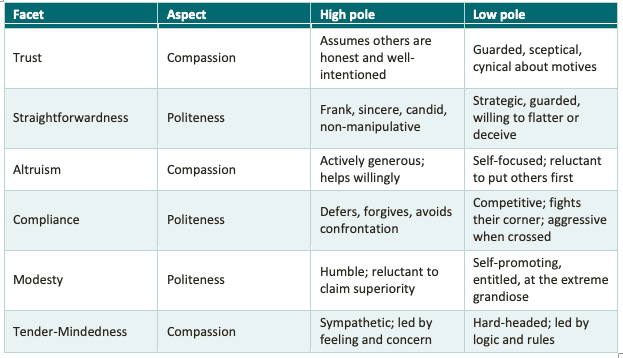
The table below sets out the six NEO facets (Costa & McCrae, 1992), the aspect on which each facet loads most strongly, and the behavioural signature of each pole.
4.1 Trust
Trust is the disposition to assume that other people are honest, sincere and well-intentioned. High-trust individuals give others the benefit of the doubt, build relationships quickly, and create the psychological conditions in which collaboration and disclosure can flourish. Its low pole is a guarded, sceptical, sometimes cynical stance that reads others' motives warily and assumes self-interest until proven otherwise. The crucial point is that neither pole is simply correct: high trust is adaptive — even essential — in collaborative, repeated-interaction settings where most people are, in fact, trustworthy, and corrosive in adversarial, one-shot, or low-integrity environments where it invites exploitation. Low trust is the opposite: a handicap in a high-trust team, an asset in due diligence, fraud detection, or a negotiation with a counterparty who does not have your interests at heart. The skill is calibration — trusting by default while remaining alert to the cues that should prompt its revocation.
4.2 Straightforwardness
Straightforwardness is frankness and sincerity: a reluctance to manipulate, flatter, dissemble or play interpersonal games. High scorers say what they mean and mean what they say; their candour makes them dependable and, in the best cases, trusted truth-tellers. The low pole of this facet is one of the most consequential in all of personality, because it is precisely the manipulativeness, deceitfulness and willingness to use others that sits near the centre of the dark traits and the DSM-5 Antagonism domain (Section 12). It is worth noting, however, that very high straightforwardness has its own costs: unvarnished frankness, delivered without the social lubrication of tact, can read as bluntness or naïveté, and the person who cannot shade the truth for diplomatic effect is sometimes at a disadvantage in the more theatrical corners of organisational life.
4.3 Altruism
Altruism is an active, willing concern for others, expressed in helping behaviour and generosity. It is the facet most directly responsible for organisational citizenship — the discretionary effort, mentoring, covering and quiet helping that keeps teams functioning far beyond anyone's job description. High-altruism individuals find genuine reward in others' flourishing; they are the colleagues who make a workplace humane. The shadow side is not the helping itself but its indiscriminate, boundary-free version: the person whose altruism has no off-switch becomes the team's default dumping ground, says yes until they are overwhelmed, and subsidises others' poor planning with their own evenings and weekends. Altruism without boundaries is how good people burn out.
4.4 Compliance
Compliance describes how a person handles interpersonal conflict. High scorers defer, forgive, inhibit aggression and seek to keep the peace; low scorers compete, push back, and are willing to fight their corner. Of all six facets, compliance is the one most directly implicated in the costs of agreeableness explored later in this article, because very high compliance is the engine of conflict avoidance — the inability to say no, to hold a position under pressure, to negotiate hard, or to deliver a difficult message. It is also the facet most easily exploited: a highly compliant person is, almost by definition, the path of least resistance for anyone seeking to extract a concession. Strategic, situational low compliance — the capacity to be firm and to fight one's corner when the situation genuinely warrants it — is the single most valuable thing most highly agreeable people can learn to add to their repertoire.
4.5 Modesty
Modesty is humility about one's own merits and a reluctance to claim superiority or special treatment. High-modesty individuals are unassuming, share credit, and are pleasant to work alongside precisely because they do not compete for status at every turn. The low pole runs from healthy self-confidence through self-promotion to, at the extreme, the entitlement and grandiosity characteristic of narcissistic profiles. As with the other facets, there is a genuine trade-off: modesty is interpersonally attractive and socially binding, but in organisations that reward visibility and self-advocacy, the relentlessly modest are systematically under-credited for their contributions and overlooked for advancement. Modesty wins goodwill; it does not, by itself, win promotions.
4.6 Tender-Mindedness
Tender-mindedness is sympathy and concern grounded in feeling, as opposed to a harder-headed, rules-and-logic orientation to social decisions. High scorers are moved by need and make decisions with the human consequences vividly in mind; low scorers reason from principle, policy and the longer-term or aggregate good, even when that produces locally uncomfortable outcomes. This facet maps closely onto the empathy–compassion distinction drawn earlier, and onto a recurring tension in leadership: the tender-minded leader who cannot make a redundancy decision because they feel each individual's distress too acutely, versus the tough-minded leader who can carry the decision but may discount the human cost. Neither is wholly right. The wisest social and managerial judgement usually requires both the capacity to feel the particular and to reason about the whole.
5. The Bright Side: What High Agreeableness Delivers
It would be a serious distortion to spend an article on the costs of agreeableness without first being clear about its very substantial benefits — benefits that the most comprehensive evidence base available describes in unusually strong terms. In 2022, Michael Wilmot and Deniz Ones published the most authoritative synthesis of the trait to date: a quantitative review of 142 meta-analyses, reporting effects for 275 variables across more than 1.9 million participants drawn from over 3,900 studies (Wilmot & Ones, 2022). Their headline finding is striking. Across the full range of outcomes examined, agreeableness had desirable effects for 93% of variables. Whatever its costs in specific competitive arenas, agreeableness is, on balance and across life as a whole, an enormously constructive trait.
Wilmot and Ones distilled the trait's functioning into eight themes that together form a useful map of its bright side: self-transcendence (orienting beyond narrow self-interest), contentment (a settled, positive emotional life), relational investment (building and maintaining close bonds), teamworking (cooperating effectively in groups), work investment (diligent, conscientious effort), lower results emphasis (caring less about winning at others' expense), social norm orientation (respecting rules and conventions), and social integration (being woven into a supportive web of relationships). Read together, these themes describe the person almost everyone wants as a colleague, a partner and a neighbour.
The benefits show up concretely across the domains that matter most to organisations and individuals alike:
Relationships and well-being. Agreeableness is one of the strongest personality predictors of relationship quality and stability, and a reliable contributor to subjective well-being. The most comprehensive meta-analysis of personality and well-being to date confirms that agreeableness makes a real, if smaller, contribution alongside the heavier hitters of low neuroticism and high extraversion — and that facet-level prediction outperforms domain-level prediction (Anglim et al., 2020). Wilmot and Ones (2022) characterise the agreeableness–well-being link as a medium-sized effect: agreeable people are not merely pleasant to others; they tend to be more content themselves.
Teamwork and cohesion. Agreeableness is among the strongest Big Five predictors of team cohesion and of the constructive management of disagreement (Graziano et al., 1996; Mount, Barrick, & Stewart, 1998). A longitudinal study of 648 military personnel by Reizer, Harel and Ben-Shalom (2023) is particularly instructive: an agreeable personality at the outset predicted greater well-being two months later, with perceived team cohesion serving as the mechanism, and the effect was significantly stronger when leaders offered support aligned with people's basic psychological needs. The practical takeaway is that agreeable individuals not only contribute to cohesion; they also benefit disproportionately from supportive leadership, making investment in such leadership a high-return strategy for agreeable teams.
Cooperation, trust and citizenship. Through the Altruism and Trust facets in particular, agreeable people provide the discretionary helping, mentoring, and good corporate citizenship that no job description can mandate but that every functioning organisation depends on. They build the trust and psychological safety that let teams take risks, voice concerns and surface problems early. In service, caring and team-dependent roles — which is to say a very large share of the modern economy — moderate-to-high agreeableness is a straightforward performance asset (Mount et al., 1998).
Prosociality that feeds back into the self. A growing literature confirms the intuition behind Reizer and colleagues' title — that helping others tends to help the helper. Prosocial behaviour is reliably, if modestly, associated with the helper's own well-being, especially when the helping is freely chosen rather than coerced and when it builds rather than depletes the person's relationships. Agreeableness is, in effect, the dispositional engine of this virtuous circle.
None of this is sentimental. It is the considered verdict of the largest evidence synthesis the field possesses. The costs explored in the rest of this article are real and important, but they are costs at the margins of an overwhelmingly positive trait — concentrated in specific competitive situations, at the very high extreme, and in particular facets. Keeping that proportion in view is essential to reading the rest of this piece correctly.
6. The Dark Side: When Warmth Becomes a Liability
If 93% of agreeableness's measured consequences run in a desirable direction, the remaining slice nonetheless contains some of the most consequential findings in applied personality science, because it falls disproportionately on the arenas in which careers, incomes and organisational outcomes are decided. The dark side of agreeableness is not, for the most part, the dramatic harm done by its low pole (that is covered in Section 12). It is the quieter, more insidious cost paid by highly agreeable people themselves, and by the organisations that fail to help them.
Conflict avoidance and its accumulating cost. The engine of most agreeableness costs is very high. Compliance: the deep reluctance to enter, sustain or win interpersonal conflict. In the moment, conflict avoidance feels like kindness and often is. Over time, however, the person who consistently says yes when they mean no, who absorbs others' demands rather than stating their own needs, and who defers when they should push back, accumulates a silent ledger of unredeemed concessions. That ledger does not stay silent forever. It tends to surface as resentment, passive aggression, withdrawal of goodwill, or — in the worst case — a sudden, disproportionate rupture when the burden finally exceeds the person's capacity to suppress it. The external presentation of agreeableness is frequently sustained long after the internal experience has curdled, which is precisely why the cost is so often invisible until it is acute.
Exploitability. The same facets that make agreeable people valuable make them targets. High Altruism with weak boundaries, high Trust in low-integrity environments, high Compliance under pressure, and high Modesty in visibility-driven cultures combine to create a person whom others — consciously or not — learn they can lean on, defer work to, and under-credit. This is not a moral failing on the agreeable person's part; it is a predictable response by everyone else to the incentives the agreeable person sets up.
Self-subordination and under-advocacy. Because agreeable people weight others' interests heavily, they systematically under-advocate for themselves: in pay, in promotion, in the allocation of credit and opportunity, and in the defence of their own time and priorities. This is the mechanism behind the "agreeableness penalty" examined in detail in Section 8, and it is the single most career-limiting feature of the trait.
Leadership softening. At the high extreme, agreeableness can erode the very standards a leader is meant to uphold. The discomfort of causing short-term interpersonal displeasure inhibits the highly agreeable leader's willingness to deliver difficult feedback, hold people accountable, and make unpopular but necessary decisions. The result is a slow drift: standards that are never quite enforced, problems that are never quite named, and a team that — paradoxically — is under-served by a leader who cares about them a great deal. We return to this leadership paradox in Section 8.3.
The throughline is that the dark side of agreeableness rarely results from caring too little. It is the result of caring in a way that has no boundary, no off-switch, and no capacity for strategic firmness. That diagnosis matters, because it points directly at the remedy — not less warmth, but the addition of a complementary skill — which we develop in Sections 13 and 14.
7. Behaviours and Life Outcomes
Agreeableness does not merely describe a temperament; it predicts, with modest but reliable effect sizes, a wide range of the outcomes people care about most. The honest framing throughout is that personality–outcome correlations are typically in the range of r = .10 to .30 — traits shift the odds rather than determine fates — but that modest correlations accumulate into large consequences across many decisions, many people and many years (Roberts et al., 2007; Soto, 2019).
Work performance. Agreeableness is not a strong general predictor of job performance, unlike conscientiousness. Its value is role-specific: it predicts performance in caring, service, helping, and team-dependent roles, where cooperation is central to the work, and it can be a mild handicap in competitive, negotiation-heavy, or purely results-driven roles (Mount et al., 1998; Judge & Zapata, 2015). A general caution applies to all such figures: a major 2022 reanalysis argued that decades of selection research had overstated the operational validity of many predictors, including personality, prompting a continuing debate about effect sizes (Sackett et al., 2022). The defensible summary is that personality traits are genuine, useful, incremental predictors of performance — best used in combination with cognitive ability and structured assessment, never as a sole pass-or-fail gate.
Earnings and career progression. This is where agreeableness extracts its most uncomfortable price. Across studies, more agreeable individuals tend to earn less than their disagreeable peers, negotiate less effectively for themselves, and advance more slowly into senior roles — the "agreeableness penalty" examined in full in Section 8. A 2024 meta-analysis of the Big Five and earnings confirmed the pattern at the broadest level: openness, conscientiousness and extraversion correlate positively with earnings, while agreeableness and neuroticism correlate negatively (Vella, 2024).
Counterproductive behaviour and integrity. The performance story has a mirror image: the avoidance of harm. Counterproductive work behaviour — theft, fraud, bullying, harassment, sabotage and the quieter withdrawal of effort — is predicted less by the bright performance traits than by low agreeableness, low conscientiousness, and the integrity dimension that the HEXACO model isolates as Honesty-Humility (Ashton & Lee, 2007). Organisations routinely select for the traits that drive performance while ignoring the traits that prevent harm, and a single high-performing but exploitative individual can destroy more value than several diligent colleagues create.
Relationships. Agreeableness, along with emotional stability, is one of the two traits most central to durable, satisfying relationships. Its facets of Trust, Altruism, and Tendermindedness underwrite the forgiveness, generosity, and responsiveness that long partnerships require, and low agreeableness adds measurable risk of relationship dissatisfaction and breakdown (Malouff et al., 2010). The same warmth that costs at the negotiating table pays, repeatedly, at home.
Health and longevity — a careful word. It is tempting to assume that so prosocial a trait must also lengthen life. The most authoritative recent evidence counsels caution. A 2025 systematic review and meta-analysis of personality and mortality, pooling data from 569,859 people across four continents, found that higher conscientiousness and extraversion predicted reduced mortality risk, and higher neuroticism predicted increased risk — but that agreeableness showed no reliable association with mortality, even after adjustment for small-study bias (McGeehan et al., 2025). Agreeableness clearly supports the quality of relationships and day-to-day well-being, and good relationships are themselves health-protective; but the direct trait-to-longevity link that holds for conscientiousness does not appear to hold for agreeableness on current evidence. This is exactly the kind of claim where the responsible course is to report what the best data show rather than what the trait's reputation would lead us to expect.
8. Nice Guys Never Win: The Agreeableness Penalty Examined
In 1948, the baseball manager Leo Durocher is popularly remembered for declaring that "nice guys finish last". The exact wording is a later condensation of what he actually said, and the attribution should be treated as cultural shorthand rather than a verified quotation. But as a compressed hypothesis about agreeableness and worldly success, it has proved unnervingly durable — because a substantial and well-replicated body of research has gone a long way toward confirming it, at least in specific and important respects.
8.1 The Earnings Penalty
The landmark study is Judge, Livingston and Hurst's (2012) "Do nice guys — and gals — really finish last?", published in the Journal of Personality and Social Psychology. Across four complementary studies — three large survey datasets and one experiment — the authors found a consistent and substantial relationship: more agreeable individuals earn significantly less than their less agreeable counterparts, and the effect is markedly stronger for men. In their data, highly agreeable men earned in the region of 18% less than highly disagreeable men; subsequent analyses and reporting of the same effect have put the gap as high as roughly 26% (on the order of ten thousand dollars a year) for men, against a much smaller and less reliable penalty of a few per cent for women (Judge et al., 2012). The exact percentage varies with the dataset and the controls applied, and these specific figures should be verified against the primary paper before high-stakes use; the direction and robustness of the effect, however, are not in serious dispute.
Why is the penalty so much larger for men? The authors' fourth experimental study pointed to backlash: agreeable men violate a deeply held gender expectation that men will advocate assertively for their own interests, and they are penalised — in evaluations and rewards — for the violation. Agreeable women, by contrast, are behaving congruently with the (itself problematic) expectation, so they neither gain a disagreeableness premium nor suffer as steep an agreeableness penalty. The mechanism, in other words, is not that niceness is intrinsically unproductive; it is that the labour market rewards self-advocacy and that highly agreeable people, especially men, do less of it.
8.2 The Penalty, the Gender Pay Gap, and the Negotiation Deficit
The earnings finding has been confirmed and extended by more recent work. The 2024 meta-analysis of the Big Five and earnings places the agreeableness penalty firmly within the broader pattern of personality and pay (Vella, 2024), and analyses using large national panels have shown that personality differences between men and women — including women's higher average agreeableness — account for a meaningful share of the gender pay gap, on a similar order to differences in work experience. The implication is sobering for women who are both highly agreeable and, on average, somewhat higher in neuroticism, the disadvantages can compound, because lower emotional stability further reduces bargaining assertiveness.
The mechanism is not mysterious. Agreeable individuals are less willing to demand higher compensation, less comfortable with the adversarial dynamics of bargaining, more likely to accept a first offer, and more inclined to make early concessions to preserve the relationship. In Peterson's negotiating framing, the highly compassionate negotiator instinctively advocates for the other party; in a salary discussion, that means leaving money on the table. This generalises well beyond pay. In commercial negotiation more broadly, highly agreeable people tend to compromise early, concede too much, and prioritise relationship preservation over outcome — a pattern that produces sub-optimal deals systematically and accumulates, deal by deal, across a career.
Clinical psychology recognised this dynamic long before organisational psychology quantified it. Assertiveness training — the intervention most directly aimed at highly agreeable individuals — explicitly teaches people to advocate for their own interests: to ask for more, to state preferences clearly, to say no without guilt, and to hold a position under social pressure. The very fact that this often requires structured intervention is revealing. For the highly agreeable, asserting their own interests can feel not merely uncomfortable but faintly wrong, as though it were a betrayal of who they are. It is not. It is the single skill they most need — and, crucially, it is a skill, not a personality transplant.
8.3 The Leadership Paradox
The relationship between agreeableness and leadership is more nuanced than a simple penalty. Historically, agreeableness was regarded as the least relevant of the Big Five for leadership emergence and effectiveness (Judge et al., 2002): agreeable people do not push themselves forward, advocate for their own advancement, or project the status-seeking confidence that selection processes read as leadership potential, and they are therefore systematically under-selected. A 2022 meta-analysis spanning more than two decades of research confirmed this historical picture while arguing that it is changing — as servant, inclusive and psychologically-safe models of leadership gain ground, the warmth, empathy and collaborative orientation of agreeable leaders are increasingly recognised as genuine assets rather than liabilities (Blake et al., 2022).
The paradox is that the same warmth that makes agreeable leaders effective at building cohesion can make them ineffective at the harder edges of the role. The discomfort of causing interpersonal displeasure inhibits the highly agreeable leader from delivering difficult feedback, enforcing standards, and making unpopular decisions on which the team's improvement depends. Evidence reported in Personality and Individual Differences (2022) suggests that highly agreeable leaders deliver less constructive feedback and that the teams they lead show lower reflexivity — a reduced capacity to reflect on and correct their own performance. (The precise authorship of this specific study should be confirmed before it is cited in print; the broader finding is consistent with the Blake et al. meta-analysis.) Niceness, in this specific sense, can directly impair a team's ability to improve. The remedy is the same one prescribed for the individual: not a change of personality, but the addition of a skill — the capacity to be warm and firm, to care for people enough to tell them the truth.
8.4 The Unexpected Advantages of Low Agreeableness
If the costs of high agreeableness are real, intellectual honesty requires acknowledging the corresponding advantages of its lower pole — not as an argument for unpleasantness, but as a corrective to the naming bias that treats "disagreeable" as simply bad. Moderately disagreeable people earn more, because they negotiate assertively and decline sub-optimal outcomes. They are harder to exploit, because they notice and correct asymmetric exchanges rather than silently absorbing them. They are freer from the resentment trap, because they do what they judge right rather than what they feel they ought to do to keep the peace. They are more willing to tell difficult truths, deliver uncomfortable feedback, and name the problems that agreeable colleagues tactfully avoid. And at moderate levels, disagreeableness supplies the competitive drive — the persistent pursuit of one's interests and the refusal to give ground under pressure — that powers a great deal of socially productive achievement.
The decisive distinction is between disagreeableness as a chronic disposition and disagreeableness as a deployable strategy. The evidence supports the latter: the capacity and willingness to be assertive, direct and self-advocating when the situation requires it. The former — habitual antagonism as one's default stance toward the world — ultimately corrodes the relationships and cooperation on which sustained performance depends, and at its extreme connects to the dark and clinical territory of Section 12. The aim, in short, is not to become disagreeable. It is to acquire the option of disagreeableness — to be able to access firmness on demand, and then to return to warmth.
9. Agreeableness in Teams
Agreeableness behaves differently at the team level than at the individual level, and the difference has direct implications for anyone who builds or leads teams. Where some traits benefit from diversity, agreeableness behaves as what the team-composition literature calls a supplementary trait: teams benefit from members who are similarly and consistently moderate-to-high in agreeableness, and they suffer in predictable, measurable ways from variance — and above all from the presence of even one markedly disagreeable member.
9.1 The Bad Apple Effect
The most robust finding in this area is the "bad apple" effect, integrated and modelled by Felps, Mitchell and Byington (2006): a single team member who behaves negatively, cynically or disagreeably can degrade the functioning of an entire group out of all proportion to their number. The mechanism is well understood. Negative behaviour spreads through emotional contagion (Barsade, 2002); it provokes defensive, guarded responses from previously cooperative members; and the physiological and motivational effects of negative interactions are stickier and longer lasting than those of positive ones. Secondary coverage of this research programme frequently attaches a figure of a 30–40% reduction in team performance to a single bad apple. That magnitude is plausible and widely cited, but it is a characterisation of the wider research programme rather than a single clean statistic from the Felps et al. review, and it should be presented as an indicative figure — "something on the order of thirty to forty per cent" — rather than as an established constant. The qualitative claim is not in doubt: one chronically disagreeable member can do remarkable damage.
9.2 Variance: Why Diversity in Agreeableness Hurts
A widely held belief holds that personality diversity is generally good for teams. For agreeableness specifically, the evidence points the other way. Lee and Park (2020), studying 93 creative teams, found that diversity in members' agreeableness was positively associated with both task conflict and relationship conflict, which in turn were negatively associated with team creativity and satisfaction respectively — and the effect held even after controlling for average agreeableness and diversity in the other Big Five traits (Lee & Park, 2020, Journal of Research in Personality). Teams whose members are similarly agreeable achieve mutual understanding more easily and experience less friction; teams that mix high- and low-agreeableness members struggle to find a shared register and generate avoidable conflict. For work that depends on sustained collaboration, homogeneity in agreeableness outperforms diversity.
9.3 The Supplementary-Trait Logic and the Corporate-Citizen Dilemma
The author's own doctoral research with distributed knowledge-work teams confirmed that agreeableness functions as a supplementary trait in team composition: low variance at the high-agreeableness pole supports performance, while high variance — particularly where disagreeable individuals are present — predicts lower performance through conflict and the breakdown of social cohesion (Keca, 2019). This is consistent with Trait Activation Theory (Section 10): a team in which everyone is similarly agreeable constitutes a "strong situation" that activates cooperative behaviour across all members, reinforcing the norms that sustain performance.
The same research identified a subtler liability at the high end — the corporate-citizen dilemma. Highly agreeable teams, like highly agreeable individuals, find it difficult to say no. When other teams or departments come seeking help, resources or attention, the agreeable team's altruistic disposition makes it the natural target and the path of least resistance, and its own core performance can be quietly compromised by the very helpfulness that makes it admirable (Keca, 2019). The dilemma facing the highly agreeable team is precisely the one facing the highly agreeable individual: when to prioritise its own goals and when to be a good citizen of the wider organisation. Left unmanaged, the answer defaults to "always help", and the team pays for it. This is not an argument against helpfulness; it is an argument for structured helpfulness — clear priorities, explicit permission to decline, and leadership that protects the team's core mission from well-meaning erosion.
10. Trait Activation: Strong and Weak Situations
Personality does not express itself uniformly across all contexts. Two complementary ideas explain when and how strongly a trait will show up in behaviour, and both have immediate practical use.
The first is situation strength. "Strong" situations — those with clear rules, close observation, explicit expectations and significant consequences — compress the range of behaviour, so that people of very different dispositions behave similarly. "Weak" situations — ambiguous, unstructured, low-oversight — give personality room to express itself, so that dispositional differences show through. Judge and Zapata (2015) demonstrated that all five traits predict performance better in weak situations, where there is latitude for disposition to operate.
The second is Trait Activation Theory (Tett & Guterman, 2000; Tett & Burnett, 2003), which adds specificity: a given trait is expressed only when the situation provides cues relevant to that particular trait. Agreeableness is activated by situations that afford cooperation, helping, relationship maintenance and the resolution of interpersonal tension — and it is suppressed, or recast as a liability, in situations defined by competition, scarce contested resources, or zero-sum bargaining. The same agreeable disposition that shines in a collaborative project team may go quiet, or actively cost its owner, across a negotiating table.
For agreeableness, three practical implications follow.
First, engineer strong situations to protect agreeable people from their own conflict-avoidance. Because very high compliance struggles to say no in the moment, the most effective protection is structural rather than exhortatory. Clear priority governance, explicit authority to decline external requests, role clarity that names what is and is not the team's job, and norms that make "no" a legitimate and expected answer all give agreeable individuals the cover to act in their own and the team's interest without feeling they have violated their values. You cannot reliably will an agreeable person to push back; you can design an environment in which pushing back is the prescribed behaviour.
Second, be deliberate about when to activate disagreeable behaviour. Organisations that keep appointing confident, agreeable teams often drift into premature consensus and under-challenge their own decisions. Two levers are available. The selection lever adds people disposed to dissent. The situational lever engineers challenge regardless of disposition — a formal devil's advocate, written pre-mortems before discussion, the separation of idea-generation from evaluation, and reward for surfacing risks rather than punishment. Changing the situation often shifts behaviour faster and more reliably than waiting to change the people.
Third, recognise the similarity-attraction trap. Highly agreeable teams tend to recruit further agreeable members, compounding their agreeableness through homophily over time (Keca, 2019). This strengthens the cooperative norm — but it also deepens the risks of exploitation and consensus. The well-led agreeable team is one that consciously counteracts its own drift: importing challenge, protecting its boundaries, and treating its niceness as a strength to be governed rather than a virtue to be maximised.
11. How Agreeableness Interacts With the Other Traits
No trait acts alone. The meaning and consequences of agreeableness depend heavily on the company it keeps within a given personality profile, and personality literacy means learning to read the configuration rather than a single dimension. The formal statistical interactions between traits tend to be modest relative to their independent contributions, so most of the predictive work is done by where a person sits on each dimension separately; but configurations are nonetheless invaluable for understanding a person in the round (Asendorpf, Borkenau, Ostendorf, & van Aken, 2001).
Agreeableness × Conscientiousness. Two highly conscientious people diverge sharply depending on their agreeableness. The high-conscientiousness, high-agreeableness person becomes a dependable, cooperative steward — reliable and warm. The high-conscientiousness, low-agreeableness person becomes a relentless, exacting driver who may achieve more and alienate more. The same diligence, configured differently, produces a mentor or a martinet.
Agreeableness × Extraversion. High agreeableness with high extraversion produces the warm, energising, well-liked connector — socially generous and broadly trusted. High extraversion with low agreeableness produces a very different figure: socially confident, status-seeking and persuasive, but willing to use that social power instrumentally. This combination is disproportionately represented among effective salespeople and dealmakers — and, at its darker edge, among the charming manipulators of Section 12.
Agreeableness × Neuroticism. High agreeableness with high neuroticism is the profile most prone to the resentment trap and to anxious people-pleasing: the person who cannot say no and worries intensely about the consequences either way. It is also, as noted in Section 8.2, the combination that most undermines bargaining power, particularly for women navigating gendered expectations. High agreeableness with low neuroticism (emotional stability) is far more sustainable — warm, giving and not destabilised by the occasional need to disappoint someone.
Agreeableness × Openness. Agreeableness shapes how openness is expressed socially. High openness with high agreeableness yields the curious, tolerant, intellectually generous colleague who explores ideas without needing to win; high openness with low agreeableness yields the provocative iconoclast who enjoys challenging orthodoxy and treading on toes. In innovation contexts, organisations frequently need both the agreeable connectors who build coalitions and the disagreeable challengers who puncture consensus.
The leadership reading. Put these together, and the adaptive leadership profile comes into focus. It is rarely maximal agreeableness. It is the capacity to be warm and firm by turns — high enough in Trust, Altruism and Tendermindedness to build genuine commitment, but able to access low Compliance when a decision must be defended, a standard enforced, or a difficult truth told. The leaders teams most respect are not the nicest available; they are the ones who combine evident care with the willingness to be unpopular in the team's long-term interest.
12. The Shadow Side: Dark Traits, Mental Health and the DSM-5
So far we have treated low agreeableness mostly as a matter of competitive edge. At its extreme, however, the low pole of this trait is the personality core of the most aversive patterns psychology studies — and the high pole, too, has its clinical hazards. Understanding both protects organisations from genuine harm and individuals from misreading their own difficulties.
12.1 Low Agreeableness and the Dark Traits
The Dark Triad — narcissism, Machiavellianism and psychopathy (Paulhus & Williams, 2002), later extended to the Dark Tetrad by the addition of everyday sadism — is not a separate system from the Big Five so much as a region within it. Each of the dark traits is characterised, above all, by low agreeableness: the manipulativeness of the low Straightforwardness facet, the grandiosity and entitlement of low Modesty, the callousness of low Tendermindedness, and the exploitative disregard that runs through low Altruism and low Trust. Narcissism adds a strong dose of agentic extraversion; psychopathy adds low neuroticism (fearlessness) and low conscientiousness (impulsivity); Machiavellianism adds strategic, cold calculation. But the shared, defining core of all of them is antagonism — agreeableness viewed from its shadow side.
This has a sharp organisational implication. The most dangerous profile is not bare disagreeableness, which is merely abrasive and tends to be detected and contained. It is low agreeableness combined with high conscientiousness, high extraversion and social intelligence — the so-called "successful psychopath" pattern, in which exploitation is executed competently, charmingly and undetected. The HEXACO model captures this risk most directly through its sixth factor, Honesty-Humility, which is the strongest personality predictor of fraud, exploitation, harassment, and unethical decision-making (Ashton & Lee, 2007). For anyone working in financial services, compliance, audit or leadership selection, this is not an academic nicety: the combination of low integrity with high ability and charm is precisely the profile that defeats naïve controls.
A subtler and more recent finding deserves mention. The "Dark Empath" research of Heym and colleagues (2021) identified a group who combine dark traits with intact empathy — people who understand others' emotions perfectly well and use that understanding instrumentally. They are, in some respects, more interpersonally effective and more dangerous than classic low-empathy dark personalities, precisely because their social skills mask their antagonism. It is a useful corrective to the comforting assumption that those who exploit others simply "can't read the room". Some read it beautifully.
12.2 Antagonism in the DSM-5
Modern psychiatric classification has converged with personality science on exactly this point. The DSM-5's Alternative Model of Personality Disorders (Section III) describes maladaptive personality through five broad domains, each an extreme variant of a Big Five dimension. The domain that corresponds to the low pole of agreeableness is Antagonism (American Psychiatric Association, 2013). Its facets read like a catalogue of the low ends of the agreeableness facets: Manipulativeness, Deceitfulness, Grandiosity, Attention-Seeking, Callousness and Hostility. Antagonism is central to the diagnostic profiles of narcissistic and antisocial personality disorder, and the dimensional approach makes explicit what the trait literature implies — that these disorders are not alien categories but the maladaptive extremes of ordinary personality variation (Widiger & Crego, 2019). The mapping is not perfect, and it remains a matter of active research, but the broad correspondence between low agreeableness and clinical antagonism is among the better-established bridges between normal and disordered personality.
12.3 The Clinical Hazards of the High Pole
It would be a mistake to leave the impression that only the low pole carries clinical risk. Very high agreeableness has its own characteristic vulnerabilities. The extreme high end of Compliance and the dependence on others' approval can shade toward dependent personality features — difficulty making decisions without reassurance, intense discomfort with disagreement, and a tendency to subordinate one's own needs to retain relationships. The conflict-avoidance and self-subordination described in Section 6 are genuine risk factors for chronic stress, low-grade depression and the slow erosion of self-worth that comes from never advocating for oneself. And the empathy-driven helper who cannot maintain separation is the classic candidate for compassion fatigue and burnout (Singer & Klimecki, 2014). These are not reasons to value agreeableness less. There are reasons to take the developmental task at the heart of this article seriously: helping warm people add the boundaries and assertiveness that make their warmth sustainable.
A necessary note of care: this is a sensitive area. Personality traits are not diagnoses, and the presence of a high or low standing on agreeableness says nothing, by itself, about a disorder. The value of the trait–clinical bridge is in understanding tendencies and risks, not in labelling people. Anyone concerned about their own or another's mental health should seek a qualified professional rather than reasoning from a trait profile.
13. Putting It to Work: Practical Uses of the Five-Factor Model
The Five-Factor Model earns its keep not as a parlour game of self-classification but as a practical instrument for organisations and individuals. Several principles govern its responsible use, and agreeableness illustrates each of them well.
For organisations. First, measure at the right altitude. The bandwidth–fidelity trade-off means broad domains predict broad outcomes while narrow facets predict narrow ones. A development conversation pitched at the domain — "be more agreeable" — is almost useless; the same conversation pitched at the facet — "your low Compliance serves you in negotiation but is costing you goodwill in cross-functional meetings, where deferring occasionally would build the capital you'll later want to draw on" — is actionable. Second, match traits to role demands rather than chasing an ideal profile. Agreeableness is an asset in caring, service and team-dependent roles and a mild handicap in competitive, negotiation-heavy ones; there is no universally "good" level. Third, design for the downside, not just the upside. Because counterproductive behaviour is driven by low agreeableness and low integrity, selection that screens only for performance traits leaves the door open to the capable exploiter; integrity-relevant measurement and transparent accountability matter as much as competence. Fourth, use personality as one input among several, never as a sole pass-or-fail gate — a position reinforced by the ongoing debate about effect sizes in selection (Sackett et al., 2022). Fifth, engineer situations, not just hire dispositions (Section 10): the fastest route to the cooperation, challenge or restraint an organisation needs often runs through the design of roles, incentives and norms rather than through recruitment alone.
For teams. The composition logic of Section 9 translates into concrete practice: aim for consistent moderate-to-high agreeableness rather than a high-variance mix; act decisively and early on the chronically disagreeable member, because the instinct to give endless benefit of the doubt is precisely what allows bad-apple dynamics to compound; protect highly agreeable teams structurally from the corporate-citizen trap; and invest in supportive leadership, which yields a disproportionate return on agreeable members' well-being and cohesion (Reizer et al., 2023).
For individuals. Self-knowledge is the first deliverable. Knowing where you sit on each agreeableness facet lets you anticipate your characteristic blind spots — the meetings where you'll concede too early, the favours you'll regret saying yes to, the credit you'll fail to claim. For the highly agreeable, the highest-leverage development is not a personality change but the addition of skills: assertiveness, boundary-setting, and negotiation as learnable competencies. The reframe that makes this stick is moral as much as tactical: advocating for your legitimate interests is not a betrayal of your values; declining a request is not unkindness; telling a hard truth is often the most caring thing available. For the more disagreeable, the developmental task is the mirror image — deliberately investing in the warmth, trust-building and credit-sharing that do not come naturally but that determine whether one's competence translates into influence. Personality is meaningfully stable, but it is not fixed; traits shift across the lifespan, and targeted, effortful practice can change behaviour even when it does not transform temperament.
14. Why It Matters: Relationships, Performance, Health and a Life Well Lived
Why should a senior executive, a people professional, or a reflective individual spend time understanding a single personality trait? Because agreeableness sits at the intersection of almost everything that determines whether a working life — and a personal one — goes well.
It governs the quality of our relationships, at home and at work, more directly than any other trait. The warmth, trust, generosity and forgiveness it supplies are the raw materials of the bonds that, across a lifetime, turn out to matter more for human flourishing than almost anything else. It shapes organisational performance through cohesion, citizenship and cooperation on the upside, and through the bad-apple effect and the corporate-citizen trap on the downside — which is why those who compose and lead teams cannot afford to treat it as a soft, secondary consideration. It influences career and economic outcomes through the agreeableness penalty, quietly costing the most cooperative people income, advancement and influence unless they learn to advocate for themselves. It connects, at its extremes, to mental health and the clinical disorders of the DSM-5 — antagonism at the low pole, dependence and burnout at the high. And while it does not, on current evidence, directly lengthen life (McGeehan et al., 2025), it powerfully shapes the relationships and the day-to-day well-being that make a life worth living.
The single most important message of the evidence is also the most hopeful. The goal is not to become less kind. Agreeableness, on the largest synthesis we possess, runs in a desirable direction for the overwhelming majority of life's outcomes (Wilmot & Ones, 2022); the world needs more of its warmth, not less. The goal is to make that warmth sustainable and effective — to pair genuine care with the boundaries, assertiveness and willingness to confront that prevent it from curdling into resentment, exploitation and self-neglect. The profile the evidence most consistently rewards is neither the relentlessly nice nor the reliably hard. It is the person who can be warm and firm by turns who cares enough to tell the truth, who can say no without guilt and yes without resentment, who builds trust freely but revokes it wisely, and who negotiates as hard for themselves as they would, instinctively, for someone they love.
So: do nice guys never win? In specific, well-documented arenas — pay, negotiation, self-advancement — the nicest competitors do tend to finish behind. But the framing of the question is the trap. The people who win and live well are not disagreeable. They are the agreeable who have learned, deliberately and without apology, to fight their corner when it counts — and then to go back to being kind.