1. The dial that quietly runs your life
There is one trait — just one — that helps predict how far you will go in your career, how much you will earn, how well you will do in education, how healthy you will be and, on average, how long you will live. After raw cognitive ability, nothing else about your personality comes close (Roberts et al., 2007). Psychologists gave this powerful thing a rather flat, administrative name: conscientiousness.
Strip away the jargon and conscientiousness answers a single question that other people are quietly asking about you all the time: can I rely on this person to follow through? It is the difference between those who talk about doing something and those who actually do it; between people whose word is a commitment and people you have to chase. It is, in the everyday sense, the trait of finishing.
For the senior leaders, managers and people professionals who make up much of this channel’s audience, conscientiousness is not an abstraction. It is the quality you are implicitly screening for in every hire, every promotion and every project assignment — usually without a clear model of what you are actually measuring, where its limits lie, or how it behaves when you put several conscientious people in a room together. For the reflective individual, it is the part of your character that most directly shapes whether your intentions become outcomes. And unlike intelligence, which is largely fixed by adulthood, the evidence suggests this one can be developed (Roberts et al., 2017; Stieger et al., 2021).
This article is a careful, evidence-based tour of the trait: where the idea came from, what it is made of, what it predicts, where it helps and where it harms, and what to do with that knowledge. It draws on a century of research and on the most recent meta-analytic and longitudinal work available at the time of writing, and it is deliberately honest about what the evidence does and does not establish.
A note on register. Everything here is intended to educate, not diagnose. Personality is a map, not a verdict. Where the science is contested or a figure is uncertain, this article says so plainly. That is what evidence-based work looks like.
2. Where the idea came from
Conscientiousness did not arrive fully formed. It was discovered, slowly, by researchers trying to bring order to the most chaotic dataset imaginable: the entire vocabulary people use to describe one another.
2.1 The lexical hypothesis
The foundational idea is the lexical hypothesis: the notion that the differences between people which matter most will, over time, become encoded as single words in a language. If a characteristic is socially important, people will invent a term for it. Count and cluster those terms, the argument runs, and the structure of personality itself should fall out of the dictionary. In 1936, Gordon Allport and Henry Odbert took this seriously enough to comb an unabridged English dictionary and extract some 18,000 person-descriptive terms, of which around 4,500 described relatively stable traits (Allport & Odbert, 1936). It was an extraordinary act of cataloguing — and far too large to use. The history of trait psychology since has largely been the history of reducing that unwieldy list to something both manageable and true.
2.2 From Cattell to the Big Five
Raymond Cattell used early factor analysis to compress the list into sixteen factors (Cattell, 1943). His solution proved hard to replicate, but it seeded the method. In the 1960s, Ernest Tupes and Raymond Christal, analysing trait ratings across several samples, repeatedly recovered five — not sixteen — broad, robust factors (Tupes & Christal, 1961/1992). Warren Norman confirmed the structure and gave the dimensions their early labels (Norman, 1963). After a relatively quiet period, Lewis Goldberg revived and championed the five-factor structure, and it was he who popularised the now-ubiquitous name the Big Five (Goldberg, 1990).
One of those five factors was consistently a dimension of dependability, will, and the tendency to plan, persist and conform to standards. Different researchers called it different things — ‘will to achieve’, ‘dependability’, ‘conscientiousness’, ‘constraint’ — but the same factor kept reappearing across languages, samples and methods. That convergence is precisely what gives the Big Five its credibility: it was not designed; it was found, again and again, by people who were often hoping for something else.
2.3 The NEO model and the move to facets
Paul Costa and Robert McCrae built the most influential operationalisation of the model. Their Revised NEO Personality Inventory (NEO-PI-R) does not stop at the five broad domains; it divides each one into six narrower facets, giving thirty in total (Costa & McCrae, 1992). For conscientiousness, the six facets are competence, order, dutifulness, achievement-striving, self-discipline and deliberation. This facet structure is the heart of the present article, because it is at the facet level that the trait becomes genuinely useful: two people with an identical overall conscientiousness score can be built from entirely different facet profiles, and therefore suited to entirely different work.
More recently, Colin DeYoung and colleagues identified an intermediate level between the broad domain and the narrow facets: each Big Five trait, they showed, splits cleanly into two correlated but distinct aspects. For conscientiousness these are industriousness (the drive to work, focus and achieve) and orderliness (the preference for structure, tidiness and rules) (DeYoung et al., 2007). The two-aspect view has become one of the most practically illuminating refinements in the field, and we return to it below.
A useful way to anchor all of this came from a century-spanning review by Michael Wilmot and Deniz Ones, who synthesised a hundred years of research and concluded that conscientiousness is, functionally, the trait of goal-directed self-regulation — the disposition to set, pursue and complete goals in an organised, dependable way (Wilmot & Ones, 2019). Keep that phrase in mind. It explains almost everything that follows.
3. What conscientiousness actually is
Each Big Five trait describes how you relate to one big thing. Extraversion is how you relate to other people and to reward; neuroticism is how you relate to threat and to your own negative emotion; openness is how you relate to ideas and novelty. Conscientiousness is how you relate to goals, plans, obligations and standards.
It is best pictured as a dial, not a box to be ticked. Almost nobody is purely conscientious or purely careless; most of us sit somewhere along a continuum, and — crucially — we can sit at different points on each of the underlying components. The high scorer tends to set high standards, plan ahead, keep commitments and finish what they start; they are notoriously hard to distract. The low scorer tends to be more spontaneous, easy-going and flexible, sometimes careless, often excellent company — but harder to rely on with a deadline. Neither pole is simply ‘good’ or ‘bad’; each carries advantages and costs that depend entirely on context.
An honest puzzle. One thing rarely mentioned: psychologists still cannot fully explain the mechanism. Conscientiousness barely shows up on standard laboratory tests of willpower or delay-of-gratification — put a conscientious person and a disorganised one in front of the classic self-control task and you often cannot tell them apart. Yet across decades of real life, the conscientious person’s outcomes are measurably better. We can see the effect clearly; the engine under the bonnet is still partly a mystery. Beware anyone who claims otherwise.
3.1 The two aspects: the planner and the doer
Go one level beneath the headline trait and it divides into two distinct aspects (DeYoung et al., 2007). Learn to tell them apart and you will never read yourself or a colleague the same way again.
Industriousness is the engine. The industrious person carries out their plans, does not waste time, stays focused even when the task is dull, and finishes. Note the exact wording the research favours: the marker is not ‘I plan things’ but ‘I carry out my plans’. That distinction is everything. Planning is comfortable; it feels like progress while costing nothing. Planning without execution is not conscientiousness — it is wishful thinking. Industriousness is the bridge between intention and action, and it is the side most strongly associated with performance and life outcomes.
Orderliness is structure and rules. The orderly person keeps things tidy, follows schedules, likes routine, attends to detail, and is genuinely bothered by mess and by people who do not pull their weight. Orderliness is a real asset in complex, coordinated work — but pushed too far it curdles into fussiness, inflexibility and the policing of other people’s desks.
These two aspects can come apart almost entirely. You can be a hard-driving, visionary founder — high industriousness, hopeless orderliness, brilliant and chaotic. Or a meticulous operator who keeps everything immaculate but never pushes for more. Same word on the label; two completely different people, suited to different jobs. So before anyone calls themselves ‘conscientious’, the better question is: which engine are you actually running — the drive, or the order?
3.2 How conscientiousness is measured
Because the trait is invisible in the abstract, how we measure it matters. The most established instruments are self-report questionnaires: the NEO-PI-R, which yields the domain and its six facets (Costa & McCrae, 1992), and freely available equivalents such as the items of the International Personality Item Pool. These ask people to rate statements about their own habits — keeping things tidy, following through, working hard — and they work well for research and for honest self-insight.
Self-report has a known weakness, however. In high-stakes settings such as job selection, people can and do present themselves more favourably than the truth warrants, and conscientiousness is one of the easiest traits to inflate, because everyone knows what the ‘right’ answer looks like. This is one reason the corrected validities discussed in section 6.1 are modest, and why thoughtful organisations triangulate rather than rely on a single questionnaire.
Conscientiousness has one redeeming measurement property the other traits partly lack: it is visible. Your follow-through, tidiness and reliability are observable to anyone who has worked or lived alongside you, which makes observer ratings — from colleagues, managers or partners — unusually informative, and often more accurate about your actual behaviour than your own self-image. The practical lesson for self-assessment is simple: do not only take the quiz; ask the people who have had to depend on you.
4. The six NEO facets in detail
Beneath the two aspects sit the six NEO facets — six dials inside the one big dial (Costa & McCrae, 1992). It is convenient to group the first three as your relationship with standards and the second three as the engine of action, though in practice they interweave.
4.1 Your relationship with standards
Competence
Competence is the quiet, settled belief that you are capable — that you can handle whatever lands in front of you. It is close to genuine self-efficacy, and it is a steadying force under pressure. The person high in competence does not spiral when things go wrong, because somewhere underneath they trust that they will cope and can summon the resources to do so. The person low in competence second-guesses everything and is more easily overwhelmed. Of the six, competence is the facet most entangled with emotional stability, which is one reason it predicts calm, effective functioning in demanding roles.
Order
Order is tidiness and method in their purest form: the person whose tools are on the shadow board, whose calendar actually means something, who keeps the plan straight while everyone else is firefighting. It is the facet that most clearly defines the orderliness aspect. Order is invaluable in complex, multi-party work where a dropped detail is expensive. Its shadow is nit-picking and an inability to let ‘good enough’ be good enough — the point at which method becomes obstruction.
Dutifulness
Dutifulness is the sense of obligation — whether a promise genuinely binds you or is merely words you said to get someone off your back. It is the bedrock of integrity and of being the kind of person others can depend on without ever having to check. When people say ‘his word is his bond’, they are describing high dutifulness. In a world where most people’s follow-through is patchy, that reliability is a quiet superpower. Its excess is an inability to say no — a theme we will meet again in the dark side of the trait.
4.2 The engine of action
Achievement-striving
Achievement-striving is ambition with direction — the drive to excel, to win, to push past ‘good enough’. It is the fuel behind sustained high performance, the thing that gets a person to the work at 5am when nobody is watching. It is the facet most associated with status and income attainment. Turned to maximum with nothing to temper it, however, it is also the fuel behind workaholism: winning the career while quietly losing the relationships and the health that were supposed to make the career worthwhile.
Self-discipline
Self-discipline is the heart of the trait — the ability to begin, and to keep going, when it is boring, when you would rather not, when the easy option is glowing on your phone. More than any other facet, it explains why conscientious people succeed at school, at work and in life. In plain terms it is doing the thing you said you would do after the feeling that made you say it has worn off. And here is the hopeful part, returned to later: of all the components of personality, self-discipline appears to be among the most trainable (Stieger et al., 2021).
Deliberation
Deliberation is thinking before acting — weighing consequences instead of swinging at the first impulse. The person high in deliberation reads the contract, sleeps on the big decision and does not fire off the angry email. It is the facet that protects against costly mistakes and reckless risk. Its excess is paralysis: so much weighing that nothing is ever decided, the analysis that never quite finishes.
Why the carve-up matters in practice. Because the facets dissociate, most organisations screen for the wrong one. The person who must execute a flawless launch under a brutal deadline needs self-discipline and deliberation. The person chasing an audacious target needs achievement-striving. The person holding a complex, multi-party programme together needs order and dutifulness. Same trait on paper; different people altogether. Hire for the headline score alone and you will eventually wonder how someone so ‘conscientious’ could let you down so badly.
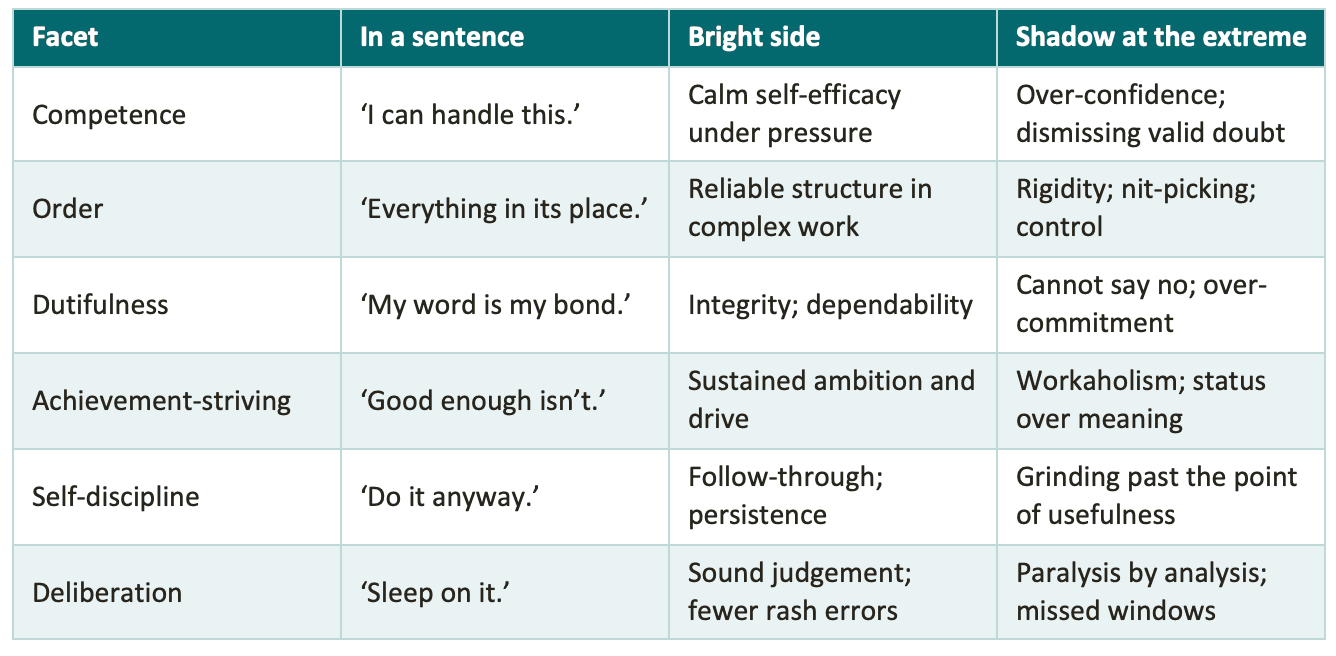
4.3 How to spot — and develop — each facet
Because the facets are behavioural, each leaves visible fingerprints and each responds to a different lever. Competence shows up as composure under pressure, and is built by accumulating mastery experiences — deliberately stretching, then succeeding, so the belief ‘I can cope’ is earned rather than merely asserted. Order shows up in environments and calendars; it is supported less by willpower than by systems — a place for everything, a single trusted list — and, for the over-orderly, by practising deliberate tolerance of ‘good enough’. Dutifulness shows up in kept promises; it is strengthened by making commitments explicit and public, and protected by learning to decline gracefully before over-committing.
Achievement-striving shows up as standards and ambition; it is fuelled by clear, meaningful goals and, for the workaholic, tempered by defining what ‘enough’ looks like in advance. Self-discipline shows up in follow-through on dull tasks; it is the most trainable facet (section 12), and responds best to reduced friction and pre-commitment rather than exhortation. Deliberation shows up as the pause before action; it is cultivated by building deliberate waiting periods into consequential decisions — and, for the over-deliberate, by setting decision deadlines so analysis cannot run forever. The general principle: you rarely develop a facet by wanting it more, but by changing the environment and the commitments that call it forth.
5. The bright side and the dark side
The cultural assumption is that conscientiousness is an unalloyed good — that more is always better. The evidence does not support that. The bright side is real and powerful, but the trait has a genuine dark side, and the relationship with many outcomes is not a straight line.
5.1 The curvilinear truth: too much of a good thing
For a range of jobs, the relationship between conscientiousness and performance is not linear but curvilinear — an inverted U. Performance rises with conscientiousness up to a point, then plateaus or even declines (Le et al., 2011). The optimum is moderately high, not maximal. Past the peak, the very strengths of the trait invert: order hardens into rigidity and an inability to adapt when the plan needs to change; achievement-striving tips into workaholism; dutifulness becomes an inability to refuse, so the most conscientious person in the building quietly drowns under everyone else’s commitments and burns out — and is usually the last to admit it, because admitting it feels like failing at the one thing they are good at.
Honesty about the evidence. The curvilinear finding is well-established for some roles and outcomes but is not universal, and the downturn at the top end is typically modest in size. The safe, defensible reading is this: there is little evidence that being maximally conscientious is better than being moderately high, and good reason — rigidity, perfectionism, reduced adaptability — to think it can be worse, especially in dynamic, creative or fast-changing work. Treat ‘more is always better’ as a myth, not the opposite extreme as a law.
5.2 When strengths become pathologies
At the far end, the orderly, perfectionistic, everything-in-its-place pattern shades into what psychiatry calls obsessive-compulsive personality — examined in detail in section 10. It is a particular trap in leadership. The leader whose orderliness cannot tolerate deviation, who needs every job done exactly their way, tends not to lead well, because real people and real organisations are messy, dynamic and constantly changing. The growth edge for the highly conscientious is rarely more discipline; it is the harder skill of knowing when to stop polishing and deliver.
It is worth saying clearly that low conscientiousness has its own bright side, easily forgotten in a productivity culture. Spontaneity, flexibility, comfort with ambiguity and a willingness to abandon a failing plan are real strengths — in entrepreneurship, in crisis response, in creative and exploratory work. The goal is not to maximise the dial. It is to understand where you sit, and to manage the costs of your own setting.
6. What the trait predicts: behaviours and life outcomes
Few claims in personality psychology are as heavily replicated as the link between conscientiousness and consequential outcomes. In a landmark comparison, Brent Roberts and colleagues showed that conscientiousness rivals or exceeds socioeconomic status and cognitive ability as a predictor of mortality, divorce and occupational attainment — a striking result given how much more attention the other two receive (Roberts et al., 2007).
6.1 Work and career
Across almost every job ever studied — from labourer to lawyer to chief executive — conscientiousness is the most consistent personality predictor of who will perform well over time (Barrick & Mount, 1991; Wilmot & Ones, 2019). It is not the flashiest trait, but it is the most reliable, and its benefit is broad: it helps in roles where what matters most is simply who keeps going. That makes it, in principle, accessible to everyone, not only those born with a high IQ.
An important recent correction. For decades, textbooks reported relatively large validity figures for personality and cognitive tests in personnel selection. A careful re-analysis by Sackett and colleagues showed that the standard statistical corrections for ‘range restriction’ had been systematically over-applied, inflating those numbers; properly corrected, the validities are meaningfully smaller than long taught (Sackett et al., 2022). Conscientiousness remains the best-validated Big Five predictor of job performance — but its true operational validity is modest, not enormous. This does not undermine the trait’s importance; it disciplines how confidently we should sell any single predictor, and it is exactly the kind of self-correction that distinguishes science from sales.
6.2 Education and skill development
Conscientiousness predicts grades and qualifications, often as well as or better than measured ability, because attainment rewards persistence as much as raw talent. The world is full of clever people who never finish anything; conscientiousness is the trait of finishing. For anyone designing learning — in schools, universities or corporate development — this is a reminder that habits, structure and follow-through are not the soft accompaniment to ability but a large part of the result.
6.3 Health and longevity
This is where the trait becomes personal. Conscientious people, on average, smoke less, drink less, exercise more, eat better, adhere to medical advice more closely and take fewer needless risks. A landmark meta-analysis by Bogg and Roberts linked conscientiousness to nearly the full range of behaviours that shorten life (Bogg & Roberts, 2004). In a real sense, your personality is partly a health behaviour.
The downstream consequence is longevity itself. A quantitative review by Kern and Friedman concluded that more conscientious individuals tend to live longer (Kern & Friedman, 2008). The most recent and most comprehensive evidence comes from a 2025 systematic review and meta-analysis of longitudinal data pooling almost six million person-years from more than half a million people across four continents (McGeehan et al., 2025). It found that only three of the Big Five independently predicted mortality — neuroticism, extraversion and conscientiousness — and that conscientiousness showed the strongest protective effect: each one-point increase was associated with roughly a 10% lower risk of death at any given time. Higher neuroticism raised risk by about 3% per point; extraversion lowered it by about 3%; openness and agreeableness showed weak or no independent association.
Reading the longevity figure responsibly. ‘Roughly 10% lower risk per point’ is a population-level hazard estimate from observational data, not a personal guarantee and not proof that personality causes longer life on its own. The most credible mechanism is behavioural and cumulative: conscientious tendencies nudge thousands of small daily choices — about food, movement, sleep, risk and adherence — in a healthier direction over decades (Bogg & Roberts, 2004). That is encouraging rather than deterministic, because behaviour is exactly what can be changed.
6.4 Wealth, relationships and the texture of a life
The same dependability that serves careers tends to serve relationships and finances. Conscientious people are, on average, better at saving, less likely to default, more likely to keep the commitments that hold a partnership together, and less likely to divorce (Roberts et al., 2007). None of this is destiny — the effects are probabilistic and modest at the individual level — but in aggregate, across a whole life, a trait that quietly improves the odds on health, work, money and relationships is worth understanding properly.
6.5 Citizenship, counterproductive behaviour and leadership
The performance story is broader than task output. Conscientiousness is one of the most reliable predictors of organisational citizenship — the discretionary, beyond-the-job-description effort that makes teams work — and one of the most reliable negative predictors of counterproductive work behaviour, from absenteeism and rule-breaking to theft and sabotage (Wilmot & Ones, 2019). In plain terms, conscientious people tend not only to do their own job well but to do the unglamorous extra that holds a place together, and to refrain from the corrosive behaviours that quietly damage it.
In leadership, the trait’s role is real but more nuanced than for individual contribution. Conscientiousness supports the reliability dimension of leading — delivering on commitments, running disciplined operations, following through — which is part of why it predicts who emerges and performs as a manager. But leadership also demands vision, adaptability and the tolerance of ambiguity, and here very high orderliness can become a liability: the leader who needs every task done exactly their way struggles in dynamic conditions (section 5.2). The most effective senior profile tends to pair conscientious dependability with enough openness to change course, and enough emotional stability to stay composed when plans break.
7. Putting the model to work
A model is only as valuable as the decisions it improves. The Five-Factor Model, and conscientiousness within it, earns its keep in two arenas: the organisation and the individual life.
7.1 In organisations
Selection — with appropriate humility. Conscientiousness is a legitimate input to hiring for most roles, but section 6.1’s caution applies: no single trait predicts performance strongly on its own, and well-designed, structured assessment of the whole person against the actual job beats fixating on one dial (Sackett et al., 2022). Personality measures are also susceptible to faking and self-presentation in high-stakes selection, which argues for using them as one structured input among several rather than a gatekeeper.
- Screen for the right facet, not the headline. Decide which facets the role genuinely demands — self-discipline and deliberation for precise, deadline-critical execution; achievement-striving for ambitious targets; order and dutifulness for complex coordination — and assess those, not a single composite.
- Design jobs and processes that supply structure. Because the trait is activated by situations (section 8), clear goals, visible standards, real deadlines and genuine accountability raise effective conscientiousness across the whole team — not just the people who already have it.
- Compose teams for consistency, not just the highest average (section 9). The spread of conscientiousness across members can matter more than the mean.
- Coach the over-conscientious. Your most diligent people are the ones most at risk of perfectionism, over-commitment and burnout. The development conversation they need is about boundaries, delegation and ‘done is better than perfect’, not more effort.
7.2 For individuals
For the reflective individual, the model is a tool for self-knowledge and better choices.
- Career fit. Knowing whether you lean industrious (all engine, perhaps chaotic) or orderly (all structure, perhaps short of fire) tells you a great deal about the roles in which you will be both happy and effective. Fighting your own profile is exhausting; designing around it is liberating.
- Self-management. If you are low in conscientiousness, the answer is rarely ‘try harder’; it is to borrow structure from the environment — deadlines, commitments, accountability — so the disciplined option becomes the easy one.
- Knowing your shadow. If you are high, the work is to notice where discipline curdles into rigidity, standards into paralysing perfectionism, and duty into the inability to say no.
- Reading others accurately. Conscientiousness is one of the few traits other people can observe and rate well, because your follow-through is visible to everyone who has ever relied on you. If you want an honest reading of where you stand, ask the colleagues and the partner who depend on you; their assessment is often more accurate than your own.
8. Strong and weak situations: switching the trait on
A trait is a latent tendency, not a constant behaviour. It does not fire automatically; it is switched on or off by situational cues. This is the core insight of Trait Activation Theory: a personality trait expresses itself in behaviour only when the situation provides cues relevant to that trait (Tett & Burnett, 2003; Tett & Guterman, 2000).
8.1 Strong versus weak situations
Psychologists distinguish strong situations, which contain clear expectations, structure and consequences, from weak situations, which leave behaviour under-specified. Strong situations compress individual differences — in a tightly run operating theatre or a regulated audit, almost everyone behaves conscientiously because the situation demands it. Weak situations amplify individual differences — give people a vague brief, a flexible deadline and no oversight, and the gap between the disciplined and the rest widens dramatically. Conscientiousness is activated by the cues a strong situation supplies: a clear goal, a visible standard, real accountability, a deadline with an actual consequence attached.
The remote-work implication. Much modern knowledge work has quietly become a weak situation: vague objectives, ‘flexible’ deadlines, little ambient accountability, and a phone full of frictionless distraction. When genuinely conscientious people ‘drift’ in such settings, that is not usually a character flaw — it is the predictable result of stripping away the cues that activate the trait. Rebuild the cues — explicit goals, visible standards, real deadlines, light accountability — and the behaviour returns.
8.2 The practical lever: design beats willpower
The deepest practical message of the whole field is this: situations beat willpower. You do not become disciplined mainly by gritting your teeth harder in the moment; you become disciplined by designing the moment in advance, so that the disciplined option is also the path of least resistance. For a leader, this reframes the job: less hunting for naturally disciplined people, more engineering of situations in which discipline is easy. For an individual, it means building systems — laying out the kit the night before, writing one clear next action, committing in front of a witness — rather than relying on motivation, which behaves like weather and cannot be depended upon.
9. How conscientiousness interacts with other traits
Traits do not act in isolation; their effects are conditioned by the rest of the profile, and by the profiles of the people around you.
9.1 Within the individual
- Conscientiousness × emotional stability. The combination of high conscientiousness and low neuroticism is a particularly powerful predictor of performance: the drive to deliver, paired with the composure not to be derailed by setbacks (Judge & Erez, 2007). High conscientiousness with high neuroticism is a more anxious, self-punishing profile — productive but prone to over-work and worry.
- Conscientiousness × openness. Conscientiousness supplies follow-through; openness supplies novelty and ideas. High on both is the profile of the person who not only generates ideas but actually ships them — valuable in innovation. Very high conscientiousness with low openness can produce excellent execution within a fixed paradigm but resistance to necessary change.
- Conscientiousness × agreeableness. Together these underpin ‘good citizenship’ — dependable, cooperative contribution. But high conscientiousness with low agreeableness can manifest as exacting, hard-driving standards imposed on others; and a calculated, disciplined disagreeableness is part of how some difficult personalities operate effectively (section 10).
- Conscientiousness × extraversion. Achievement-striving paired with extraverted assertiveness is a common executive profile — energetic, ambitious, visible. The risk is style outrunning substance: confidence read as competence.
9.2 Across the team: variance and the sucker effect
Here the research takes a counter-intuitive turn that many managers miss. The instinct when building a team is to maximise the average conscientiousness — stack it with diligent people. But the variance between members can matter more than the mean. Original doctoral research with knowledge-work teams found that, viewed through Trait Activation Theory, it is often the similarity of conscientiousness across members, not its elevation alone, that supports performance: wide variance — a mix of the very diligent and the markedly less so — tends to corrode teams more reliably than a uniformly moderate level (Keca, 2019).
The mechanism is painfully human. Picture an eight-person rowing crew. If one member stops pulling — the free-rider — the others carry them for a while. Then the most conscientious rowers notice, and something very human kicks in: why am I breaking my back while he coasts and we cross the line together? To restore rough fairness, they ease off too. Psychologists call this the sucker effect — nobody wants to be the mug — and the slackening spreads from one oar to the whole crew (Keca, 2019). The withdrawal of effort is often rationalised through moral disengagement, the set of mental manoeuvres by which people excuse behaviour that violates their own standards.
The leadership rule. Negative behaviour travels through a group faster than positive behaviour; one person’s visible withdrawal is more contagious than another’s extra effort. So build for consistency, not merely the highest possible average — and where a mix is unavoidable, make the standard and its consequences visible, so your diligent people never feel like mugs. A single tolerated free-rider can cost you your best contributors’ discretionary effort.
9.3 Compensatory and synergistic combinations
Two practical patterns are worth naming. Some trait combinations are synergistic — each amplifies the value of the other, as with high conscientiousness and high openness in innovation, or high conscientiousness and low neuroticism in high-pressure delivery. Others are compensatory — one trait offsets the cost of another. A highly conscientious team member can partly compensate for a less organised but highly creative colleague, provided the structure is shared rather than resented. The practical move for a leader is to read profiles in combination, not in isolation: pair the visionary who never finishes with the finisher who needs a vision; place the careful deliberator beside the impulsive risk-taker; and make sure the conscientious linchpin is recognised, not silently exploited until they disengage.
10. Dark traits, mental health and the clinical picture
Conscientiousness sits at the boundary between healthy personality and personality pathology in an unusual way: both its low and its high extremes have clinical relevance. Understanding this protects against two errors — romanticising the trait, and pathologising ordinary variation.
10.1 The dark triad
The ‘dark triad’ describes three overlapping, socially aversive but non-clinical traits: Machiavellianism (manipulative, strategic self-interest), narcissism (grandiosity and entitlement) and psychopathy (callousness and impulsivity) (Paulhus & Williams, 2002). Their clearest shared correlate in the Big Five is low agreeableness. Conscientiousness enters the picture mainly through psychopathy, whose impulsive, low-self-control, consequence-blind core is, in trait terms, substantially low conscientiousness. The reckless, irresponsible, here-and-now orientation that defines the impulsive side of psychopathy is close to the opposite of the planful, dutiful, deliberate conscientious profile.
There is an important nuance for organisations. A manipulative individual who is also high in conscientiousness is, in some respects, more dangerous, not less: the discipline and self-control supply the patience and follow-through to execute a self-serving strategy over time. Trait combinations, not single traits, drive the most consequential behaviour — a recurring theme of this article.
10.2 The low pole: disinhibition
In the DSM-5 Alternative Model of Personality Disorders (Section III), the maladaptive low pole of conscientiousness is named explicitly. The domain Disinhibition is defined as an orientation toward immediate gratification and impulsive behaviour ‘driven by current thoughts, feelings, and external stimuli, without regard for past learning or consideration of future consequences’ — and the manual frames it directly as the opposite of conscientiousness (American Psychiatric Association, 2013). Markedly low conscientiousness, expressed as irresponsibility, impulsivity, distractibility and recklessness, is a building block of several personality disorder presentations, most obviously the antisocial pattern.
10.3 The high pole: rigid perfectionism and OCPD
At the opposite extreme lies obsessive-compulsive personality disorder (OCPD) — not to be confused with obsessive-compulsive disorder (OCD), which is a different condition. The DSM-5 describes OCPD as a pervasive pattern of preoccupation with orderliness, perfectionism, and mental and interpersonal control, at the expense of flexibility, openness and efficiency (American Psychiatric Association, 2013). In trait language, this is maladaptively high conscientiousness: perfectionism so demanding that tasks are never finished, rigidity that cannot tolerate another’s method, workaholism that crowds out relationships, and excessive deliberation that stalls decision.
The dimensional models capture this well. The ICD-11 trait model includes a domain called anankastia — perfectionism, emotional and behavioural constraint — which corresponds closely to the high end of conscientiousness, while its disinhibition domain captures the low end. Researchers in this tradition put the point memorably: maladaptive conscientiousness is still conscientiousness — the same underlying content, expressed at a damaging extreme (Widiger & Crego, 2019). A noteworthy limitation of the DSM-5 alternative model is that, unlike the ICD-11, it does not include a distinct high-conscientiousness (compulsivity/anankastia) domain, which many researchers regard as a gap.
10.4 Mental health more broadly
Beyond the personality disorders, low conscientiousness shows modest but consistent associations with a range of common difficulties. A large meta-analysis linking the Big Five to anxiety, depressive and substance-use disorders found that high neuroticism and low conscientiousness together characterise much common psychopathology, with low conscientiousness most visible in substance-use and externalising problems (Kotov et al., 2010). The clinical literature increasingly views many disorders not as wholly separate categories but as extreme, impairing regions of the same trait continua that describe everyone — a dimensional view that fits the FFM closely.
Two cautions balance this picture. First, the associations with common mental-health difficulties are modest and non-specific: low conscientiousness is a risk marker, not a cause or a diagnosis, and most people low in the trait have no disorder at all. Second, the danger of the high pole is easy to underestimate, precisely because society rewards it; the perfectionism, over-work and rigidity that can damage health and relationships are often praised as virtues until they tip into genuine impairment. Naming both poles honestly — without glamorising the high end or stigmatising the low — is part of using this knowledge responsibly.
Boundaries and care. None of this licenses armchair diagnosis. Personality traits are continua; a clinical disorder requires distress or impairment and a qualified assessment. Describing where a tendency sits on a dial is education; labelling a colleague — or yourself — with a disorder is not, and can do real harm. If any of this resonates personally and is causing difficulty, the right step is a conversation with a qualified professional.
11. A contemporary twist: conscientiousness in a digital, AI-shaped world
The trait was mapped long before smartphones and generative AI. Both are now reshaping how it is measured, expressed and rewarded — in ways that matter for leaders and individuals alike.
11.1 Your behaviour is now a personality test
Digital devices record fine-grained traces of behaviour, and those traces leak personality. In a notable study, machine-learning models predicted Big Five scores from purely behavioural smartphone data — patterns of communication, app use, mobility, music and day-/night-time activity — with accuracy well above chance, though far from perfect (Stachl et al., 2020). Conscientiousness, interestingly, was among the harder traits to read from raw behaviour, but it could still be inferred from signals as mundane as how reliably someone kept their phone charged. The opportunity is benign — lighter, less intrusive assessment, and digital tools tuned to how a person actually works. The risk is not: the same inference enables psychological micro-targeting, the use of inferred traits to influence people without their knowledge or consent. For organisations, this raises real questions of consent, transparency and data ethics that are only now being worked out.
11.2 Conscientiousness and the adoption of AI
As generative AI moves from novelty to everyday collaborator, individual differences shape who benefits. The early evidence is genuinely preliminary — small samples, mixed findings — and should be read cautiously. One pilot reported that conscientiousness and agreeableness interacted with the quality of work people produced when assisted by AI chatbots, with openness and conscientiousness plausibly supporting engagement through curiosity and goal-directed use (Kovbasiuk et al., 2025). The honest summary is that the field is nascent: the sensible expectation is that how conscientious people integrate AI — systematically, with verification and follow-through — will matter more than whether they adopt it, but this awaits stronger evidence.
11.3 Why self-discipline may be getting more valuable, not less
There is a deeper, more speculative point worth stating as a hypothesis rather than a finding. The digital environment is an engine for manufacturing weak situations and frictionless distraction: infinite content, blurred boundaries between work and leisure, and a device engineered to fragment attention. In section 8 we saw that weak situations amplify individual differences in conscientiousness. If that logic holds, the premium on self-regulation — the ability to direct one’s own attention and follow through without external scaffolding — should rise, not fall, as AI removes the friction from both useful work and endless diversion. In an age that automates execution, the scarce human skill may increasingly be deciding what to execute, and actually doing it.
12. Change across the lifespan — and on purpose
12.1 The maturity principle: conscientiousness tends to rise with age
One of the most reassuring findings in the field is that conscientiousness is not only changeable through deliberate effort but tends to rise naturally across the early and middle adult years. A meta-analysis of 92 longitudinal samples found that people, on average, become more conscientious — alongside more emotionally stable and socially dominant — most markedly between the ages of about 20 and 40, with further gains into middle age (Roberts, Walton, & Viechtbauer, 2006). Psychologists call this the maturity principle: across cultures, most people drift towards becoming more responsible, organised and dependable as they take on the roles of adult life — a first serious job, a mortgage, a partnership, the care of children or ageing parents.
The leading explanation is social investment: as people commit to age-graded roles that reward and demand reliability, they gradually internalise the behaviours those roles require, and the trait shifts to match. This matters for two reasons. First, it tells the younger or less-disciplined reader that the dial is not set for life — the population trend runs in the helpful direction. Second, it reframes development: much trait growth happens not through introspection but through taking on commitments that pull conscientious behaviour out of you. The graduate who is chaotic at 22 is often unrecognisably more organised at 35 — not because they resolved to be, but because a decade of real obligations quietly rebuilt the habit.
The practical reading. Natural maturation and deliberate intervention point the same way: conscientiousness grows when life supplies roles, responsibilities and structures that demand it — which is simply the trait-activation lesson of section 8, played out across decades rather than days. If you want to grow it on purpose, do not wait for motivation; take on a commitment that makes the disciplined behaviour non-optional.
12.2 The hopeful part: discipline is built, not just born
If conscientiousness were fixed, this article would be interesting but fatalistic. It is not fixed. Personality traits are moderately heritable and broadly stable, but they are not static — they shift across the lifespan and, importantly, they respond to deliberate effort.
A systematic review of 207 intervention studies found that psychological interventions can produce real, durable trait change — on the order of one-fifth to one-third of a standard deviation, with effects that persisted at follow-up (Roberts et al., 2017). The strongest causal evidence specifically for conscientiousness comes from a randomised controlled trial of a three-month smartphone-based coaching intervention, which provided the clearest demonstration to date that ordinary adults can intentionally change their personality, including becoming more conscientious, in non-clinical settings (Stieger et al., 2021).
The practical method matters as much as the possibility. People who succeed do not rely on summoning more motivation — motivation rolls in and out like weather. They build systems that do not depend on how they feel: reducing decisions (laying out tomorrow’s work, or kit, tonight), specifying one concrete next action rather than a vague intention, and committing publicly so that a promise made to another person carries more weight than one made only to oneself. This is the same lesson as section 8, applied to the self: you do not become disciplined by willing it in the moment; you become disciplined by designing the moment so the disciplined thing is the easy thing.
Realistic expectations. Change is real but gradual, and the effect sizes above are meaningful rather than miraculous. The encouraging headline stands on solid evidence: of all the elements of personality, the self-discipline at the heart of conscientiousness appears to be among the most responsive to deliberate, well-designed effort. Unlike intelligence, this dial can be turned.
13. Why this matters — and how it helps
It is fair to ask why a busy executive or a reflective individual should invest in understanding one personality trait. The answer is that conscientiousness sits at the junction of almost everything people say they care about — relationships, performance, health and the shape of a life — and that understanding it converts a vague sense of ‘some people just have it together’ into something you can actually work with.
- Relationships. Dependability is the quiet currency of trust. Knowing your own follow-through — and reading others’ accurately — lets you build relationships and teams on realistic foundations rather than hope. It also explains a common source of friction: the orderly and the spontaneous often misread each other as, respectively, rigid and unreliable, when they are simply differently calibrated.
- Organisational performance. Conscientiousness is the most consistent personality input to performance, but its value is unlocked by design — fitting facets to roles, supplying situational structure, and composing teams for consistency — far more than by hunting for a magic candidate. Leaders who understand the trait stop relying on willpower and start engineering the conditions that produce reliable work.
- Health and longevity. Because the trait operates largely through everyday behaviour, understanding it is genuinely empowering: the behaviours that mediate its link to health and life expectancy are precisely the ones that can be changed (Bogg & Roberts, 2004; McGeehan et al., 2025).
- Self-direction. Perhaps most importantly, knowing where you sit — and that the dial can move — replaces self-criticism with strategy. If you are low, you borrow structure; if you are high, you guard against rigidity and burnout. Either way, you stop fighting your nature blindly and start managing it deliberately.
The positive framing is earned, not glib. This is not a counsel to maximise output or to grind. It is the opposite: a case for understanding a powerful tendency well enough to use its strengths, contain its costs, and — where it helps — develop it on purpose.
14. Common misconceptions
Few traits are as widely discussed and as frequently misunderstood as this one. Five misconceptions are worth correcting directly.
- ‘Conscientiousness is basically intelligence.’ No. They are distinct, and only weakly correlated. Intelligence is about cognitive horsepower; conscientiousness is about how reliably that horsepower — whatever its level — is harnessed and applied. The two predict outcomes partly independently, which is precisely why conscientiousness keeps paying off in roles where persistence matters more than brilliance.
- ‘More is always better.’ No. For many roles the relationship is curvilinear, peaking at moderately high (Le et al., 2011). The aim is the sweet spot, not the maximum; beyond the peak lie perfectionism, rigidity and burnout.
- ‘It’s fixed — you either have it or you don’t.’ No. Conscientiousness rises naturally across early and middle adulthood (Roberts, Walton, & Viechtbauer, 2006) and responds to deliberate intervention (Stieger et al., 2021). It is among the most malleable parts of personality.
- ‘Conscientious just means uptight, or “Type A”.’ No. That caricature describes only the orderly, controlling end of one aspect. A highly industrious person can be relaxed, messy and easy-going while still finishing everything that matters. Conflating the whole trait with fussiness misses most of what it is.
- ‘Low conscientiousness means lazy or bad.’ No. Lower scorers bring spontaneity, flexibility, comfort with ambiguity and a willingness to abandon a failing plan — real advantages in fast-moving, creative or exploratory work. Every setting on the dial carries both gifts and costs.
15. What conscientiousness is not — limits and caveats
A responsible account names its boundaries. Several caveats run through everything above.
- Probabilities, not destinies. Trait–outcome relationships are real but, at the level of the individual, modest and probabilistic. Personality shifts the odds; it does not decide the result. Plenty of conscientious people struggle and plenty of low scorers flourish.
- Context is king. The same trait that is an asset in one role is a liability in another. There is no universally ‘best’ level; there is only fit between profile, role and situation.
- Measurement has limits. Most evidence rests on self-report questionnaires, which are vulnerable to self-presentation and faking, and on Western, educated samples. Properly corrected validities are smaller than once advertised (Sackett et al., 2022).
- Culture and equity. What counts as ‘conscientious’ behaviour is partly culturally shaped, and using personality in selection raises fairness considerations that deserve careful, lawful handling.
- Education, not diagnosis. The clinical material in section 10 describes the extreme, impairing ends of a continuum; it is not a tool for labelling oneself or others.
16. Conclusion
Conscientiousness is the unglamorous trait that quietly does the heavy lifting in a human life. It is goal-directed self-regulation — the disposition to set, pursue and finish what matters — expressed through two aspects and six facets that come apart in revealing ways. It predicts performance, learning, health and longevity more broadly than any other trait bar intelligence, yet more is not always better: the optimum is moderately high, and its extremes shade into perfectionism, rigidity and, at the far poles, clinical pathology. It is switched on and off by situations, conditioned by the rest of your profile and by the people around you, increasingly visible in your digital exhaust, and — most hopefully — responsive to deliberate change.
For the leader, the lesson is to stop chasing disciplined individuals and start designing disciplined conditions. For the individual, it is that the dial can move, and that systems beat willpower. Understanding where you sit on this one trait is not a verdict on your character; it is the beginning of an honest, useful conversation with yourself — and the first step towards turning intention into outcome.
A map, not a verdict. If you would like to see where you sit on this and the other four traits, a free, evidence-based personality assessment is available at keca.co.uk.