1. The person who owns the room
You have seen it happen. The confident one in the meeting — quick with an opinion, first to speak, completely at ease in the room — gets the promotion. The quieter colleague, who actually knew the detail and had done the real work, watches it sail past them. If that pattern has ever made your blood quietly boil, this article explains exactly why it happens, and why it is one of the most expensive mistakes organisations make, over and over again.
The trait behind it is extraversion. By a clear margin, it is the best personality predictor of who becomes a leader (Judge et al., 2002). Read that carefully: not who is good at it, but who gets the job. That single distinction, between looking like a leader and being one, is the thread running through everything that follows.
Extraversion is the Big Five dimension of energy, reward and social presence. It is also the trait most tangled up in cultural myth: that extraverts are the winners and introverts the also-rans, that confidence equals competence, that the loudest voice is the most valuable one. Each of those assumptions is, at best, half true — and acting on them costs organisations and individuals a great deal. For the senior leaders, managers and people professionals who make up much of this channel’s audience, getting extraversion right is one of the highest-leverage things you can do in selection, promotion and team design. For the reflective individual, understanding where you sit — and which version of the trait you run — reframes a lifetime of social comparison.
This article gives a careful, evidence-based account of the trait: where the idea came from, what it actually is beneath the chatter, what it predicts, where it helps and where it harms, and what to do with that knowledge — whether you are the one who owns the room or the one the room keeps overlooking. It draws on a century of research and on the most recent meta-analytic and longitudinal work available at the time of writing, and it is deliberately honest about the limits of the evidence.
A note on register. Everything here is intended to educate, not diagnose. Personality is a map, not a verdict. Where the science is contested or a figure uncertain, this article says so plainly. Neither end of this trait is better than the other; each carries real strengths and real costs.
2. Where the idea came from
Of all the Big Five, extraversion has the longest and most tangled history because the words themselves are old and have shifted in meaning over time.
2.1 Jung, and a popular word with a slippery meaning
The terms introvert and extravert were popularised by Carl Jung in the 1920s, who used them to describe whether a person’s psychic energy turned inward toward the inner world or outward toward people and things (Jung, 1921/1971). Jung’s conception was rich, clinical and quite different from the modern trait; much of today’s casual usage — ‘I’m such an introvert’ — still carries his flavour rather than the scientific one. It is worth keeping the two apart: the everyday word is loose, whereas the trait studied by personality science is a precisely measured continuum that emerged from an entirely separate research tradition.
2.2 The lexical tradition and the Big Five
That tradition begins with the lexical hypothesis: the idea that the differences between people which matter most will become encoded as words in a language. Francis Galton floated the notion of sifting the dictionary for character terms as early as 1884 (Galton, 1884); Gordon Allport and Henry Odbert gave it empirical form, extracting some 18,000 person-descriptive terms from an English dictionary (Allport & Odbert, 1936). Raymond Cattell compressed that unwieldy list using early factor analysis (Cattell, 1943); Donald Fiske found that five factors recurred when Cattell’s variables were re-analysed (Fiske, 1949); and Ernest Tupes and Raymond Christal, working with United States Air Force samples, repeatedly recovered the same five robust factors (Tupes & Christal, 1961/1992). Warren Norman confirmed the structure (Norman, 1963), and Lewis Goldberg later revived it and popularised the term “Big Five” (Goldberg, 1990).
One of those five factors was always a dimension of energy, sociability, assertiveness and positive emotion. It is the factor that, across languages and methods, keeps reappearing as the social-and-reward axis of personality — and that convergence is what gives it scientific credibility. It was not invented to fit a theory; it was repeatedly found by people analysing how human beings actually describe one another.
2.3 The NEO facets and the two aspects
Paul Costa and Robert McCrae developed the most influential measure of the model, the Revised NEO Personality Inventory, which divides each domain into six narrower facets (Costa & McCrae, 1992). For extraversion, these are warmth, gregariousness, assertiveness, activity, excitement-seeking and positive emotions — the architecture this article works through in detail. More recently, Colin DeYoung and colleagues showed that each Big Five trait splits cleanly into two correlated but distinct aspects; for extraversion, these are enthusiasm (the warm, affiliative, positive-emotion side) and assertiveness (the agentic, take-charge, status-seeking side) (DeYoung et al., 2007). As we shall see, that two-aspect distinction is the single most useful refinement for anyone trying to read leadership.
2.4 What lies beneath: two rival explanations
Why do extraverts behave as they do? Two influential biological theories have competed to explain it. The older view, due to Hans Eysenck, proposed that introverts are chronically more cortically aroused than extraverts, so they seek less external stimulation to reach a comfortable level, while extraverts, under-aroused at baseline, go looking for stimulation from people, noise, and novelty to top themselves up (Eysenck, 1967). It is an elegant idea that captures something real about why a loud party energises one person and depletes another, though the evidence for the specific arousal mechanism has proved mixed.
The more influential modern account holds that extraversion reflects heightened sensitivity to reward — status, attention, excitement, social contact — underpinned by the brain’s dopamine-driven incentive-motivation system (Depue & Collins, 1999). On this view, the extrovert is not simply louder or under-aroused; they are more strongly drawn to potential rewards and feel positive emotions more intensely when things go well. It is a well-cited account that reframes the trait helpfully — but it should be held with caution: the precise role of dopamine is debated, and some of the same neural signals have been linked to impulsive sensation-seeking rather than to extraversion as such. The safe summary across both theories is that extraversion is, at its core, about stimulation, reward and positive emotion far more than about noise.
3. What extraversion actually is
Each Big Five trait describes how you relate to one big thing. Conscientiousness is how you relate to goals and standards; neuroticism is how you relate to threat. Extraversion is how you relate to people and reward — how strongly you are pulled toward social contact, stimulation and the buzz of the here and now, and how readily you experience positive emotion.
It is a dial, not a box. Most people sit somewhere in the broad middle rather than at either extreme, and there is even a word for that middle — ambivert — which describes most of us. The high scorer is energised by the company, acts decisively, projects confidence, and feels more positive day-to-day emotions. The low scorer — the introvert — finds sustained social engagement less rewarding and more draining and would often rather go deep with two people than wide with twenty. Neither is a malfunction; they are different settings on the reward dial.
The most important correction in this whole subject is that introverts are not shy. Shyness is fear of social judgment — and that is a feature of anxiety, which belongs to neuroticism, not extraversion. Introversion is something else entirely: simply being less driven by external social reward. A shy person wants to connect but is afraid; an introvert can be perfectly confident and socially skilled and simply finds a great deal of socialising less appealing and more tiring than an extrovert does. Conflating the two is the most common — and most quietly damaging — misreading of this trait, leading people to treat a preference as a problem.
This correction matters culturally as well as clinically. Almost everything our noisy culture tells the quieter person to feel inadequate about — needing time alone, flagging at the after-work drinks, preferring to think before speaking — is not a flaw to be fixed. It is simply where their reward dial sits. Recognising that is, for many people, genuinely freeing.
3.1 How extraversion is measured
Extraversion is assessed mainly through self-report questionnaires — the NEO-PI-R, which yields the domain and its six facets (Costa & McCrae, 1992), and freely available equivalents such as the International Personality Item Pool. These ask people to rate statements about how they relate to people, energy and reward. As with all self-reports, responses can be shaped by self-presentation in high-stakes settings, which is one reason the corrected validities of section 8.1 are modest.
Extraversion has, however, an unusual measurement virtue: it is among the most visible of all traits to outside observers. People form surprisingly accurate impressions of a stranger’s extraversion from very brief exposure — a few seconds of behaviour, a photograph, a short voice clip — because energy, warmth and assertiveness leak out through posture, expression, speech rate and eye contact. This is a double-edged property. It makes observer ratings genuinely informative, and it means extraversion can be read reasonably well in everyday life. But it is also exactly why extraversion dominates first impressions and assessed moments such as interviews — the trait is loud on the very channels we use to judge people quickly, which is the mechanism behind the emergence-versus-effectiveness problem examined in section 7.
4. The two aspects: warmth and drive
Go one level beneath the trait, and extraversion splits into two aspects that pull in different directions — and confusing them costs organisations a great deal (DeYoung et al., 2007).
Enthusiasm is warmth, sociability and the easy experience of positive emotion. This is the person who lights up a room, makes others feel welcome and builds the warm climate a team runs on. Enthusiasm is about affiliation — connection — and it is the side most strongly tied to your own happiness and to team cohesion.
Assertiveness is drive, social dominance and the readiness to take charge, push an agenda and speak first and forcefully. Assertiveness is not about connection; it is about status — influence, authority, being the one out in front.
Here is the distinction almost nobody makes, and the one that changes how you read people: it is assertiveness, not sociability, that predicts who becomes a leader. The meta-analytic evidence points clearly to the agentic, take-charge aspect as the driver of leadership outcomes, rather than the friendly, affiliative aspect (Do & Minbashian, 2014). This has sharp practical consequences. A quiet, reserved person who is nonetheless assertive when it matters can lead superbly. A warm, chatty, sociable person who lacks assertiveness often will not lead at all. They can share an identical overall extraversion score and be completely different in the one respect that decides the outcome. Mistaking warmth for leadership potential — or reserve for its absence — is an expensive and extremely common error.
5. The six NEO facets in detail
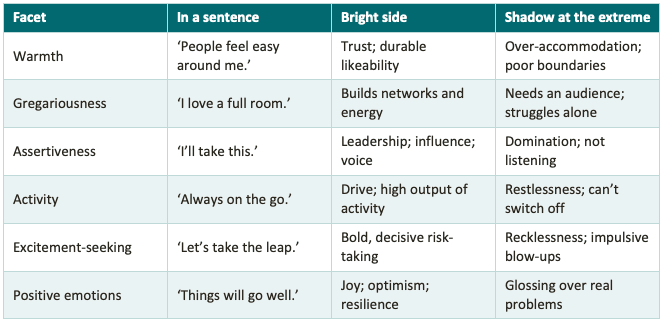
Beneath the two aspects sit the six NEO facets — six dials inside the one big dial (Costa & McCrae, 1992). The first three form the interpersonal cluster (how you do people); the second three form the energy-and-reward cluster.
5.1 The interpersonal cluster
Warmth
Warmth is the capacity for easy affection and closeness. It sits on the border with agreeableness, and it is the single facet most associated with simply being liked. Genuine warmth has a real and durable social advantage — quieter, and more lasting, than flashy charisma. It is the facet that builds trust and makes people want to work with you again.
Gregariousness
Gregariousness is the preference for company, crowds and busy rooms. Here is the trap: this is the facet most people think is extraversion — the life of the party. But it is only one of six, and on its own it predicts surprisingly little about anything that matters professionally. Plenty of highly effective people are low in gregariousness and perfectly extraverted on the facets that count.
Assertiveness
Assertiveness — which we have already met as an aspect — is social ascendancy: the readiness to lead, influence and speak up. Far more than gregariousness, this is the facet that predicts who emerges as a leader. Picture the person who is reserved in a crowd, with no interest in being the centre of attention, but who, when something genuinely matters, speaks with quiet authority and finds people falling in behind them. Low gregariousness, high assertiveness: that is a leader, and it is not the loudest person in the room.
5.2 The energy-and-reward cluster
Activity
Activity is your tempo — the brisk, busy, always-on-the-go pace of the high scorer versus a slower, more measured rhythm. The high-activity person genuinely struggles to sit still and packs the day full; the low-activity person moves through fewer things more deliberately.
Excitement-seeking
Excitement-seeking is the appetite for stimulation, novelty, intensity and risk — the most double-edged facet of the lot. It is the fuel behind bold decision-making and the willingness to take the leap others will not, and it is also behind reckless choices and spectacular blow-ups. Crucially, it varies almost independently of warmth, which is why you will meet quiet, thrill-seeking introverts who would happily jump out of a plane but cannot stand small talk, and warm, cautious extraverts who love people but never take a risk.
Positive emotions
Positive emotion is the disposition toward joy, optimism and enthusiasm. This facet does most of the heavy lifting in extraversion’s famous link to happiness, and it is a major reason the trait is the strongest predictor of personality of well-being (Anglim et al., 2020).
Why the carve-up matters in practice. The most common selection mistake in the field is thinking a role simply needs ‘an extrovert’. It does not. A sales role leans on warmth and positive emotions; a leadership role leans on assertiveness; a high-stakes risk environment needs a carefully calibrated level of excitement-seeking — too little and you freeze, too much and you blow the book. Hire the headline trait, and you will routinely hire the wrong person for the actual work.
5.3 How to spot — and develop — each facet
Each facet leaves visible fingerprints and responds to a different lever. Warmth shows up in how easily people relax around you and is developed by genuine attention to others rather than performance. Gregariousness shows up in how you recharge — and the low scorer should stop apologising for needing quiet, while the high scorer can practise the depth that breadth tends to crowd out. Assertiveness shows up in whether you speak when it matters; it is among the more developable facets, built by preparing a clear view and committing to voice it, especially for the capable-but-quiet. Activity shows up in pace and is best managed rather than maximised. Excitement-seeking shows up in your relationship with risk and is the facet most worth deliberately tempering at the high end and gently stretching at the low end. Positive emotions show up in expressed optimism and, as research on state extraversion suggests, are supported by deliberately engaging in rewarding social activity, with the important caveat discussed in section 12.
6. The bright side and the dark side
Extraversion carries a genuinely large upside — and a genuinely costly downside that the culture tends to ignore. Holding both at once is the key to reading the trait well.
6.1 The upside
The upside is real and broad. Extraversion is the trait most strongly associated with happiness: among the five, it is the strongest predictor of positive emotion and day-to-day well-being (Anglim et al., 2020). At work, it is the most consistent personality predictor of leadership across decades of research — in the landmark review, it correlated with leadership at .31, ahead of every other Big Five trait (Judge et al., 2002). And extraverts are good for teams: they lubricate the social machinery, spark discussion, draw quieter people in and help create the warm climate in which it feels safe to contribute.
6.2 The curvilinear dark side
But more is not always better. Past a point, the trait turns on its owner, following the same inverted-U logic that governs conscientiousness. The most dominant people in a room tend to suppress everyone else’s contributions — they fill all the available air, so the quieter, often better ideas are never said. Build a senior team composed mainly of high extraverts, and you do not get a powerhouse; you get a high-conflict environment where everyone competes to lead and nobody listens. On the reward side, the engine that pulls hard toward the present, turned up too high with nothing to temper it, produces impulsivity — overspending, overpromising, taking the exciting risk over the considered one. The principle this framework keeps teaching applies here too: the dark side of a strength is usually its overuse. The confident leader becomes overbearing; the energetic one becomes exhausting; the bold one becomes reckless.
6.3 The relational dark side: status that erodes
There is a subtler dark side in how status moves over time. Research on task groups shows that extraverts grab high status quickly — in the first few meetings, they win convincingly. But that status can erode as the weeks pass, the constant talking, the not-listening and the appetite for the spotlight begin to grate, and the group quietly reallocates respect toward the steadier, more consistently competent members (Bendersky & Shah, 2013). The confident person wins the first impression; they do not always win the long game. For the quieter, more competent person who has been overlooked, the research is genuinely encouraging: your moment is often the second act, not the first.
The difficult part, for the person running away with their own strength, is that they are usually the last to feel it — because pulling back feels, from the inside, like becoming less themselves. It is not. It is becoming effective.
6.4 The quiet edge: why introversion is underrated
Because the culture has so thoroughly celebrated the confident, the verbal and the visible, it is worth redressing the balance. Introverts are not failed extraverts. The reflectiveness, the deep focus, the genuine listening and the habit of thinking before speaking are not deficiencies; in a world drowning in noise and shallow takes, they are becoming a serious competitive edge — especially in complex, knowledge-intensive work where the prize goes to whoever thinks most clearly, not whoever talks most. Quieter people also tend to listen better, which makes them more receptive to others’ ideas — a quality that, as the leadership research shows, can matter enormously when the people around them have something to contribute.
There is genuinely freeing news here for the quieter reader. You do not have to become an extrovert to lead, sell, or be heard. The evidence is that range — the ability to turn up energy and assertiveness when the moment genuinely calls for it, then recover in the quiet afterwards — is both learnable and authentic (section 12), provided it is used selectively rather than worn as a permanent mask. The goal is not to convert introverts into extraverts; it is to stop treating one healthy temperament as the standard against which the other is found wanting.
6.5 Why both types persist: an evolutionary trade-off
If extraversion is so advantageous — more happiness, more status, more leadership — why has evolution not simply made everyone an extravert? The answer is that the trait is a trade-off, not a free good. In a study of several hundred British adults, higher extraversion predicted greater mating success and a larger number of lifetime partners, consistent with the trait’s reward-seeking, socially bold character — but it also predicted a higher likelihood of hospitalisation for accident or illness, and some tendency to trade parenting investment for mating effort (Nettle, 2005). Extraversion, in other words, buys opportunity at the price of risk. Where the environment rewards boldness and connection, the extravert thrives; where it punishes risk, the cautious introvert does better. Because no single setting is best across all conditions, natural selection has maintained the full range — which is the deepest reason neither end of the dial is ‘better’, only better suited to particular circumstances.
7. What the trait predicts: behaviours and life outcomes
7.1 Happiness and well-being
If conscientiousness is the trait of outcomes, extraversion is the trait of feeling good. It is the most reliable personality predictor of positive affect and subjective well-being (Anglim et al., 2020). Extraverts simply tend to experience more joy, enthusiasm, and day-to-day good feelings, partly because they are more sensitive to reward and partly because they seek out and create the social situations that generate them. This link is one of the most robust in the field — though, as section 12 makes clear, it does not follow that everyone should simply behave more like an extrovert.
Two honest qualifications matter here. First, this is largely a difference in the intensity and frequency of positive emotion, not a verdict on whose life is better: introverts are not unhappy, and many report deep contentment in quieter, lower-arousal pleasures that the standard happiness measures, tuned to enthusiasm and high energy, may undercount. Second, the link is partly a matter of how the trait is defined — positive emotion is built into extraversion — so it is no surprise the two travel together. The practical point stands nonetheless: the behaviours that generate day-to-day good feeling, chiefly rewarding social activity, are partly within everyone's reach, with the important limits set out in section 12.
7.2 Leadership: emergence versus effectiveness
This is the heart of the matter. Extraversion predicts who becomes a leader; it does not, to anything like the same degree, predict who is actually good at it — and those are not the same thing.
Consider what wins a promotion in most organisations: speaking up, projecting confidence, looking decisive, and being visible. These are extraverted behaviours, and they are on full display precisely when a person is being assessed — in the interview, the pitch, the meeting where someone is watching. But the qualities that make someone genuinely effective once in the role — judgement, listening, self-control under pressure, integrity, the willingness to let others shine instead of filling all the air — are quieter, slower to reveal themselves and far harder to read across a forty-minute interview. So, organisations select on confidence and charisma, which is selecting on emergence, and then hope for effectiveness. That single error explains a great deal of the poor, and sometimes harmful, leadership most of us have encountered.
The practical upshot. Leadership emergence and leadership effectiveness are different outcomes with different predictors. If your selection and promotion processes reward visibility and verbal confidence — as most unstructured ones do — you are optimising for emergence and leaving effectiveness to chance. The corrective is to assess the quieter qualities deliberately: structured evidence of judgement, track record, how a candidate listens and develops others, and how they behave when they are not performing for an audience.
There is a further, elegant complication that every leader should know. Extraverted leadership is not uniformly beneficial even where it does help: its value depends on the people being led. In a study of pizza-store franchises and a laboratory replication, extraverted leadership boosted group performance when employees were passive — but the advantage reversed when employees were proactive, because dominant, talkative leaders are less receptive to the initiative and ideas that proactive teams bring (Grant, Gino, & Hofmann, 2011). The practical reading is sharp: the more capable and self-starting your team, the less they need a leader who fills the room — and the more they need one who listens. The extrovert’s greatest strength becomes a liability precisely with the people most able to contribute.
7.3 Status, income and sales
Extraverts, on average, attain more status and visibility, which often translates into advancement and earnings — though much of this flows through emergence rather than performance, so it should not be read as proof of superior contribution. The sales case is instructive and frequently overstated. A single, much-cited study of call-centre representatives found an inverted-U relationship in which ambiverts outsold both strong introverts and strong extraverts, apparently because they balance talking with listening (Grant, 2013). It is a genuinely useful idea, but it rests on a single study with a specific sample, and the broad ‘ambivert advantage’ has not been firmly established in the literature; treat it as directional rather than settled.
7.4 Health and longevity
Extraversion shows a modest protective association with health and longevity. The most comprehensive recent evidence — a 2025 meta-analysis pooling almost six million person-years — found extraversion to be one of only three Big Five traits that independently predict mortality, with each one-point increase associated with roughly a 3% lower risk of death at any given time (McGeehan et al., 2025). The most plausible mechanism is social: extraverts tend to build and maintain the relationships and support networks that buffer stress and protect health. As always, this is a population-level association from observational data, not a personal guarantee, and the effect is far smaller than that of conscientiousness.
7.5 Relationships
The warmth and positive emotion at the affiliative end of the trait tend to draw people in and ease the formation of friendships and networks. The costs appear at the extremes: very high assertiveness or excitement-seeking, unbalanced by warmth, can read as domineering or unreliable, while the social confidence that opens doors can, untempered, crowd out the listening on which close relationships depend.
8. Putting the model to work
8.1 In organisations
Selection and promotion — with the emergence trap firmly in mind. Extraversion is a legitimate input for some roles, but the central caution of section 7.2 applies: unstructured processes reward emergence, and reformed personnel science has shown that the headline validity of any single predictor is more modest than once taught, once the statistics are corrected properly (Sackett et al., 2022). Use personality as one structured input among several, and be especially wary of confusing verbal confidence with competence.
- Screen for the right facet and aspect, not the headline. A client-facing role leans on warmth and positive emotions; a leadership role leans on assertiveness; a high-stakes risk role needs calibrated excitement-seeking. Assess the specific quality the work demands, not a single extraversion score.
- Separate emergence from effectiveness in promotion. Build evidence of judgment, listening, and how a candidate behaves off-stage into the process, so you are not simply promoting the most visible person.
- Do not over-stack extraverts. A senior team made up mostly of high-assertiveness extraverts tends toward conflict and poor listening rather than performance. Deliberately protect the airtime and contributions of quieter members.
- Design for the situation. Extraverted leadership adds most where things are ambiguous, and direction is missing; in a well-structured operation, it adds less (section 9).
8.2 For individuals
For the reflective individual, the model is a tool for self-knowledge and better choices — whichever end of the dial you sit on.
- Career fit. Knowing whether you run on enthusiasm (warmth, connection) or assertiveness (drive, status) — and how high your reward dial sits — tells you a great deal about the roles in which you will be both happy and effective. The two aspects lead to very different working lives.
- Range, not transformation. You do not have to become an extrovert to lead, sell or be heard. People can deliberately ‘act extraverted’ when the moment calls for it — turning it on for the presentation, the negotiation, the hard conversation — and recover in the quiet afterwards. That is range, not inauthenticity. But it is not free for everyone (see section 12).
- Know your shadow. If you are high, watch for the points where confidence becomes domination, energy becomes noise, and the love of the new becomes an inability to finish or to listen. If you are low, watch for mistaking introversion for a limit when it may be your sharpest edge.
- Read others accurately. Separate the warm from the assertive, and emergence from effectiveness, when you assess colleagues. The most impressive performer in the room is not reliably the most capable contributor.
8.3 Meetings, brainstorming and airtime
Nowhere is the dark side of extraversion more visible — or more fixable — than in how groups talk. In unstructured meetings and brainstorming sessions, airtime is captured disproportionately by the most extroverted, assertive members, regardless of who has the best idea. The result is a systematic bias: the group hears more from the confident than from the correct, and quieter members, including those who know most, contribute least. This is not a failure of character on anyone’s part; it is the predictable physics of a weak situation in which the trait runs unchecked. The fixes are structural and cheap: solicit written input before discussion so ideas are formed independently of social pressure; use explicit turn-taking or round-robin formats; ask the quietest people directly and last, after the confident have had their say; and separate idea-generation from evaluation. Leaders who do this do not merely make introverts more comfortable — they materially improve the quality of the group’s decisions by stopping the confusion between volume and value.
9. Strong and weak situations: when the trait earns its keep
Like every trait, extraversion is a latent tendency that expresses itself only when the situation supplies relevant cues — the core insight of Trait Activation Theory (Tett & Burnett, 2003; Tett & Guterman, 2000).
Extraverted leadership is most valuable when things are ambiguous — unclear goals, no map, strategy still forming. That is when energy and initiative fill the vacuum and get people moving. In a tightly structured, well-running operation, the situation already provides direction, and high-energy leadership adds far less, sometimes even getting in the way. The same logic governs followers: a more proactive, self-directing team can be stifled by a dominant extraverted leader, while a passive one may need exactly that push.
The remote-work implication. This is sharp for how we work now. Extraverts win through live social cues — presence, energy, reading the room, and corridor conversation. Flatten all of that into a grid of video tiles and muted microphones, and the very channel they are built to use is dampened. The person who dominated the open-plan office can fade on a screen, while the thoughtful colleague who writes clearly and thinks deeply quietly comes into their own. Remote and hybrid work, in other words, is a weak situation for extraverted advantage. It also carries its own cost: recent large-sample evidence links more intensive remote working to somewhat higher odds of loneliness (He et al., 2026), which affects the whole team, extraverts and introverts alike.
The practical message mirrors the one for conscientiousness: do not simply hunt for the high-energy individual. Design the situation. Decide when ambiguity genuinely calls for extraverted leadership and when structure would serve better and build channels — written as well as verbal — that let your quieter, clearer thinkers contribute on equal terms.
10. How extraversion interacts with other traits
Traits act in combination, and extraversion’s meaning shifts depending on what sits alongside it.
- Extraversion × neuroticism. High extraversion with low neuroticism is the ‘happy warrior’ profile — socially confident and emotionally steady — and is a strong predictor of well-being and resilient performance (Judge & Erez, 2007). High extraversion with high neuroticism is more volatile: outgoing and reward-seeking, but easily knocked, a combination linked to impulsive, emotionally driven behaviour.
- Extraversion × agreeableness. This pairing decides how dominance lands. Assertive and warm reads as inspiring leadership; assertive and cold reads as domineering or self-serving. The grandiose form of narcissism is, in trait terms, largely high agentic extraversion combined with low agreeableness (section 11).
- Extraversion × conscientiousness. Drive and visibility, paired with follow-through, make for a powerful executive profile — the person who both wins the room and delivers. Without conscientiousness, extraverted confidence can outrun substance: all pitch, no delivery.
- Extraversion × openness. Enthusiasm paired with openness produces the energising idea generator who can rally people around something new; it is a common entrepreneurial and creative leadership profile.
At the team level, one finding from the brand’s own doctoral research is worth flagging for anyone composing groups: high variance in extraversion across members — a mix of the very loud and the very quiet simply thrown together — tends to hurt cohesion rather than help it (Keca, 2019). The popular advice to ‘just mix extraverts and introverts’ is considerably more complicated in practice than it sounds; composition and deliberate design matter more than a crude balancing of types.
Two practical patterns are worth naming. Some combinations are synergistic, each amplifying the other — assertiveness with warmth (inspiring leadership), or extraversion with conscientiousness (the person who both wins the room and delivers). Others are compensatory, where one trait offsets another’s cost: a warm, steady colleague can soften an assertive leader’s edges, and a structured process can compensate for a team that is light on natural drive. The skill, for anyone building or leading a group, is to read profiles in combination rather than in isolation — pairing the visible with the substantive, the bold with the careful, and ensuring the quieter contributor is heard rather than simply out-talked by the more extraverted one.
11. Dark traits, mental health and the clinical picture
Like every trait, extraversion has clinical relevance at both ends — but in a pattern different from conscientiousness’s, and one that is widely misunderstood.
11.1 The bright end and the dark triad
Extraversion is, in itself, a healthy and largely adaptive trait; it is not ‘dark’. But its agentic side intersects with the dark triad of socially aversive traits — narcissism, Machiavellianism and psychopathy (Paulhus & Williams, 2002) — chiefly through narcissism. Grandiose narcissism is, in Big Five terms, largely high agentic extraversion (assertiveness, social dominance, attention-seeking) combined with low agreeableness. This is why charismatic, dominant individuals can be so compelling on first meeting and so costly over time, and it connects directly to the emergence-versus-effectiveness problem: the very qualities that win the room quickly can mask an underlying disregard for others. The lesson is not that extraversion is dangerous, but that assertive dominance unbalanced by warmth and integrity is the combination to watch.
11.2 The high pole: histrionic and externalising patterns
At the maladaptive extreme, very high extraversion contributes to the histrionic pattern — excessive attention-seeking and emotionality — and, alongside low agreeableness, to the broader externalising spectrum that also includes narcissistic and antisocial features. The DSM-5 explicitly recognises this adaptive-to-maladaptive continuity: its developers noted that histrionic personality disorder corresponds to the high pole of extraversion, just as obsessive-compulsive personality corresponds to the high pole of conscientiousness (American Psychiatric Association, 2013).
11.3 The low pole: detachment
The maladaptive low pole is named directly in the DSM-5 Alternative Model of Personality Disorders, where the domain Detachment is defined as the opposite of extraversion: withdrawal from relationships, restricted positive emotion and limited capacity for pleasure (American Psychiatric Association, 2013). Detachment is central to the avoidant and schizoid presentations, and the ICD-11 trait model includes a closely corresponding detachment domain (World Health Organisation, 2019).
The crucial distinction: introversion is not a disorder, and it is not social anxiety. Ordinary introversion — finding social reward less compelling — is a healthy variation, not detachment. And the social difficulty seen in avoidant personality and social anxiety is driven primarily by fear of negative evaluation, which belongs to neuroticism, not by low reward sensitivity. The schizoid pattern, by contrast, involves a genuine lack of desire for relationships. Telling these apart matters: the quiet, content introvert needs no fixing; the person paralysed by fear of judgement, or genuinely unable to find pleasure in connection, may benefit from support. Pathologising the first or missing the second is an error.
11.4 Mental health more broadly
Because positive emotion lives at the heart of the trait, low extraversion is a modest risk marker for depression — the combination of high neuroticism and low extraversion (high negative affect, low positive affect) characterises much depressive presentation. As with all such links, the associations are modest and non-specific: most introverts are perfectly well, and low extraversion is a correlate, not a cause or a diagnosis. The responsible reading is that extraversion’s positive-emotion engine offers some protection, while its absence is one of many risk factors.
Two cautions balance this picture. First, the associations between low extraversion and difficulties such as depression are modest and non-specific: the overwhelming majority of introverts are perfectly well, and low extraversion is a correlate, not a cause or a diagnosis. Second, the risks at the high end are easy to overlook precisely because the culture prizes confidence and energy; the domination, impulsivity and attention-seeking that can damage teams, finances and relationships are frequently mistaken for charisma and drive until they tip into real harm. Naming both poles honestly — without romanticising the bold or pathologising the quiet — is part of using this knowledge responsibly.
Boundaries and care. None of this licenses armchair diagnosis. Personality traits are continua; a clinical disorder requires distress or impairment and a qualified assessment. If any of this resonates personally and is causing difficulty, the right next step is to have a conversation with a qualified professional.
12. Change across the lifespan — and the limits of ‘just act extraverted’
12.1 The maturity principle
Extraversion shifts in a characteristic way across the lifespan. In a meta-analysis of 92 longitudinal samples, the assertive, socially dominant aspect of extraversion increased from early to middle adulthood, whereas the more sociable, high-spirited ‘social vitality’ aspect tended to decline gradually with age (Roberts, Walton, & Viechtbauer, 2006). In other words, people often become more quietly assertive and a little less gregarious as they mature — which fits the picture of growing confidence paired with a narrowing, deepening social circle. As with the other traits, this normative drift is part of the broader maturity principle: development tends to move people toward more effective functioning.
12.2 Acting extraverted: benefits, and real costs
Can you change your behaviour deliberately? Yes — within limits, and not for free. Laboratory and everyday-life studies consistently find that acting more extraverted in the moment is associated with more positive emotion, even for introverts. But the first randomised controlled trial to test this over a sustained period in daily life found an important qualification: while there was a positive overall effect on positive affect and feelings of authenticity, the benefits depended on a person’s dispositional extraversion — more introverted participants gained less, and some incurred costs, including increased negative emotion, greater tiredness and reduced authenticity (Jacques-Hamilton et al., 2019).
The honest takeaway. ‘Just act more extraverted’ is reasonable, evidence-based advice for the occasional high-stakes moment — the presentation, the negotiation, the difficult conversation — followed by genuine recovery. It is not sound advice as a sustained way of life for a strong introvert, for whom the running costs of fatigue and inauthenticity can outweigh the gains. Range is valuable; impersonation is exhausting. Use the dial deliberately, then let it return to its resting place.
13. A contemporary twist: extraversion in a remote, digital, AI-shaped world
The trait was mapped long before video calls and generative AI. Both are quietly reshaping how it is expressed and rewarded.
13.1 The channel shift
As section 9 noted, the extravert’s advantage is built on live, in-person social cues. Much modern work has moved onto channels — email, chat, asynchronous documents, video grids — that compress or remove those cues. The result is a quiet rebalancing: clarity of thought in writing, depth, and the ability to contribute without dominating the airtime become more valuable, which tends to favour the reflective. At the same time, the broader shift to remote work carries a social cost, with recent large-sample evidence associating more intensive remote working with somewhat higher loneliness (He et al., 2026) — a reminder that the affiliative, connecting side of extraversion does real work for teams that screens do not fully replace.
Social media complicates the picture further. Online platforms reward visibility, frequent posting and bold self-presentation — broadly extraverted behaviours — which can make the loud louder and amplify the confidence-over-competence dynamic at scale. Yet the same platforms also let quieter, more reflective voices reach an audience purely on the quality of their writing and thinking, without ever performing in real time. The net effect is genuinely mixed: the digital world both magnifies extraverted advantage in some channels and dissolves it in others, which is precisely why understanding which version of social ability a given channel rewards is now a practical skill rather than an abstraction.
13.2 AI as a partial equaliser
Generative AI is, in one sense, an equaliser of social presentation: it lets the quiet, clear thinker produce polished, persuasive communication without the live performance at which extraverts excel. In an environment that increasingly rewards the quality of thinking over the volume of talking, the historic premium on verbal dominance may soften. This is a reasonable hypothesis rather than an established finding — the evidence on personality and AI use is still nascent — but it points in a consistent direction: as the channel changes, so does which version of social ability pays.
14. Why this matters — and how it helps
Understanding extraversion turns a lifetime of vague social comparisons into something usable — and it helps the room owner and the quiet force alike.
- Relationships. Separating warmth from assertiveness, and emergence from effectiveness, lets you read people more accurately and build relationships on substance rather than first impressions. It also dissolves a common friction: extraverts and introverts routinely misjudge each other as, respectively, shallow and aloof, when they simply sit at different points on the reward dial.
- Organisational performance. The single most valuable correction here is to stop selecting and promoting on visibility alone. Leaders who understand the emergence-versus-effectiveness gap, and who design situations and processes that surface quieter competence, make demonstrably better people decisions.
- Health and well-being. Extraversion’s link to positive emotion and protective social connection is real, and the behaviours that mediate it — maintaining relationships, seeking rewarding activities — are partly within reach for everyone, with the caveats in section 12.
- Self-direction. Knowing your setting and being able to flex it deliberately without abandoning it replaces self-criticism with strategy. The extravert learns where to dial down; the introvert learns where to dial up — and, more importantly, stops apologising for a temperament that is a genuine strength in a noisy world.
The positive framing is earned, not glib. This is not a counsel to become louder or more dominant. It is a case for understanding a powerful social trait well enough to use its strengths, contain its costs, and value — in yourself and others — the quieter half of the room that the culture has badly underrated.
15. Common misconceptions
Few traits attract as much folk theory as this one. Five misconceptions are worth correcting directly.
- ‘Extraversion just means being loud and outgoing.’ No. Underneath, it is reward-sensitivity and positive emotion (Depue & Collins, 1999). A reserved person can be highly extraverted on the facets that matter — assertiveness, positive emotions — while disliking crowds.
- ‘Introverts are shy.’ No. Shyness is fear of social judgement, a feature of neuroticism. Introversion is simply finding social reward less compelling and more draining. Many introverts are confident and socially skilled.
- ‘Extraverts make better leaders.’ Extraversion predicts who becomes a leader far better than who leads well (Judge et al., 2002). The qualities that win the role are not the qualities that make someone effective in it, and quieter leaders are often more effective where listening and depth matter most.
- ‘More extraversion is better.’ No. The relationship with many outcomes is curvilinear; very high extraversion brings domination, poor listening and impulsive risk-taking, and status won fast can erode (Bendersky & Shah, 2013).
- ‘To succeed, you must act like an extravert.’ Only sometimes, and not for free. Acting extraverted helps in the occasional high-stakes moment, but for strong introverts a sustained extraverted performance carries real costs in fatigue and authenticity (Jacques-Hamilton et al., 2019).
16. What extraversion is not — limits and caveats
- Probabilities, not destinies. Trait–outcome relationships are real but, at the individual level, modest and probabilistic. Extraversion shifts the odds; it does not decide the result.
- Context is king. The same trait that is an asset in an ambiguous, people-facing role is a liability in a structured, solitary or deeply analytical one. There is no universally ‘best’ level — only fit between profile, role and situation.
- Measurement has limits. Most evidence rests on self-report and on Western, educated samples, and headline validities are more modest than once advertised once properly corrected (Sackett et al., 2022).
- One theory held lightly. The reward-sensitivity account is influential but not settled, and the precise neuroscience remains debated. The behavioural picture is far more secure than the mechanism.
- Education, not diagnosis. The clinical material in section 11 describes extreme, impairing ends of a continuum; it is not a tool for labelling oneself or others.
17. Conclusion
Extraversion is the trait of energy, reward and social presence — the dimension that decides who walks into a room and owns it. It is, at bottom, about sensitivity to reward and the experience of positive emotion, expressed through two aspects, enthusiasm and assertiveness, and six facets that come apart in ways that matter. It is the strongest personality predictor of happiness and of who rises to leadership — but it predicts leadership emergence far more cleanly than effectiveness, and the status it quickly wins can erode. More is not always better; its extremes bring domination, impulsivity and a relentless need for the spotlight, and its agentic side, stripped of warmth, shades into the grandiose and the narcissistic.
For the leader, the lesson is to stop mistaking confidence for competence, and to design selection, promotion and teams so that quieter capability is seen. For the individual, it is that you can flex the trait deliberately without abandoning who you are — and that if you are the quieter one, your reflectiveness may be your sharpest edge in a world drowning in noise. Understanding where you sit on this trait is not a verdict on your worth. It is the start of an honest, useful conversation — with yourself, and with the room.
A map, not a verdict. If you would like to see where you sit on this, and the other four traits, a free, evidence-based personality assessment is available at keca.co.uk.